
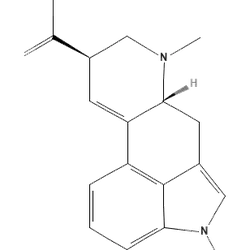
1V-LSD Stats & Data
CCCCC(=O)n1cc2CC3N(C)CC(C=C3c3cccc1c23)C(=O)N(CC)CCGIIBVGJWUZNECE-ZZWBGTBQSA-NReceptor Profile
Receptor Actions
History & Culture
1V-LSD emerged on the online research chemical market in June or July of 2021. Its appearance coincided with the announcement of new German scheduling controls targeting 1cP-LSD under the Neue-psychoaktive-Stoffe-Gesetz (NpSG), suggesting the compound was developed and released specifically as a legal alternative following this regulatory action. The substance quickly gained the informal nickname "Valerie" among users and vendors. The provenance of 1V-LSD remains unknown. Unlike many psychedelics with documented histories stretching back decades, this compound does not appear in any academic literature predating its commercial availability. Its creation appears to have been driven entirely by the grey-market research chemical industry rather than originating from pharmaceutical or academic research. The strategic use of 1-acylated lysergamide derivatives to circumvent controlled substance legislation was apparently anticipated decades before 1V-LSD's emergence. A 1988 DEA report noted the potential for such structural modifications to create legally ambiguous LSD analogues—a prediction that proved prescient with the appearance of compounds like 1V-LSD over thirty years later.
Toxicity
PsychonautWikiThe toxicity and long-term health effects of recreational 1V-LSD use have not been studied. This is because 1V-LSD is a research chemical with almost no history of human use. Anecdotal reports suggest that there are no negative health effects attributed to simply trying 1V-LSD by itself, at low to moderate doses, and using it very sparingly (although nothing can be completely guaranteed). Independent research should always be conducted to ensure that a combination of two or more substances is safe before consumption. Based on its similarity to LSD, 1V-LSD is assumed to be physiologically well-tolerated with a extremely low toxicity relative to dose.
Overdose
1V-LSD has no known toxic dose. However, higher doses increase the risk of adverse psychological reactions. These reactions include anxiety, delusions, panic attacks and, more rarely, seizures.
Addiction & dependence
Although no formal studies have been conducted, it is assumed that like LSD itself, 1V-LSD is non-addictive with a low abuse potential. There are no literature reports of successful attempts to train animals to self-administer LSD — an animal model predictive of abuse liability — indicating that it does not have the necessary pharmacology to either initiate or maintain dependence. Likewise, there is virtually no withdrawal syndrome when chronic use of LSD is stopped.
Effect Profile
Curated + 4 ReportsStrong visuals, headspace, and auditory effects with moderate body load
Tolerance & Pharmacokinetics
drugs.wikiTolerance Decay
Cross-Tolerances
Experience Report Analysis
ErowidDemographics
Gender Distribution
Too few reports for a chart: gender is known from 6 reports, and a split is drawn only from 20 reports or more. Counts are shown instead. Why 20?
- Male 5 of 6
- Not Specified 1 of 6
Age Distribution
Reports Over Time
Effect Analysis
ErowidEffects aggregated from 4 experience reports (4 single-substance Erowid)
Effect Sentiment Distribution
Confidence Distribution
Each bar is the share of reports mentioning the effect; its whisker, and the band on the rows below, is the 95% interval: where the share could plausibly be with other reports of the same kind.
Too few reports for bars: these effects come from 4 single-substance Erowid reports, and a bar is drawn only from 20 reports or more. With fewer, a percentage cannot tell a common effect from a rare one. Counts are shown instead. Why 20?
Positive Effects 4
Adverse Effects 0
Real-World Dose Distribution
ErowidFrom 7 of 9 recorded dose entries: those that state a weight (mg, g or µg), in routes with at least five of them. Values above Q3 + 3×IQR, far above what people typically take, are left out; they can include real heavy doses and overdoses, not only mistakes.
Sublingual (n=7)
Form / Preparation
Most common forms and preparations, as a share of the 5 reports that give one
Too few reports for bars: these forms come from 5 reports, and a bar is drawn only from 20 reports or more. With fewer, a percentage cannot tell a common effect from a rare one. Counts are shown instead. Why 20?
- Blotter / Tab 5 of 5
Legal Status
| Country | Status | Notes |
|---|---|---|
| Austria | Legal grey area (NPSG may apply) | Not technically illegal as a specific substance, but may fall under the Neue-Psychoaktive-Substanzen-Gesetz (NPSG) as an analogue of LSD, making it illegal to supply for human consumption. |
| Canada | Unscheduled | Not a controlled substance under Canadian drug legislation. No specific scheduling exists for this compound. |
| Germany | Controlled (NpSG) | Controlled under the Neue-psychoaktive-Stoffe-Gesetz (New Psychoactive Substances Act). An initial amendment in September 2022 failed to take effect due to a punctuation error in the legislation. The law was corrected in March 2023, effectively banning 1V-LSD. Production and import with intent to market, administration to another person, and trading are punishable offenses. Possession is illegal but not penalized. |
| Japan | Controlled | Designated as a controlled substance as of March 20, 2023. Possession, production, and distribution are prohibited under national drug control legislation. |
| Latvia | Illegal | Although not officially scheduled as a named substance, it is controlled as an LSD structural analogue pursuant to an amendment implemented on June 1, 2015. |
| South Korea | Temporarily controlled | Placed under legal control in July 2022 on a temporary but renewable basis under the national drug scheduling system. |
| Sweden | Under investigation | Has been under investigation by Swedish authorities since March 2, 2022 for potential scheduling. May become a controlled substance pending review outcome. |
| Switzerland | Controlled (Verzeichnis E) | Considered a controlled substance as a defined derivative of lysergic acid under Verzeichnis E, point 263 of the Swiss narcotics scheduling. Permitted when used exclusively for scientific or industrial purposes. |
| Turkey | Illegal | Classified as a controlled drug substance. Possession, production, supply, and importation are all prohibited under Turkish drug laws. |
| United Kingdom | Illegal (Psychoactive Substances Act) | Illegal to produce, supply, or import under the Psychoactive Substances Act 2016, which came into effect on May 26, 2016. The Act creates a blanket ban on psychoactive substances intended for human consumption. Personal possession is not criminalized under this Act. |
| United States | Unscheduled (Analogue Act may apply) | Not specifically scheduled under the Controlled Substances Act. However, since 1V-LSD functions as a prodrug for LSD, its possession and sale may be prosecutable under the Federal Analogue Act when sold or possessed with intent for human consumption. |
References
Data Sources
Cited References
- Bluelight: The Small & Handy 1V-LSD Thread
- Brandt et al. (2022): Return of the lysergamides Part VII - Analytical and behavioural characterization of 1V-LSD
- Erowid: 1V-LSD Experience Vault
- Tripsitter: 1V-LSD - A New LSD Analog
- Brandt et al. (2022): Return of the lysergamides Part VII - Analytical and behavioural characterization of 1V-LSD