
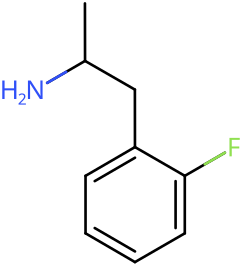
2-FA Stats & Data
[Cl-].CC(N)Cc1ccccc1F.[H+]RAKLYDJAHZCJMS-UHFFFAOYSA-NReceptor Profile
Receptor Actions
History & Culture
2-Fluoroamphetamine emerged on the online research chemical market during the 2010s as part of a broader wave of fluorinated amphetamine derivatives. This family of compounds includes 2-FMA, 3-FA, 3-FEA, and 4-FA, which are positional isomers differing in the placement of the fluorine atom on the phenyl ring. These substances gained traction as research chemical alternatives to traditional street stimulants and entactogenic compounds. Among the fluorinated amphetamine series, 2-FA developed a reputation within the research chemical community as the most functionally similar to classical amphetamine in its subjective effects profile. Users have frequently drawn comparisons between 2-FA and dextroamphetamine (the d-isomer of amphetamine), noting similarities in its stimulant character. The substitution of a hydrogen atom with fluorine on the amphetamine scaffold represents a common approach in central nervous system drug design, where such modifications can enhance a compound's lipophilicity and facilitate passage across the blood-brain barrier.
Toxicity
PsychonautWikiThe toxicity and long-term health effects of recreational 2-FA use do not seem to have been studied in any scientific context and the exact toxic dosage is unknown. This is because 2-FA has very little history of human usage. Anecdotal evidence from people who have tried 2-FA within the community suggest that there do not seem to be any negative health effects attributed to simply trying this drug at low to moderate doses by itself and using it sparingly (but nothing can be completely guaranteed). Others have commented that its d-isomer form is virtually similar to the effects of d-amphetamine, and thus far little has been shown to give reason to suspect that its toxicity is radically different (though future evidence to the contrary may prove otherwise).
Effect Profile
Curated + 4 ReportsStrong euphoria and focus with strong anxiety/jitters, mild stimulation
Tolerance & Pharmacokinetics
drugs.wikiTolerance Decay
Based on community reports (Bluelight/Reddit) and general amphetamine-class behavior; no controlled human data for 2‑FA. Frequent redosing over several days appears to flatten effects and lengthen insomnia. Data quality is anecdotal.
Cross-Tolerances
Experience Report Analysis
ErowidDemographics
Gender Distribution
Too few reports for a chart: gender is known from 5 reports, and a split is drawn only from 20 reports or more. Counts are shown instead. Why 20?
- Male 4 of 5
- Female 1 of 5
Age Distribution
Reports Over Time
Effect Analysis
ErowidEffects aggregated from 4 experience reports (4 single-substance Erowid)
Effect Sentiment Distribution
Confidence Distribution
Each bar is the share of reports mentioning the effect; its whisker, and the band on the rows below, is the 95% interval: where the share could plausibly be with other reports of the same kind.
Too few reports for bars: these effects come from 4 single-substance Erowid reports, and a bar is drawn only from 20 reports or more. With fewer, a percentage cannot tell a common effect from a rare one. Counts are shown instead. Why 20?
Positive Effects 1
Adverse Effects 0
Real-World Dose Distribution
ErowidFrom 15 of 19 recorded dose entries: those that state a weight (mg, g or µg), in routes with at least five of them. Values above Q3 + 3×IQR, far above what people typically take, are left out; they can include real heavy doses and overdoses, not only mistakes.
Insufflated (n=10)
Oral (n=5)
Form / Preparation
Most common forms and preparations, as a share of the 2 reports that give one
Too few reports for bars: these forms come from 2 reports, and a bar is drawn only from 20 reports or more. With fewer, a percentage cannot tell a common effect from a rare one. Counts are shown instead. Why 20?
- Powder / Crystals 2 of 2
Legal Status
| Country | Status | Notes |
|---|---|---|
| Canada | Schedule I (by analogue) | Considered a Schedule I controlled substance as an analogue of amphetamine under Canadian drug scheduling legislation. |
| China | Controlled substance | Specifically controlled as of October 2015 under Chinese narcotics regulations. |
| Finland | Scheduled narcotic | Listed in the government decree on substances, preparations, and plants considered to be narcotic drugs, making possession and distribution illegal. |
| France | Not scheduled (grey area) | As of December 2024, not explicitly scheduled under French law. Possession is not specifically prohibited but the substance operates in a legal grey area. |
| Germany | Controlled (NpSG) | Controlled under the Neue-psychoaktive-Stoffe-Gesetz (New Psychoactive Substances Act) since November 26, 2016. Production, import with intent to market, administration to others, and trading are punishable offenses. Possession is prohibited but not subject to criminal penalties. |
| Netherlands | Legal (pending review) | Currently not a controlled substance, though it falls within a substance category that may be scheduled under recently enacted New Psychoactive Substances legislation. |
| New Zealand | Schedule 3 | Controlled as a Schedule 3 substance due to classification as an amphetamine analogue under New Zealand drug law. |
| Switzerland | Controlled (Verzeichnis E) | Specifically named as a controlled substance under Verzeichnis E of Swiss narcotics legislation. |
| Turkey | Illegal | Classified as a controlled drug. Possession, production, supply, and importation are all prohibited under Turkish law. |
| United Kingdom | Class A | Controlled as a Class A substance under the amphetamine analogue clause of the Misuse of Drugs Act 1971. Class A classification carries the most severe penalties under UK drug law. |
| United States | Potentially Schedule II (by analogue) | May be treated as a Schedule II controlled substance under the Federal Analogue Act (21 U.S.C. § 813) when intended for human consumption, as it is considered substantially similar to amphetamine. Not explicitly scheduled on its own. |
Harm Reduction
drugs.wikiSold only as a research chemical; identity/purity vary. Misrepresentation and cross‑contamination have been documented in the NPS market, and alpha‑PVP and 4‑FA have at times been sold as other stimulants; use reagent tests and, where available, GC/FTIR drug checking to reduce substitution risk. Typical oral sessions last about 4–5 hours with a 1–3 hour peak; short duration encourages redosing, which increases cardiovascular strain, hyperthermia, and insomnia risk. Intranasal use does not substantially improve bioavailability versus oral but adds local tissue damage; saline rinses after use reduce harm but oral ROA is safer on balance. Maintain hydration with small, regular electrolyte-containing fluids; avoid overhydration. Monitor temperature and take cool‑down breaks during physical activity or warm environments; escalating body heat, chest pain, severe headache, confusion, or persistent tachycardia warrant urgent medical assessment. Amphetamine-class drugs show large inter‑individual variability from CYP2D6 genotype and urine pH; acidic urine increases clearance while alkaline urine slows it, potentially prolonging effects. Combining with MAOIs or multiple stimulants significantly elevates risk of hypertensive crisis, arrhythmias, hyperthermia, and serotonin syndrome; this is a strict avoid. Tolerance builds rapidly with consecutive‑day use; spacing sessions by at least one to two weeks is a common community strategy to lower harm. Long‑term neurotoxicity of 2‑FA specifically has not been studied in humans; given the class risks (vasospasm, hyperthermia, rhabdomyolysis), conservative dosing and rest days are prudent.
References
Cited References
- Bluelight: 2-FA Experienced summary (2010)
- Bluelight: 2-FA Mega-thread (2011)
- Cayman Chemical - 2-Fluoroamphetamine datasheet
- Discrimination of Fluoroamphetamine Regioisomers by Raman Spectroscopy (2016)
- Erowid Experience Vaults: 2-FA
- Fluoroamphetamine assay validation (J Anal Toxicol 2017)
- INCB Technical Report on illicit-lab precursors (2017)
- LC-MS/MS oral-fluid method including 2-FA (Anal Chim Acta 2019)
- PubChem: CID 121531
- Reddit: r/researchchemicals - 2-FA is actually great (2025)
- Reddit: r/researchchemicals - Recreational dose discussion (2019)
- Rösner et al. - Isomeric fluoro-methoxy-phenylalkylamines (Forensic Sci Int 2005)
- Smart - Fluorine substituent effects on bioactivity (J Fluorine Chem 2001)
- TripSit: Drug Combinations Chart
- Cayman Chemical – 2-Fluoroamphetamine datasheet
- LC–MS/MS oral-fluid method including 2-FA (Anal Chim Acta 2019)
- Fluoroamphetamine assay validation (J Anal Toxicol 2017)
Additional references
- PubChem – 2‑Fluoroamphetamine hydrochloride (compound record)
- Bluelight – The 2‑FA Mega Thread (community duration/dose reports)
- TripSit Wiki – Editing Factsheets (explicit 2‑FA dose template and nasal caution)
- Erowid – 2‑Fluoroamphetamine Experience Index (existence and qualitative range of reports)
- StatPearls (NCBI Bookshelf) – Amphetamine Toxicity (hyperthermia, hypertensive management; avoid pure β‑blockers; class risks)
- StatPearls (NCBI Bookshelf) – Dextroamphetamine–Amphetamine (CYP2D6 involvement; pH‑dependent elimination)
- Reddit r/researchchemicals – 2‑FA review/summary (2023)
- Reddit r/researchchemicals – 2‑FA vs 2‑FMA duration commentary (2019)
- Erowid newsletter – alpha‑PVP misrepresented as 2‑FA among other euphoric stimulants (mislabeling risk)
- SubstanceSearch – 2‑FA summary entry (community‑compiled overview)