
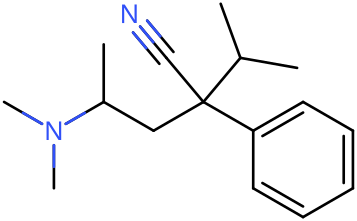
2C-B-AN Stats & Data
Receptor Profile
Receptor Actions
History & Culture
2C-B-AN first appeared in scientific literature in 2013 when researcher Daniel Trachsel documented the compound, drawing on information from personal communication with P. Rausch dating back to 2009. The substance is a derivative of 2C-B featuring an N-(α′-cyanobenzyl) substitution similar to that found in the NBOMe series. Research has established that 2C-B-AN is chemically unstable and functions as a prodrug, converting to 2C-B in vivo. The compound emerged on the European designer drug market around 2016, appearing briefly before regulatory controls were implemented. In the United Kingdom, its market presence was particularly short-lived, with supplies becoming available shortly before the Psychoactive Substances Act 2016 came into effect in May of that year, effectively ending its legal availability in that jurisdiction.
Effect Profile
CuratedModerate visuals with moderate body load, low headspace
Tolerance & Pharmacokinetics
drugs.wikiTolerance Decay
As with 2C-B and other psychedelics, short-term tolerance develops rapidly and decays over roughly 1–2 weeks; figures are heuristic from broader psychedelic use, as no PK/tolerance studies exist for 2C-B-AN.
Cross-Tolerances
Legal Status
| Country | Status | Notes |
|---|---|---|
| United Kingdom | Controlled (Psychoactive Substances Act 2016) | Controlled under the Psychoactive Substances Act 2016, a blanket ban on psychoactive substances that came into effect in May 2016. The substance briefly appeared on the market shortly before this legislation took effect. Production, supply, and importation are prohibited. |
Harm Reduction
drugs.wiki2C-B-AN appears to be an aminonitrile prodrug intended to convert in vivo to 2C-B; community chemistry threads and user reports describe it as such, but there are no formal PK studies, so expect variability in onset and potency. Given the prodrug nature, onset is often slower (~1 h) than 2C-B and redosing too early risks stacking into an overly intense peak several hours later; wait at least 2 hours between doses. Compared with 2C-B, typical oral doses are substantially higher (tens of milligrams), which increases the risk of dosing error; always weigh with a milligram scale and consider volumetric dosing for accuracy. Because 2C-B products are commonly found in pressed pills in nightlife markets and may be confused with MDMA, use lab drug checking where available; 2C-B pills on European services often contain ~10–20 mg and small adulterants have been observed. For 2C-B itself, nasal use is notoriously painful and can cause significant local irritation; for 2C-B-AN, human data by this route are very limited, so oral administration is preferred. Avoid combining with MAOIs or lithium: MAOIs can markedly potentiate phenethylamine psychedelics with hypertension risk, and lithium with classical psychedelics has been associated with seizures and severe adverse reactions in community safety lists. Tramadol lowers seizure threshold and is serotonergic; avoid co-use due to seizure/serotonin toxicity risk. DXM is serotonergic/dissociative and can unpredictably intensify psychedelic effects; harm-reduction lists flag this as a dangerous combination despite some subjective synergy reports. As a little-studied prodrug with a nitrile motif, long-term toxicity and metabolism are not characterized; minimize frequency of use, avoid high/repeated doses, and keep a sober sitter for first trials. Set and setting strongly shape outcomes; avoid if you have a personal or family history of psychosis, and allow at least 2 weeks between psychedelic sessions to reduce tolerance.
References
Cited References
Additional references
- Drug Users Bible – 2C-B-AN entry (dose, duration, prodrug note)
- Bluelight – 2C-B-AN / 2C-B aminonitrile thread (identity, prodrug concept, ballpark doses)
- TripSit – site resources incl. combo chart and volumetric dosing tool (harm reduction utilities)
- Saferparty (Swiss drug checking) – 2C-B pill notices and dosing sensitivity warning
- Saferparty – more 2C-B pill analyses (reinforces mg sensitivity and pill context)
- Bluelight – List of dangerous & potentially unsafe combinations (MAOIs + phenethylamine psychedelics; lithium + classical psychedelics)
- TripSit Wiki – Tramadol page (serotonergic activity, seizure risk, interaction cautions)
- Effect Index – 2C-B + DXM report (illustrates potentiating synergy; do not take as safety endorsement)