
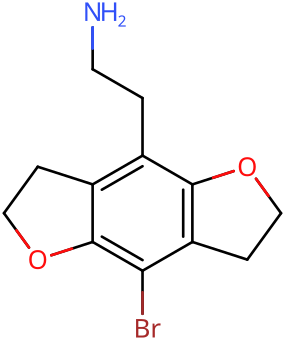
2C-B-FLY Stats & Data
C1COC2=C(C3=C(C(=C21)CCN)OCC3)BrYZDFADGMVOSVIX-UHFFFAOYSA-NReceptor Profile
Receptor Actions
History & Culture
1995–present
2C-B-FLY was first described in the scientific literature in 1995 by Aaron Phillip Monte and David E. Nichols along with colleagues at Purdue University. Monte, a Professor of Chemistry at the University of Wisconsin-La Crosse, synthesized this novel compound as part of research into the phenethylamine class. Following its initial description, Alexander Shulgin subsequently evaluated the compound, contributing to the early characterization of its psychoactive properties.
2005–2016
By 2005, 2C-B-FLY had gained sufficient popularity within the research chemical community to warrant its own dedicated Erowid vault. However, its presence in the market was abruptly disrupted in October 2009 when two deaths occurred in Denmark and the United States. These fatalities were initially and erroneously attributed to 2C-B-FLY, but investigation revealed that the substance involved was actually Bromo-DragonFLY, which had been mislabeled as 2C-B-FLY by a small research chemical vendor. This mislabeling proved catastrophic because Bromo-DragonFLY is active in the microgram range while 2C-B-FLY requires milligram doses, resulting in massive overdoses when users took what they believed to be standard 2C-B-FLY doses. The incident led to the immediate withdrawal of 2C-B-FLY from the market for several years. The compound resurfaced in early 2016 when it was released by Lizard Labs, a research chemical supplier. At that time, it represented one of the few functional psychedelic compounds readily and legally available on the open market, at least until the United Kingdom's Psychoactive Substances Act came into effect in May 2016.
Subjective Effects
Physical
- Bodily control enhancement
- Diarrhea
- Nausea
- Pupil dilation
- Spontaneous tactile sensations
- Stimulation
- Tactile enhancement
- Visual sliding
Cognitive
- Analysis enhancement
- Conceptual thinking
- Creativity enhancement
- Delusions
- Emotion enhancement
- Empathy, love, and sociability enhancement
- Immersion enhancement
- Increased music appreciation
- Increased libido
- Memory suppression
- Mindfulness
- Ego death
- Novelty enhancement
- Personal bias suppression
- Spirituality enhancement
- Thought acceleration
- Thought disorganization
- Thought loops
- Time distortion
- Unity and interconnectedness
- Wakefulness
Sensory
- Enhancements
- Distortions
- Hallucinations
- Drifting: (melting, breathing, morphing and flowing)
- Colour shifting
- Depth perception distortions
- Perspective distortions
- Symmetrical texture repetition
- Tracers
- Colour enhancement
- Pattern recognition enhancement
- Visual acuity enhancement
- Transformations
- Internal hallucinations: (autonomous entities; settings, sceneries, and landscapes; alterations in perspective and scenarios and plots)
Forked from Subjective Effect Documentation work by Josie Kins, August 2016. Via dose.wiki (CC0).
Toxicity
PsychonautWikiThe toxicity and long-term health effects of recreational 2C-B-FLY do not seem to have been studied in any scientific context and the exact toxic dose is unknown. This is because 2C-B-FLY is a research chemical with a very limited history of human usage. Anecdotal evidence from people within the community who have tried 2C-B-FLY suggests that there are no negative health effects attributed to simply trying the drug by itself at low to moderate doses and using it very sparingly (but nothing can be completely guaranteed). Independent research should always be done to ensure that a combination of two or more substances is safe before consumption. It is strongly recommended that one use harm reduction practices when using this substance.
Effect Profile
Curated + 11 ReportsStrong visuals and auditory effects with strong body load, moderate headspace
Strong sensory enhancement with moderate euphoria, stimulation, and empathy
Duration Timeline
BluelightTolerance & Pharmacokinetics
drugs.wikiTolerance Decay
Cross-tolerance with serotonergic psychedelics is expected; anecdotal decay to baseline ~2 weeks. Data quality is limited; space experiences to reduce variability.
Cross-Tolerances
Experience Report Analysis
ErowidDemographics
Gender Distribution
Too few reports for a chart: gender is known from 19 reports, and a split is drawn only from 20 reports or more. Counts are shown instead. Why 20?
- Male 18 of 19
- Not Specified 1 of 19
Age Distribution
Reports Over Time
Effect Analysis
ErowidEffects aggregated from 11 experience reports (11 single-substance Erowid)
Effect Sentiment Distribution
Confidence Distribution
Each bar is the share of reports mentioning the effect; its whisker, and the band on the rows below, is the 95% interval: where the share could plausibly be with other reports of the same kind.
Too few reports for bars: these effects come from 11 single-substance Erowid reports, and a bar is drawn only from 20 reports or more. With fewer, a percentage cannot tell a common effect from a rare one. Counts are shown instead. Why 20?
Positive Effects 10
Adverse Effects 3
Show 2 neutral or unclassified mentions
Dosage Distribution
Dose distribution from experience reports, one dose per report (the first listed). Doses above Q3 + 3×IQR, far above what people typically take, are left out of the median and range and listed under each route: most are real heavy doses or overdoses, not mistakes.
Real-World Dose Distribution
ErowidFrom 30 of 31 recorded dose entries: those that state a weight (mg, g or µg), in routes with at least five of them. Values above Q3 + 3×IQR, far above what people typically take, are left out; they can include real heavy doses and overdoses, not only mistakes.
Oral (n=30)
Common Combinations
Most co-occurring substances, as a share of all 19 reports filed under 2C-B-FLY
Too few reports for bars: these combinations come from 19 reports, and a bar is drawn only from 20 reports or more. With fewer, a percentage cannot tell a common effect from a rare one. Counts are shown instead. Why 20?
- THC 6 of 19
Form / Preparation
Most common forms and preparations, as a share of the 13 reports that give one
Too few reports for bars: these forms come from 13 reports, and a bar is drawn only from 20 reports or more. With fewer, a percentage cannot tell a common effect from a rare one. Counts are shown instead. Why 20?
- Liquid 4 of 13
- Pill / Tablet 4 of 13
- Powder / Crystals 3 of 13
Body-Weight Dosing
Dose per kg of body weight, one dose per report (the first listed), from reports giving a weight of 30–250 kg. Doses above Q3 + 3×IQR, far above what people typically take, are left out of the median and range and listed under each route.
1 report gave a dose above the typical range (0.46 mg/kg), so it is not in the figures above. Listing a dose here does not mean it is safe.
Show the report
- 0.46 mg/kg · another drug taken too
Redose Patterns
Redosing behavior across 13 reports
Too few reports for a chart: redosing is known from 13 reports, and a split is drawn only from 20 reports or more. Counts are shown instead. Why 20?
- Single dose 10 of 13
- Redosed 3 of 13
Legal Status
| Country | Status | Notes |
|---|---|---|
| Austria | Illegal (NPSG) | Controlled under the Neue-Psychoaktive-Substanzen-Gesetz (New Psychoactive Substances Act). Possession, production, and sale are prohibited. |
| Canada | Schedule III (CDSA) | Classified as a controlled substance under Schedule III of the Controlled Drugs and Substances Act as of October 31, 2016. Scheduled as a derivative of 2,5-dimethoxyphenethylamine. |
| Finland | Scheduled | Listed in the government decree on psychoactive substances banned from the consumer market. |
| Germany | Controlled (NpSG) | Regulated under the Neue-psychoaktive-Stoffe-Gesetz (New Psychoactive Substances Act) since November 26, 2016. Production and importation with intent to distribute, administration to others, and trading are criminally punishable. Possession is prohibited but carries no penalty. |
| Italy | Schedule I | Listed as a Schedule I controlled substance. Possession, production, sale, and purchase are illegal. |
| Netherlands | Legal (research chemical) | Currently available as a research chemical when not sold for human consumption. However, pending legislation on New Psychoactive Substances may result in future scheduling. |
| Poland | Unscheduled | Not explicitly scheduled under Polish drug law. However, as a derivative of 2,5-dimethoxyphenethylamine, it could potentially be classified as a Group II-P substance under analogue provisions. |
| Sweden | Illegal | Controlled substance as of April 2018. Possession, sale, purchase, and use are prohibited under Swedish narcotics legislation. |
| Switzerland | Ambiguous | Legal status remains unclear. The compound's structural classification under Verzeichnis E point 130 is contested, as it does not clearly fit the definition of an alkyl, alkoxy, alkylenedioxy, or halide derivative of phenethylamine due to its fused ring system. |
| Turkey | Illegal | Classified as a controlled drug. Possession, production, supply, and importation are prohibited. |
| United Kingdom | Illegal (Psychoactive Substances Act) | Controlled under the Psychoactive Substances Act 2016, which came into effect on May 26, 2016. Production, supply, and importation are criminal offenses. The compound was legally available on the open market prior to this blanket ban. |
| United States | Unscheduled | Not specifically scheduled or controlled under federal law. However, the Federal Analogue Act may apply if the substance is sold or possessed with intent for human consumption, given its structural and pharmacological similarity to the Schedule I substance 2C-B. |
Harm Reduction
drugs.wiki2C-B-FLY’s oral onset can be slow and variable (20–180+ minutes), so redosing early carries a real overshoot risk; wait at least 3 hours before considering any additional dose. Mislabeling events in 2009 involved Bromo-DragonFLY being sold as 2C-B-FLY; the former is far more potent, longer-lasting, and notably more vasoconstrictive—use reagent tests as a preliminary screen only and prefer GC/MS drug checking when feasible; treat unknown batches with allergy tests (≤1 mg) and conservative titration. Insufflation is commonly reported as extremely painful for 2C-x and specifically for 2C-B-FLY; it tends to shorten duration and roughen the come-up—oral is generally preferred for predictability. As with phenethylamine psychedelics, expect transient increases in heart rate and blood pressure; those with cardiovascular, seizure, or bipolar disorders should avoid or consult a clinician. Salt form affects mass: most references cite the HCl or HBr salts; HBr typically requires roughly 10–20% more mass than HCl for equivalent base—always calculate by salt and weigh accurately. Because of the slow come-up and moderate length, plan set/setting, hydration, and recovery time; avoid combining with stimulants, tramadol, or MAOIs. If effects escalate well past 12 hours with pronounced cold/numb extremities and severe vasoconstriction, suspect misidentification (e.g., Bromo-DragonFLY) and seek medical care; do not redose or take vasoconstrictors. As with all psychedelics, cross-tolerance with other 5-HT2A agonists occurs for several days; spacing experiences by 2+ weeks helps restore baseline sensitivity and reduces compulsive redosing pressure.
References
Data Sources
Cited References
- Drug Users Bible: 2C-B-FLY
- Greene, S. L. (2013). Benzofurans and benzodifurans. In Novel Psychoactive Substances
- Talaie et al. (2009). Dose-independent occurrence of seizure with tramadol
- TripSit Factsheet: 2C-B-FLY
- TripSit Factsheet: 2C-B-FLY
- Isomer Design: 2C-B-FLY Drug Status Report
- Drug Users Bible: Index
Additional references
- Erowid 2C-B-FLY Vault (overview, articles, experiences)
- Erowid article: Survey Provides New 2C-B-Fly Data (onset/chronology)
- Erowid 2C-B-FLY images: Energy Control GC/MS on mislabelled batch (BD-FLY)
- Erowid: Shulgin draft entry with chemical identifiers (HCl salt CAS)
- Drug Users Bible: 2C-B-FLY (dose ranges, duration summary)
- Bluelight warning thread: Bromo-DragonFLY sold as 2C-B-FLY (Energy Control alert)
- Bluelight combo safety lists for psychedelics (MAOI, lithium, stimulants, tramadol)
- TripSit main site & combo chart announcements (general interaction guidance)
- Bluelight on 2C-B salt forms (HBr vs HCl potency by mass; general phenethylamine salt assumptions)
- Reddit r/2CB_FLY: community notes on intranasal pain/shorter duration