
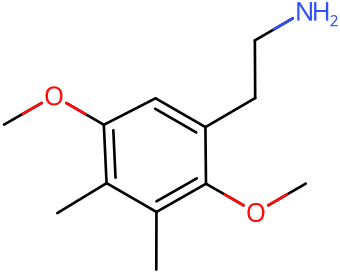
2C-G Stats & Data
NCCc1cc(OC)c(C)c(C)c1OCNFOHGLKGLZIHJQ-UHFFFAOYSA-NPharmacology
DrugBankDescription
In Shulgin's book PiHKAL, the dosage range is listed as 20 to 35 mg. Effects are similar to the related Ganesha, and are extremely long lasting; the duration is 18–30 hours. Visual effects are muted or absent, and it is described in PiHKAL as an "insight-enhancer". Unlike other members of the 2C family, 2C-G is nearly as potent as its amphetamine cousin.
Receptor Profile
Receptor Actions
History & Culture
2C-G was first synthesized by Alexander Shulgin and initially described in his 1991 book PiHKAL (Phenethylamines I Have Known and Loved). The compound, also designated as 2C-G-0 or 3-methyl-2C-D, shares structural and pharmacodynamic characteristics with both 2C-D and its corresponding amphetamine analog, Ganesha. Shulgin's research established the foundation for what became known as the 2C-G series, which encompasses several related homologues. In his documentation, Shulgin classified 2C-G as a genuine psychedelic with notable insight-enhancing properties, though he observed that its remarkably extended duration made it impractical for therapeutic applications. He noted an unusual convergence in potency between 2C-G and its amphetamine counterpart Ganesha, whereas phenethylamines are typically somewhat less potent than their corresponding amphetamine analogs. The substance has remained extremely rare within the broader landscape of 2C-family compounds.
Effect Profile
CuratedStrong visuals with moderate headspace, mild auditory effects and body load
Tolerance & Pharmacokinetics
drugs.wikiTolerance Decay
Pattern extrapolated from community reports on 2C-x and general psychedelic tolerance models (5-HT2A downregulation). Expect markedly diminished effects for several days, with near-baseline by 2–4 weeks. Data quality is low; individual variability is large.
Cross-Tolerances
Legal Status
| Country | Status | Notes |
|---|---|---|
| Canada | Schedule III | Classified as a controlled substance under Schedule III as of October 31, 2016. |
| United Kingdom | Class A | Controlled as a Class A substance along with all other compounds featured in PiHKAL. Class A drugs carry the most severe penalties under the Misuse of Drugs Act 1971. |
| United States | Schedule I | Controlled as a Schedule I substance due to its classification as a positional isomer of 2C-E and DOM under the Controlled Substances Act. |
Harm Reduction
drugs.wiki• Active oral range is reported as 20–35 mg with 18–30 h duration in the original PiHKAL entry; this unusually long span increases risks of fatigue, sleep loss, and decision-making lapses late in the experience, so plan a 36–48 h recovery window and avoid redosing. • Onset can be slow; some G-series compounds reach full intensity 2–3 h after dosing. Redosing before 3 h risks accidental over-intoxication. • Users and Shulgin’s own notes describe relatively mild visual phenomena and a clearer, more stimulating headspace compared to other 2C-x, with occasional appetite suppression; stimulation without strong visuals can still produce anxiety, tachycardia, and vasoconstriction. • Because the active range is low tens of milligrams, accurate weighing is essential; use a calibrated 0.001 g scale or volumetric dosing to prevent dangerous overshoot. • Avoid insufflation: other 2C-x phenethylamines cause severe nasal irritation and unpredictable potency when snorted; oral is the established route for 2C-G. • Do not combine with MAOIs (including harmala alkaloids); MAO inhibition can markedly and unpredictably potentiate psychedelics. • Combining with other stimulants (including high caffeine doses) increases cardiovascular strain and anxiety; keep caffeine typical dietary or lower, and avoid amphetamines. • If an experience becomes overwhelming, non-pharmacological de-escalation (reassurance, quiet space, hydration) is first-line; in a true crisis, benzodiazepines can be used by a sober sitter or medical professional, but repeated benzo use carries tolerance and dependence risks and should not be routine. • 2C-G has been scarce; recent market appearances have included inconsistent labeling and premixed capsules that prevent accurate dose control. Use a lab-based drug checking service when possible; reagent results for 2C-G are not well characterized. • People with cardiovascular disease, uncontrolled hypertension, severe anxiety, or sleep disorders should avoid 2C-G due to its long stimulation window and potential for insomnia. • Legal status varies; synthesis, possession, or distribution may be illegal in many jurisdictions.
References
Data Sources
Cited References
Additional references
- Erowid Online Books: PiHKAL #27 2C-G (dosage, duration, qualitative comments)
- Isomerdesign PiHKAL review table (lists 2C-G as 3,4-dimethyl-2,5-dimethoxy-PEA; 20–35 mg active)
- PiHKAL #30 2C-G-5 (slow onset 1–3 h; very long duration — used here to justify slow-onset caution for G-series)
- Erowid 2C-E Dose page (milligram accuracy caution; insufflation issues with 2C-x)
- TripSit Wiki — Drug combinations (general rationale for stimulant + psychedelic caution; MAOI potentiation warning framework)
- TripSit Wiki — 2C-B (interaction caution with serotonergic meds; general 2C-x HR)
- Erowid — Psychedelic Crisis FAQ (de-escalation first; benzodiazepines as medical abortive in acute crises)
- Erowid — Benzodiazepines: Bits & Pieces (tolerance and dependence risks with repeated use)
- Bluelight — Big & Dandy 2C-G-X thread (community context on G-series rarity and duration)
- Reddit r/researchchemicals — 2C-G vendor capsule labeling inconsistency (supports drug checking recommendation)
- Saferparty.ch — Drug Checking service (example of lab testing resource)