
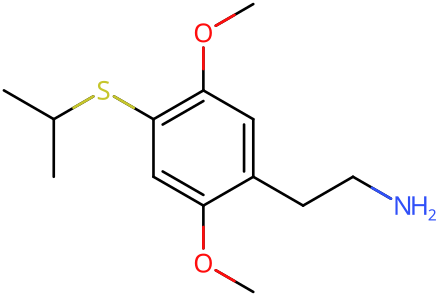
2C-T-4 Stats & Data
CC(C)SC1=C(C=C(C(=C1)OC)CCN)OCHDYZSVKZKDPLDT-UHFFFAOYSA-NReceptor Profile
Receptor Actions
History & Culture
2C-T-4 was first documented in the scientific literature by Alexander Shulgin and his colleagues in a 1991 journal article. Later that same year, Shulgin provided a more comprehensive account of the compound in his book PiHKAL (Phenethylamines I Have Known and Loved), where he devoted a chapter to describing his personal experiences with the substance. In these writings, Shulgin reported an intense "plus-four" experience on his rating scale at a dose of 12 milligrams, representing the highest possible classification for subjective psychedelic effects. The abbreviated name "T-4" has occasionally been used to refer to 2C-T-4, though this terminology carries potential for confusion. The same designation is shared by cyclotrimethylenetrinitramine (RDX), a powerful explosive, as well as thyroxine, a naturally occurring amino acid hormone in the body. Shulgin himself noted this naming overlap in his writings, clarifying that the psychedelic compound shares nothing beyond the shorthand with either of these unrelated substances.
Effect Profile
Curated + 10 ReportsStrong visuals with moderate auditory effects and body load, mild headspace
Duration Timeline
BluelightTolerance & Pharmacokinetics
drugs.wikiTolerance Decay
Model extrapolated from serotonergic psychedelic tolerance patterns; individual variability high; data are largely anecdotal for 2C‑T‑4 specifically.
Cross-Tolerances
Experience Report Analysis
ErowidDemographics
Gender Distribution
Age Distribution
Reports Over Time
Effect Analysis
ErowidEffects aggregated from 10 experience reports (10 single-substance Erowid)
Effect Sentiment Distribution
Confidence Distribution
Each bar is the share of reports mentioning the effect; its whisker, and the band on the rows below, is the 95% interval: where the share could plausibly be with other reports of the same kind.
Too few reports for bars: these effects come from 10 single-substance Erowid reports, and a bar is drawn only from 20 reports or more. With fewer, a percentage cannot tell a common effect from a rare one. Counts are shown instead. Why 20?
Positive Effects 8
Adverse Effects 3
Show 3 neutral or unclassified mentions
Also reported in combinations. In the 10 2C-T-4 reports where another drug was taken too, 1 mentions hospital, emergency services or an overdose, 1 a seizure and 0 psychosis (too few reports for percentages). In the 10 single-substance reports: 1, 0 and 0. These are not in the figures above: they cannot be put down to 2C-T-4 alone, and a mention is not always something that happened to the writer.
Dosage Distribution
Dose distribution from experience reports, one dose per report (the first listed). Doses above Q3 + 3×IQR, far above what people typically take, are left out of the median and range and listed under each route: most are real heavy doses or overdoses, not mistakes.
2 reports gave a dose above the typical range (30 mg), so they are not in the figures above. 1 of them mentions hospital, emergency services or an overdose. Listing a dose here does not mean it is safe.
Real-World Dose Distribution
ErowidFrom 29 of 31 recorded dose entries: those that state a weight (mg, g or µg), in routes with at least five of them. Values above Q3 + 3×IQR, far above what people typically take, are left out; they can include real heavy doses and overdoses, not only mistakes.
Oral (n=29)
Common Combinations
Most co-occurring substances, as a share of all 20 reports filed under 2C-T-4; whiskers are 95% intervals
Form / Preparation
Most common forms and preparations, as a share of the 15 reports that give one
Too few reports for bars: these forms come from 15 reports, and a bar is drawn only from 20 reports or more. With fewer, a percentage cannot tell a common effect from a rare one. Counts are shown instead. Why 20?
- Powder / Crystals 8 of 15
- Capsule 4 of 15
- Pill / Tablet 2 of 15
Body-Weight Dosing
Dose per kg of body weight, one dose per report (the first listed), from reports giving a weight of 30–250 kg. Doses above Q3 + 3×IQR, far above what people typically take, are left out of the median and range and listed under each route.
Redose Patterns
Redosing behavior across 16 reports
Too few reports for a chart: redosing is known from 16 reports, and a split is drawn only from 20 reports or more. Counts are shown instead. Why 20?
- Single dose 13 of 16
- Redosed 3 of 16
Legal Status
| Country | Status | Notes |
|---|---|---|
| Canada | Schedule III (CDSA) | Designated as a controlled substance under Schedule III of the Controlled Drugs and Substances Act effective October 31, 2016. Possession, trafficking, and production carry criminal penalties. |
| China | Controlled substance | Added to the national list of controlled substances in October 2015. Manufacturing, distribution, and possession are prohibited. |
| Denmark | Schedule B | Listed as a Schedule B controlled substance under Danish drug control legislation. This classification restricts possession and distribution. |
| Sweden | Prohibited (health hazard) | Classified as a health hazard by the Swedish National Institute of Public Health (Statens folkhälsoinstitut) on July 15, 2007 under regulation SFS 2007:600. Controlled under the Act on the Prohibition of Certain Goods Dangerous to Health (Lagen om förbud mot vissa hälsofarliga varor), making both sale and possession illegal. |
| United States | Schedule I | Designated as a Schedule I controlled substance on July 9, 2012 under the Synthetic Drug Abuse Prevention Act of 2012. Classified as having high abuse potential with no currently accepted medical use in treatment. |
Harm Reduction
drugs.wiki• Identity and isomer check: historic market confusion between 2C‑T‑4 and the inactive isomer psi‑2C‑T‑4 existed due to a gamma/psi transcription error in early online PiHKAL copies; ensure proper labeling and avoid vendors using “gamma‑2C‑T‑4.”
• Reagent tests: Marquis typically shifts orange→salmon/red with 2C‑T‑4, similar to other 2C‑T compounds; reagent colors cannot distinguish 2C‑T‑2/‑4/‑7, so laboratory verification is recommended.
• Come‑up can be slow/uneven; avoid redosing for at least 3 hours. Related thio‑phenethylamines (e.g., 2C‑T‑7) frequently take 1–3 h to fully develop orally.
• Insufflation significantly increases adverse effects with this family and has been implicated in multiple 2C‑T‑7 fatalities; oral administration is the lower‑risk route.
• Expect moderate body load (nausea, muscle tension, vasoconstriction) and difficulty sleeping; plan a next‑day recovery window and avoid late‑evening dosing.
• Tolerance builds acutely after one session and typically halves over ~7 days, with cross‑tolerance to other serotonergic psychedelics (LSD, psilocybin, 2C‑x).
• Avoid combinations with lithium, MAOIs, tramadol, or strong stimulants. Cannabis can unpredictably intensify effects.
• Market adulteration/misrepresentation: materials sold as “2C” or “tusi/pink cocaine” often contain mixed stimulants, ketamine, MDxx, or trace opioids rather than true 2C compounds; use trusted lab checking services when possible.
• Use a 0.001 g (1 mg) scale; the dose‑response becomes steep beyond ~15 mg in many users, and inter‑individual variability is high.
• Eat lightly 3–4 h prior and sip fluids; antiemetics like ondansetron (non‑sedating, non‑serotonergic) have been used anecdotally for nausea but avoid serotonergic agents.
References
Data Sources
Cited References
- Wikipedia: 2C (psychedelics)
- PsychonautWiki: 2C-T-x
- ACMD. '2C-Phenethylamines: A Review of the Evidence' (UK Home Office, 2014)
- Dean et al. '2C or Not 2C: Phenethylamine Designer Drug Review' - Journal of Medical Toxicology (2013)
- EMCDDA Europol Early-Warning System: 2C-T-4 Reports (case series 2012–2019)
- PubChem: Compound Summary for CID 135359 (2C-T-4)
- Shulgin & Shulgin – PiHKAL #41: 2C-T-4
- Shulgin & Shulgin – PiHKAL: A Chemical Love Story
- Wagmann et al. 'Interactions of phenethylamine-derived psychoactive substances of the 2C-series with human monoamine oxidases' - Drug Testing and Analysis (2019)
Additional references
- Erowid 2C‑T‑4 Vault (overview)
- PiHKAL index entries (#41 2C‑T‑4; #42 psi‑2C‑T‑4)
- Erowid: The Case of the Fictional Phenethylamine (gamma vs psi 2C‑T‑4)
- Marquis reagent reactions list (includes 2C‑T‑4 = orange→red/salmon)
- TripSit combination guidance (2C‑x/2C‑T‑x classes; MAOI, stimulant, tramadol, cannabis cautions)
- TripSit overview of 2C‑x family
- Erowid 2C‑T‑7: Insufflation risks and reported deaths (class caution)
- Erowid 2C‑T‑7 Pharmacology/overdose discussion (insufflation death case)
- Bluelight ‘Big & Dandy 2C‑T‑4’ thread (variability, dissociative feel, long duration)
- PubChem Compound Summary for 2C‑T‑4
- Toronto Drug Checking Service: 2C‑labelled ‘tusi’ often contains other drugs (misrepresentation risk)