
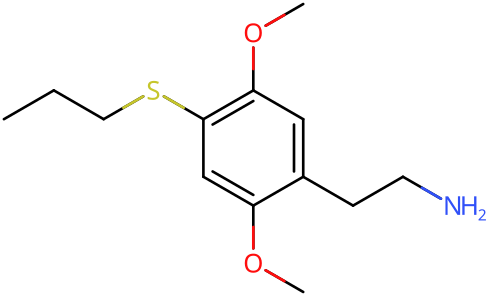
2C-T-7 Stats & Data
CCCSc1cc(OC)c(CCN)cc1OCOLEVEPDJOFPJTF-UHFFFAOYSA-NPharmacology
DrugBankMechanism of Action
Studies involving a bromine-substituted analogue, 2C-B (4-bromo-2,5- dimethoxyphenethylamine), have shown it to be a partial agonist for 5-HT2 (5-HT2A and 5-HT2C) serotonergic receptors and 1-adrenergic receptors. At 10-6 M, 2C-B also acted as a competitive 5-HT antagonist, but, at higher concentrations (2.8 x 10⁻⁵M), it acted as a non-competitive 5-HT antagonist. ... As 2C-T-7 is phenethylamine based, it is possible that it may have serotonergic receptor affinity similar to 2C-B (i.e. binding t
Metabolism
... it is likely that its metabolism may proceed via similar pathways as 2C-B, possibly with additional metabolic reactions.
Receptor Profile
Receptor Actions
History & Culture
1980–1991
2C-T-7 was developed around 1980 by Alexander Shulgin and Peyton Jacob III as part of Shulgin's extensive research program into substituted phenethylamines. The compound was first described in scientific literature by Myron Stolaroff by 1990, with more detailed characterization published by Shulgin and colleagues the following year. The compound was subsequently included in Shulgin's influential 1991 text PiHKAL (Phenethylamines I Have Known and Loved), where it holds a distinguished position among his self-designated "magical half-dozen"—the six phenethylamine compounds Shulgin considered most significant from his research. This group comprises mescaline, DOM, 2C-B, 2C-E, 2C-T-2, and 2C-T-7, with mescaline being the only member that Shulgin did not personally design and synthesize.
1991–2002
Following its publication in PiHKAL, 2C-T-7 remained relatively obscure through the 1990s, produced primarily in underground college laboratories and by small commercial research operations. Around the year 2000, availability expanded significantly as grey-market commercial vendors began supplying the compound, and it transitioned from an obscure research chemical to a recreational substance appearing at parties and clubs across North America and Europe. During this period, 2C-T-7 was sold openly in Dutch and Japanese smartshops as well as through online retailers. In the Netherlands, the compound briefly appeared on the market after 2C-T-2 had been prohibited, filling the resulting commercial gap before being banned in turn.
2002–present
In January 2002, Rolling Stone magazine published "The New (legal) Killer Drug," an article that brought substantial public attention to 2C-T-7. While the piece suggested the substance was legal, its status under United States law was actually ambiguous at the time due to the Federal Analogue Act. The accuracy of the Rolling Stone coverage was subsequently challenged in a detailed response published on the website disinfo.com. As of August 2007, at least three deaths had been reported in association with 2C-T-7 use. These fatalities involved either insufflated doses of 30 milligrams or greater, or occurred when the compound was combined with stimulants such as MDMA. The deaths and heightened media scrutiny contributed to rapid regulatory responses in multiple jurisdictions.
Subjective Effects
Physical
- Spontaneous tactile sensations: The body high of 2C-T-7 is intense but, in comparison to 2C-E or 2C-B, it can be considered mild though is still capable of becoming very powerful and highly physically euphoric. It is similar yet distinct from the body high experienced on 2C-E, 2C-B, and LSD. The sensation itself can be described as intense and will manifest itself in the form of a continuously shifting tingling sensation that travels up and down the body in spontaneous waves.
- Stimulation: In terms of its effects on the physical energy levels of the tripper, 2C-T-7 is usually considered to be very energetic and stimulating in a fashion that is quite comparable to that of other phenethylamines such as 2C-B, 2C-E and 2C-P.
- Increased bodily control: Although this component is capable of manifesting itself in a distinct and noticeable fashion for most users, it does not generally seem to be as apparent or intense as the same component found within LSD and 2C-B.
- Tactile enhancement
- Nausea: Mild to extreme nausea is commonly reported when consumed in moderate to high dosages and either passes once the tripper has vomited or gradually fades by itself as the peak sets in.
- Temperature regulation loss
Cognitive
The head space of 2C-T-7 is described by many as one which is both insightful and relatively normal in its thought processes even at moderate to high dosages.
- Current mind state enhancement
- Thought acceleration
- Feelings of fascination, importance and awe
- Time distortion
- Introspection
- Personal bias suppression
- Conceptual thinking
- Ego suppression, loss and death
- Thought loops
- Feelings of interdependent opposites
- Delusions
- Unity and interconnectedness
Sensory
- Enhancements
- Distortions
- Hallucinations
- Visual drifting: (Melting, Flowing, Breathing and Morphing) - In comparison to other psychedelics, this effect can be described as highly detailed, slow and smooth in motion, static in their appearance and extremely realistic in style but with a subtle digital/cartoonish form.
- Tracers
- After images
- Texture repetition
- Colour shifting
- Scenery slicing
- Increased visual acuity
- Enhancement of colour
- Enhanced pattern recognition
2C-T-7 produces a full range of high level hallucinatory states in a fashion that is more consistent and reproducible than that of many other commonly used psychedelics, particularly in comparison to other substances within the phenethylamine family.
- External hallucinations
- Internal hallucinations: In comparison to other psychedelics such as LSD, 2C-T-7 is very high in hallucinations embedded within visual geometry. This particular effect commonly contains hallucinations with scenarios, settings, concepts and autonomous entity contact. They are more common within dark environments and can be described as internal in their manifestation, lucid in believability, interactive in style and almost exclusively of religious, spiritual, mystical or transcendental nature in their overall theme.
Forked from Subjective Effect Documentation by Josie Kins, April 2014. Via dose.wiki (CC0).
Toxicity
PsychonautWikiAs of August 2007, there have been at least three reported deaths associated with the use of 2C-T-7. These incidents occurred with insufflated doses of 30 mg or more, or in combination with stimulants such as MDMA,. There have also been a number of reports describing concerning physical side effects and hospitalizations, typically following insufflation. It is strongly discouraged to administer 2C-T-7 non-orally because this can cause vomiting, numerous negative side effects, or death at high doses. In Erowid's Fall 2000 2C-T-7 survey, it was reported that the insufflation of 2C-T-7 resulted in more negative side effects than oral administration.
Effect Profile
Curated + 190 ReportsStrong visuals, headspace, and auditory effects with strong body load
Strong stimulation and sensory enhancement with moderate euphoria and empathy
Duration Timeline
BluelightCommunity Effects
TripSitTolerance & Pharmacokinetics
drugs.wikiTolerance Decay
Pattern inferred from general serotonergic psychedelic tolerance behavior; empirical decay to baseline typically takes 10–14 days. Users often report diminished effects if re-dosing within one week.
Cross-Tolerances
Demographics
Gender Distribution
Age Distribution
Reports Over Time
Effect Analysis
Erowid + BluelightEffects aggregated from 189 experience reports (139 single-substance Erowid + 51 Bluelight)
Effect Sentiment Distribution
Confidence Distribution
Each bar is the share of reports mentioning the effect; its whisker, and the band on the rows below, is the 95% interval: where the share could plausibly be with other reports of the same kind.
Positive Effects 74
Adverse Effects 51
Show 29 more adverse effects
Show 24 neutral or unclassified mentions
Also reported in combinations. In the 67 2C-T-7 reports where another drug was taken too, 11 (16.4%) mention hospital, emergency services or an overdose, 0 (0.0%) a seizure and 3 (4.5%) psychosis. In the 139 single-substance reports: 12.2%, 1.4% and 4.3%. These are not in the figures above: they cannot be put down to 2C-T-7 alone, and a mention is not always something that happened to the writer.
Dose-Response Correlation
How effect frequency changes across dose levels. Whiskers, and the numbers' hover text, give each figure's 95% interval.
Not drawn, too few reports (a dose tier needs 20): Oral Light (n=11), Oral Common (n=10), Oral Heavy (n=15), Insufflated Heavy (n=16). Why 20?
View data table
| Effect | Strong (n=29) |
|---|---|
| Visual Distortions | 82.8% (95% interval 66 to 92 percent) |
| Nausea | 55.2% (95% interval 38 to 72 percent) |
| Anxiety | 44.8% (95% interval 28 to 62 percent) |
| Music Enhancement | 37.9% (95% interval 23 to 56 percent) |
| Empathy | 34.5% (95% interval 20 to 53 percent) |
| Stimulation | 34.5% (95% interval 20 to 53 percent) |
| Color Enhancement | 34.5% (95% interval 20 to 53 percent) |
| Sedation | 31.0% (95% interval 17 to 49 percent) |
| Muscle Tension | 31.0% (95% interval 17 to 49 percent) |
| Euphoria | 27.6% (95% interval 15 to 46 percent) |
| Auditory Effects | 24.1% (95% interval 12 to 42 percent) |
| Closed-Eye Visuals | 24.1% (95% interval 12 to 42 percent) |
| Dissociation | 24.1% (95% interval 12 to 42 percent) |
| Confusion | 24.1% (95% interval 12 to 42 percent) |
| Ego Dissolution | 24.1% (95% interval 12 to 42 percent) |
Subjective Effect Ontology
Experience ReportsStructured effect tags extracted from 256 Erowid & Bluelight experience reports using a controlled vocabulary of 220+ canonical effects across 15 domains.
Gastrointestinal
Visual
Dose–Effect Mapping
Experience ReportsHow reported effects shift across dose tiers, based on 139 single-substance experience reports. The shaded band on each bar is its 95% interval. An arrow (↑ ↓) marks a change between the lowest and highest tier that count an effect only when the gap is bigger than chance would explain; ~ means no clear change. How changes are called
Not drawn, too few reports (a dose tier needs 20): Oral Light (n=11), Oral Common (n=10), Oral Heavy (n=15), Insufflated Heavy (n=16). Why 20?
Limited tier coverage — most reports fall within the Strong range. Effects at other dose levels may not be represented.
| Effect | Strong (n=29) | Change with dose |
|---|---|---|
| visual distortions | ||
| nausea | ||
| anxiety | ||
| music enhancement | ||
| empathy | ||
| stimulation | ||
| color enhancement | ||
| sedation | ||
| muscle tension | ||
| euphoria | ||
| auditory effects | ||
| closed-eye visuals | ||
| dissociation | ||
| confusion | ||
| ego dissolution | ||
| introspection | ||
| tactile enhancement | ||
| headache | ||
| open-eye visuals | ||
| time distortion |
Showing top 20 of 27 effects
Dosage Distribution
Dose distribution from experience reports, one dose per report (the first listed). Doses above Q3 + 3×IQR, far above what people typically take, are left out of the median and range and listed under each route: most are real heavy doses or overdoses, not mistakes.
Oral
1 report gave a dose above the typical range (160 mg), so it is not in the figures above. Listing a dose here does not mean it is safe.
Show the report
Insufflated
Real-World Dose Distribution
ErowidFrom 251 of 268 recorded dose entries: those that state a weight (mg, g or µg), in routes with at least five of them. Values above Q3 + 3×IQR, far above what people typically take, are left out; they can include real heavy doses and overdoses, not only mistakes.
Insufflated (n=81)
Oral (n=158)
Smoked (n=10)
Common Combinations
Most co-occurring substances, as a share of all 206 reports filed under 2C-T-7; whiskers are 95% intervals
Form / Preparation
Most common forms and preparations, as a share of the 176 reports that give one; whiskers are 95% intervals
Body-Weight Dosing
Dose per kg of body weight, one dose per report (the first listed), from reports giving a weight of 30–250 kg. Doses above Q3 + 3×IQR, far above what people typically take, are left out of the median and range and listed under each route.
Oral
2 reports gave a dose above the typical range (1.441–2.075 mg/kg), so they are not in the figures above. Listing a dose here does not mean it is safe.
Show the reports
- 2.075 mg/kg
- 1.441 mg/kg · another drug taken too
Insufflated
1 report gave a dose above the typical range (0.858 mg/kg), so it is not in the figures above. Listing a dose here does not mean it is safe.
Show the report
Smoked
Redose Patterns
Redosing behavior across 179 reports
Legal Status
| Country | Status | Notes |
|---|---|---|
| Australia | Schedule 9 | Covered by analogue drug laws and formally added to Schedule 9 (the most restrictive category) by the National Drugs and Poisons Schedule Committee in 2005. |
| Austria | Illegal | Prohibited under the Suchtmittelgesetz (SMG). Possession, production, and sale are illegal. |
| Belgium | Controlled | Added to the list of illegal psychotropic substances on November 8, 2004. |
| Brazil | Controlled | Possession, production, and sale are illegal. Listed on Portaria SVS/MS nº 344 as of February 18, 2014. |
| Canada | Schedule III | Controlled as of October 31, 2016 as a derivative of 2,5-dimethoxyphenethylamine under the 2C-phenethylamine catch-all provision. |
| China | Category I psychotropic substance | Controlled substance as of October 2015. Illegal to sell, buy, import, export, and manufacture. |
| Denmark | Category B | Added to category B of the controlled substances list on August 23, 2003. |
| Estonia | Schedule I | Added to Schedule I in February 2011 alongside several other novel psychoactive substances. |
| Finland | Controlled | Scheduled under the government decree on substances, preparations, and plants considered to be narcotic drugs. |
| Germany | Anlage I BtMG | Controlled under Anlage I of the Betäubungsmittelgesetz (Narcotics Act) as of July 1, 2001. Manufacturing, possession, import, export, purchase, sale, procurement, and dispensing are illegal without a license. |
| Greece | Controlled | Became a controlled substance on February 18, 2003. |
| Italy | Tabella I | Added to Tabella I (list of prohibited plants and substances) by Ministry of Health statement on January 11, 2005. |
| Latvia | Schedule I | Classified as a Schedule I controlled substance. Possession, production, and distribution are prohibited. |
| Netherlands | List I (Opiumwet) | The first country to ban 2C-T-7 after brief availability in smartshops. Following the ban on 2C-T-2, 2C-T-7 appeared on the market but was quickly prohibited under List I of the Opium Law. |
| Poland | Schedule I (I-P) | Reported as a Schedule I controlled substance. Possession, production, and distribution are prohibited. |
| Portugal | Controlled | Legislation enacted in January 2005 to control 2C-T-7 alongside 2C-I, 2C-T-2, and TMA-2. |
| Slovakia | Grade 2 | Added to Grade 2 (equivalent to Schedule II under the 1971 UN Convention on Psychotropic Substances) in October 2009. |
| Sweden | Schedule I | First classified as a health hazard under the Act on the Prohibition of Certain Goods Dangerous to Health (SFS 1999:58) as of April 1, 1999, making it illegal to sell or possess. Subsequently added to Schedule I as of March 16, 2004. |
| Switzerland | Controlled (Verzeichnis D) | Specifically named as a controlled substance under Verzeichnis D of Swiss narcotics legislation. |
| United Kingdom | Class A | Controlled as a Class A substance under the Misuse of Drugs Act 1971 as a result of the phenethylamine catch-all clause. In 1999, the Home Office effectively placed all compounds listed in PiHKAL into Class A. |
| United States | Schedule I | Classified as Schedule I by emergency DEA ruling on September 20, 2002. Permanently placed in Schedule I on March 18, 2004 when the DEA published a Final Rule in the Federal Register (69 FR 12794). Manufacturing, buying, possessing, or distributing without a DEA license is illegal. |
Harm Reduction
drugs.wikiEvidence-based harm-reduction points and corrections: 1) Insufflation carries disproportionate risk: at least two deaths followed nasal doses around 30–35 mg, and users frequently report burning pain, vomiting, and delirium; therefore nasal use is strongly discouraged in favor of oral titration. Source: Erowid dosage/effects pages and death summaries; EU risk communication. 2) Onset is often delayed (60–150 min, sometimes longer), which tempts premature redosing; waiting a full 3 hours before any adjustment is a practical guardrail. Source: Erowid basics/effects. 3) Likely MAO‑A involvement: sulfur‑substituted phenethylamines in this family have shown selective, reversible MAO‑A inhibition in vitro; in practice, combining 2C‑T‑7 with MAOIs (including linezolid/harmalas) or strongly serotonergic agents (MDMA, DXM, tramadol, meperidine) increases serotonin‑toxicity risk; avoid. Source: summary of Monte et al. reported on Drugs‑Forum; NCBI/StatPearls MAOI interaction guidance; Erowid deprenyl case notes. 4) Documented fatalities: at least three publicly reported deaths (two insufflated, one oral with MDMA). The prior claim of “eight deaths” is not supported by the curated sources below, so the figure is corrected to “at least three.” Source: Erowid death summaries. 5) Reagent testing: Marquis typically gives salmon orange/red with 2C‑T‑7. Use multiple reagents and beware mis-sold phenethylamines/NBOMe analogs; always test each batch. Source: Erowid Marquis chart and history notes. 6) Set, setting, sitter: high-dose reactions may include dissociation, agitation, or delirium; vomiting plus confusion increases aspiration risk; a sober sitter and calm environment reduce danger; seek emergency care for persistent chest pain, high temperature, seizures, cyanosis, or uncontrolled agitation; medical benzodiazepines are standard for severe agitation. Source: Erowid effects/overdose narratives. 7) Route cautions: IM/IV/injection has been associated with severe adverse events and is further discouraged; rectal use is less characterized—dose reductions versus oral are prudent. Source: Erowid surveys/pharmacology article. 8) Tolerance: acute tolerance emerges after one session and decays over about 10–14 days, with cross‑tolerance to serotonergic psychedelics (LSD, psilocybin). Source: TripSit general psychedelic tolerance guidance; community reports; Erowid survey patterns. 9) Street names and recognition: “T7,” “Blue Mystic,” “Beautiful,” and “Tripstasy/7‑Up” have appeared in historical markets; knowing aliases helps with test‑kit interpretation and avoiding misrepresented pills. Source: Erowid vault and East Bay Express article mirrored at Erowid. 10) Pharmacokinetics are not characterized in humans; no reliable elimination half‑life is published in the curated literature below. Duration of effects should not be conflated with half‑life. Source: Erowid basics notes “Pharmacology Summary Needed.”
References
Data Sources
Cited References
- Bluelight Trip Report - 2C-T-7 (20 mg) - New Experience (user: greenmeanies, 2010)
- Camilleri A et al. Phenethylamine Designer Drugs Review. Clin Toxicol 2013
- CDC MMWR. Deaths Associated With 2C-T-7 Use - Oklahoma & Wisconsin, 2000-2001
- Fantegrossi WE et al. Hallucinogen-like actions of 2C-T-7 in mice and rats. Psychopharmacology 2005
- Gallardo-Godoy A et al. Sulfur-Substituted α-Alkyl Phenethylamines as Selective & Reversible MAO-A Inhibitors. J Med Chem 2005
- Hartman J. An Amateur Qualitative Study of 48 2C-T-7 Bioassays
- Shulgin A; Shulgin A. PIHKAL entry #43 2C-T-7
- US-DEA Drug & Chemical Information: 2C-T-7
- Wagmann L et al. Interactions of phenethylamine-derived psychoactive substances of the 2C-series with human monoamine oxidases. Drug Test Anal 2019
- Monte AP et al. Sulfur-Substituted α-Alkyl Phenethylamines as Selective & Reversible MAO-A Inhibitors. J Med Chem 2004
Additional references
- Erowid 2C‑T‑7 Vault main
- Erowid 2C‑T‑7 Dosage
- Erowid 2C‑T‑7 Effects/Duration
- Erowid 2C‑T‑7 Basics (onset/duration, cautions)
- Erowid 2C‑T‑7 Deaths (insufflated and MDMA combo)
- Erowid ‘Sulfurous Samadhi’ Pharmacology/User surveys
- Erowid ‘Sulfurous Samadhi’ History (Blue Mystic; street names)
- Erowid Marquis reagent chart (2C‑T‑7 salmon orange/red)
- EU Drugs Agency risk note: sniffing 2C‑T‑7 increases risk of severe/lethal overdose
- EU Council Decision to control 2C‑I/2C‑T‑2/2C‑T‑7/TMA‑2
- Drugs‑Forum summary of Monte et al.: sulfur‑substituted phenethylamines as selective reversible MAO‑A inhibitors
- NCBI StatPearls: MAOIs overview and contraindications (serotonin syndrome; tyramine)
- NCBI StatPearls: Dextromethorphan (contraindicated with MAOIs)
- NCBI StatPearls: Linezolid (MAOI; serotonin syndrome risk)
- DrugBank: MAO‑A inhibition increases sumatriptan exposure
- TripSit: Psychedelic tolerance overview (1–2 weeks)