
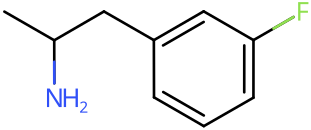
3-FA Stats & Data
CC(N)Cc1cccc(F)c1PIOCLGPCMNPZFT-UHFFFAOYSA-NReceptor Profile
Receptor Actions
History & Culture
3-Fluoroamphetamine emerged as part of a wave of designer fluorinated amphetamine compounds that gained popularity in the late 2000s as research chemical alternatives to traditionally available stimulants. This series includes related compounds such as 2-FA, 2-FMA, 3-FEA, and 4-FA. The substance was first formally documented on the recreational drug market when Belgium reported its appearance to the European Early Warning System in January 2009. Little is known about the precise origins of 3-fluoroamphetamine's synthesis or early development. Unlike many amphetamine derivatives with extensive pharmaceutical or military research histories, 3-FA appears to have emerged primarily within the designer drug and research chemical context. The compound has been utilized in pharmacological studies examining monoamine release mechanisms, and has attracted some research interest for potential neuropharmacological applications. Its history of human recreational use remains extremely short, with distribution occurring almost exclusively through online grey market vendors rather than through traditional street drug channels.
Toxicity
PsychonautWikiThe toxicity and long-term health effects of recreational 3-FA use do not seem to have been studied in any scientific context and the exact toxic dosage is unknown. This is because 3-FA has an extremely short history of human usage. Anecdotal evidence from people who have tried 3-FA within the community suggests that there do not seem to be any negative health effects attributed to simply trying this drug at low to moderate doses by itself and using it sparingly (but nothing can be completely guaranteed). It is perhaps worth noting that in the field of medicinal chemistry, the fluorine substitution is sometimes seen as desirable in central nervous system pharmaceutical agents, and is a common practice due to the corresponding increase in lipophilicity granted by the substitute.
Effect Profile
Curated + 2 ReportsStrong euphoria with moderate stimulation, mild sensory enhancement and empathy
Strong euphoria and focus with strong anxiety/jitters, mild stimulation
Tolerance & Pharmacokinetics
drugs.wikiTolerance Decay
Acute tolerance to subjective and cardiovascular effects develops within a session; partial recovery occurs over several days with baseline typically returning within 1–2 weeks if abstinent. Cross-tolerance with other amphetamines is expected due to shared transporter-mediated mechanisms.
Cross-Tolerances
Experience Report Analysis
ErowidDemographics
Gender Distribution
Too few reports for a chart: gender is known from 5 reports, and a split is drawn only from 20 reports or more. Counts are shown instead. Why 20?
- Male 3 of 5
- Not Specified 2 of 5
Age Distribution
Reports Over Time
Real-World Dose Distribution
ErowidFrom 10 of 13 recorded dose entries: those that state a weight (mg, g or µg), in routes with at least five of them. Values above Q3 + 3×IQR, far above what people typically take, are left out; they can include real heavy doses and overdoses, not only mistakes.
Oral (n=10)
Form / Preparation
Most common forms and preparations, as a share of the 4 reports that give one
Too few reports for bars: these forms come from 4 reports, and a bar is drawn only from 20 reports or more. With fewer, a percentage cannot tell a common effect from a rare one. Counts are shown instead. Why 20?
- Powder / Crystals 3 of 4
Legal Status
| Country | Status | Notes |
|---|---|---|
| China | Controlled substance | Classified as a controlled substance as of October 2015. |
| Finland | Scheduled narcotic | Listed in the government decree on substances, preparations, and plants considered to be narcotic drugs. |
| France | Unscheduled (grey area) | As of December 2024, not explicitly scheduled under French drug laws. Possession is technically legal but exists in a regulatory grey area. |
| Germany | NpSG controlled | Controlled under the Neue-psychoaktive-Stoffe-Gesetz (New Psychoactive Substances Act) since November 26, 2016. Production, import for market placement, administration to others, and trading are punishable offenses. Possession is prohibited but not subject to criminal penalty. |
| New Zealand | Schedule 3 (Class C) | Classified as a Schedule 3 Class C controlled substance due to its status as an amphetamine analogue under New Zealand drug scheduling. |
| Switzerland | Verzeichnis E | Specifically named as a controlled substance under Verzeichnis E of Swiss narcotics legislation. |
| Turkey | Illegal | Classified as a controlled drug. Possession, production, supply, and importation are all prohibited. |
| United Kingdom | Class A | Controlled as a Class A substance under the amphetamine analogue clause of the Misuse of Drugs Act 1971. Class A classification carries the most severe penalties under UK drug law. |
| United States | Unscheduled (analogue liability) | Not explicitly scheduled at the federal level but may be prosecuted under the Federal Analogue Act (21 U.S.C. § 813) as structurally similar to amphetamine. This provision applies only when the substance is intended for human consumption, treating it as equivalent to a Schedule I or II controlled substance. |
Harm Reduction
drugs.wiki3-FA (PAL-353) is a monoamine releasing agent with high selectivity for dopamine and norepinephrine over serotonin in in vitro assays and in vivo primate studies, which correlates with reinforcing potential. Human pharmacokinetics are not established; user timelines suggest a 4–8 h primary effect window with residual stimulation and insomnia into the next day. Marked batch-to-batch potency variability has been reported; always allergy test (1–2 mg), use a milligram scale, and titrate slowly. Redosing can escalate cardiovascular strain and insomnia; set a hard cap and avoid extended binges (>24 h) due to psychosis/seizure risk. Stimulant risks include hypertension, tachycardia, vasoconstriction (cold extremities), hyperthermia, and dehydration; actively manage temperature and electrolytes, especially during dancing/exertion. Avoid combinations that raise serotonin (e.g., DXM, tramadol, MDMA) or lower seizure threshold (e.g., bupropion); MAOIs are a hard contraindication. Use drug checking: vendors sometimes mislabel ring-substituted amphetamines/cathinones; multi-reagent testing and, where available, spectrometric checking reduce adulterant risks. Nasal use increases local tissue irritation and infection risk; use clean equipment and isotonic saline rinses post-session. People with cardiovascular disease, uncontrolled hypertension, hyperthyroidism, glaucoma, or a history of psychosis should avoid use; anyone on prescription psych meds should consider interaction risks and spacing. Space sessions by at least 1–2 weeks to allow tolerance and sleep patterns to normalize; prioritize nutrition (carbohydrates, protein) and rehydration after use. Sexual compulsion and prolonged arousal are commonly reported; plan consent and protection ahead and beware of priapism risks.
References
Cited References
Additional references
- Behavioral and neurochemical effects of amphetamine analogs that release monoamines in the squirrel monkey (includes PAL-353)
- Wee et al., Relationship between serotonergic activity and reinforcing effects of a series of amphetamine analogs (EC50 data cited)
- 3-Fluoroamphetamine — Bluelight Neuroscience & Pharmacology (discussion with EC50 values and DA efflux summary)
- RCs (3-FA) 3-fluoro-amphetamine Megathread — Bluelight (user reports, potency variability, redose compulsion discussion)
- 3-fluoroamphetamine (3-FA) Experiences — Drugs-Forum (oral 20–40 mg; 4–6 h duration reports)
- 3-FA reports and thoughts — r/researchchemicals (dose variability, insufflated + oral stacking anecdotes)
- 3fa - i have a few questions — r/researchchemicals (binge risk discussion)
- Harm Reduction: Biology, Pharmacology and Drugs 101 — Bluelight (serotonin syndrome, stimulant risks, hyperthermia)
- TripSit Drug Combinations (community HR resource widely referenced)
- Bupropion and stimulants — Bluelight/Drugs-Forum threads (seizure risk with concomitant stimulants)
- Isomer Design — 3-FA entry (synonyms, identifiers, links to PubChem)
- Toronto Drug Checking Service (value of lab drug checking and common adulterants in unregulated supply)