
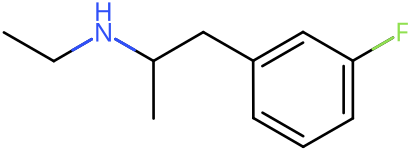
3-FEA Stats & Data
[Cl-].CCNC(C)Cc1cccc(F)c1.[H+]VWEIOFROPKRPJC-UHFFFAOYSA-NReceptor Profile
Receptor Actions
History & Culture
3-Fluoroethamphetamine belongs to a series of designer fluorinated amphetamine derivatives that emerged in the 2010s, which includes related compounds such as 2-FA, 2-FMA, 3-FA, 4-FMA, and 4-FA. These substances were developed as novel psychoactive compounds for the research chemical market. The compound first appeared on the grey market in mid-2016, when it became available for purchase through online research chemical vendors. Unlike many other stimulants, 3-FEA has not been documented being sold on the streets and its distribution has remained primarily within online research chemical communities. Due to its recent emergence, 3-FEA has an extremely limited history of human use, and virtually no scientific research has been conducted on its effects in humans.
Toxicity
PsychonautWikiThe toxicity and long-term health effects of recreational 3-FEA use do not seem to have been studied in any scientific context and the exact toxic dosage is unknown. This is because 3-FEA has an extremely brief history of human usage, first becoming available in mid-2016. Early anecdotal reports suggest that there do not seem to be any negative health effects attributed to simply trying this substance at low to moderate doses by itself and using it very cautiously sparingly (although nothing can be completely guaranteed).
Effect Profile
Curated + 2 ReportsModerate stimulation and euphoria with mild sensory enhancement, low empathy
Moderate euphoria with strong anxiety/jitters, mild stimulation, low focus
Tolerance & Pharmacokinetics
drugs.wikiTolerance Decay
Rapid subjective tolerance and binge patterns are reported with related stimulants; spacing use by several weeks minimizes tolerance and comedown severity. Data are primarily anecdotal.
Cross-Tolerances
Experience Report Analysis
ErowidDemographics
Gender Distribution
Too few reports for a chart: gender is known from 5 reports, and a split is drawn only from 20 reports or more. Counts are shown instead. Why 20?
- Male 5 of 5
Age Distribution
Reports Over Time
Real-World Dose Distribution
ErowidFrom 12 of 14 recorded dose entries: those that state a weight (mg, g or µg), in routes with at least five of them. Values above Q3 + 3×IQR, far above what people typically take, are left out; they can include real heavy doses and overdoses, not only mistakes.
Insufflated (n=12)
Legal Status
| Country | Status | Notes |
|---|---|---|
| Austria | Illegal (NPSG) | Production and sale prohibited under the Neue-Psychoaktive-Substanzen-Gesetz (New Psychoactive Substances Act). This legislation covers novel psychoactive substances not explicitly listed in traditional drug schedules. |
| Canada | Schedule I (analog) | Controlled as an amphetamine analog under the Controlled Drugs and Substances Act. Schedule I substances carry the most severe penalties for trafficking and possession. |
| France | Not scheduled | As of December 2024, not explicitly listed as a controlled substance. Possession exists in a legal grey area, though this status may change. |
| Germany | Controlled (NpSG) | Regulated under the Neue-psychoaktive-Stoffe-Gesetz since November 26, 2016. Production, import with intent to distribute, administration to others, and commercial trading are criminal offenses. Possession is prohibited but does not carry criminal penalties. |
| New Zealand | Schedule 3 | Controlled as an amphetamine analog under national drug legislation. Schedule 3 substances are considered to have moderate potential for harm. |
| Switzerland | Controlled (Verzeichnis E) | Regulated as a derivative of α-methylphenethylamine under Verzeichnis E point 130 of the narcotics scheduling ordinance. An exemption exists for scientific or industrial applications. |
| United Kingdom | Class A | Controlled under the amphetamine analog clause of the Misuse of Drugs Act 1971. Class A classification carries the most severe penalties, including up to 7 years for possession and life imprisonment for supply. |
| United States | Unscheduled (Analogue Act applies) | Not explicitly scheduled federally but may be prosecuted under the Federal Analogue Act (21 U.S.C. § 813) as substantially similar to amphetamine. This applies only when the substance is intended for human consumption, potentially subjecting it to Schedule II restrictions. |
Harm Reduction
drugs.wikiSold solely as a research chemical with variable and sometimes misrepresented content; drug checking is strongly advised. Advanced laboratory methods (e.g., GC/MS or LC–HRMS) are required to reliably distinguish 3-FEA from related isomers like 3-FA or 4-FA; reagent kits cannot confirm identity and mislabeling has been documented in the stimulant market. Oral administration is generally preferred over insufflation for fluoroamphetamines due to significant nasal irritation and mucosal injury risk. Combining with other stimulants or high caffeine markedly increases cardiovascular strain; stick to one stimulant at a time and avoid energy drinks. As an entactogenic stimulant, 3-FEA carries typical risks of hyperthermia and dehydration; sip fluids regularly but avoid overhydration to reduce hyponatremia risk, and take cooling breaks in hot environments. Redosing beyond the initial peak increases adverse effects (nausea, tremor, jaw tension, insomnia) while providing diminishing returns; allow full offset and adequate sleep before considering any reuse. Do not self-treat stimulant comedowns with beta-blockers; if you experience chest pain, severe headache, confusion, or very high blood pressure/heart rate, seek urgent care—benzodiazepines are the first-line treatment in emergency settings for stimulant toxicity. Evidence on human pharmacokinetics is limited; metabolism pathways are not established, so be especially cautious if taking CYP2D6-inhibiting medications (inference from MDMA data).
References
Cited References
- Bluelight: 3-FEA 26mg oral first-time experience (2017)
- Bluelight: 3-FEA compound thread (2018)
- Bluelight: 3-FEA large dose discussion (2021)
- Identification and characterization of 3-fluoroethamphetamine in seized material (2018)
- PubChem: CID 57458869 - 3-Fluoroethamphetamine
- Rothman et al. - 5-HT2B Receptors in Cardiac Valvulopathy (2000)
- Tessel & Woods - N-ethylamphetamine self-injection in rhesus monkeys (1978)
- Withdrawal from 3-Fluoroethamphetamine study (2024)
- PubMed: 3-FEA monoamine release & withdrawal study (2024)
Additional references
- PubChem CID 137700471 – 3-Fluoroethamphetamine hydrochloride (identity/structure)
- PubMed – Withdrawal from 3-FEA induces hyperactivity and depression-like behaviors in male mice (2024)
- Bluelight TR – 26 mg oral first-time (2017)
- Bluelight – 3-FEA large-dose discussion (2021)
- Bluelight – 3-FEA general thread (2017)
- Drugs-Forum – 3-FEA info thread (user experiences)
- Drugs-Forum – 3-FA experiences (nasal irritation, tolerance)
- Saferparty – 4-FA substance page (nasal irritation; prefer oral)
- Saferparty – 4F‑MPH sold as 4‑FA (mislabeling warning; need lab testing)
- Drugchecking.community – Lab methods and harm-reduction context
- DrugWise – Amphetamines (avoid mixing with other stimulants; general HR)
- TripSit Wiki – Antidepressants (MAOI/SSRI interaction cautions)
- TripSit Wiki – Drug combinations (stimulant combo cautions)
- TripSit Wiki – MDA page (hyperthermia, dehydration vs. hyponatremia HR)
- NCBI StatPearls – Cocaine (ED management; benzodiazepines first-line; beta-blocker nuances)
- PubMed – CYP2D6 function moderates MDMA PK/PD in humans (inference for CYP2D6 caution)
- PubMed – CYP2D6 inhibition (bupropion) alters MDMA stereoselective PK (inference)