
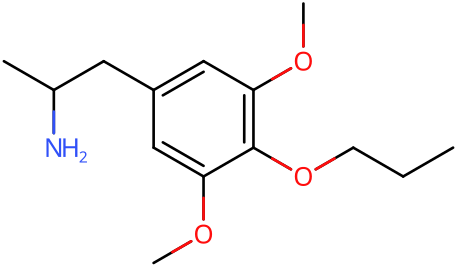
3C-P Stats & Data
CCCOc1c(OC)cc(CC(C)N)cc1OCKKMCHCCXGKYEKJ-UHFFFAOYSA-NReceptor Profile
Receptor Actions
Toxicity
PsychonautWikiThe toxicity and long-term health effects of recreational 3C-P use do not seem to have been studied in any scientific context and the exact toxic dose is unknown. This is because 3C-P is a research chemical with very little history of human usage. Anecdotal evidence from people within the community who have tried 3C-P suggests that there are no negative health effects attributed to simply trying it by itself at low to moderate doses and using it very sparingly (but nothing can be completely guaranteed). Independent research should always be done to ensure that a combination of two or more substances is safe before consumption. It is strongly recommended that one use harm reduction practices when using this substance.
Addiction & dependence
3C-P is not habit-forming, and the desire to use it can actually decrease with use. It is most often self-regulating. Tolerance to the effects of 3C-P is built almost immediately after ingestion.
Effect Profile
Curated + 4 ReportsStrong visuals, auditory effects, and headspace with strong body load
Strong euphoria with strong anxiety/jitters, mild stimulation and focus
Tolerance & Pharmacokinetics
drugs.wikiTolerance Decay
As with other 5‑HT2A psychedelics, acute tolerance develops rapidly after a single session and tends to decay across one to two weeks. Data for 3C‑P specifically are anecdotal; estimates extrapolated from mescaline/2C/DOx literature.
Cross-Tolerances
Experience Report Analysis
ErowidDemographics
Gender Distribution
Too few reports for a chart: gender is known from 7 reports, and a split is drawn only from 20 reports or more. Counts are shown instead. Why 20?
- Male 5 of 7
- Not Specified 2 of 7
Age Distribution
Reports Over Time
Effect Analysis
ErowidEffects aggregated from 4 experience reports (4 single-substance Erowid)
Effect Sentiment Distribution
Confidence Distribution
Each bar is the share of reports mentioning the effect; its whisker, and the band on the rows below, is the 95% interval: where the share could plausibly be with other reports of the same kind.
Too few reports for bars: these effects come from 4 single-substance Erowid reports, and a bar is drawn only from 20 reports or more. With fewer, a percentage cannot tell a common effect from a rare one. Counts are shown instead. Why 20?
Positive Effects 1
Adverse Effects 0
Also reported in combinations. In the 3 3C-P reports where another drug was taken too, 0 mention hospital, emergency services or an overdose, 0 a seizure and 1 psychosis (too few reports for percentages). In the 4 single-substance reports: 0, 0 and 0. These are not in the figures above: they cannot be put down to 3C-P alone, and a mention is not always something that happened to the writer.
Real-World Dose Distribution
ErowidFrom 9 of 11 recorded dose entries: those that state a weight (mg, g or µg), in routes with at least five of them. Values above Q3 + 3×IQR, far above what people typically take, are left out; they can include real heavy doses and overdoses, not only mistakes.
Oral (n=9)
Form / Preparation
Most common forms and preparations, as a share of the 4 reports that give one
Too few reports for bars: these forms come from 4 reports, and a bar is drawn only from 20 reports or more. With fewer, a percentage cannot tell a common effect from a rare one. Counts are shown instead. Why 20?
- Capsule 2 of 4
Legal Status
| Country | Status | Notes |
|---|---|---|
| Japan | 3C-P is a controlled substance in Japan effective February 28th, 2018. | |
| United Kingdom | It is illegal to produce, supply, or import this drug under the Psychoactive Substance Act, which came into effect on May 26th, 2016. | |
| United States | 3C-P is technically not scheduled in the United States, but could be considered an analog of mescaline and may, therefore, be considered a Schedule I drug under the Federal Analogue Act. |
Harm Reduction
drugs.wiki3C‑P is very rare and poorly characterized; assume high uncertainty. Start low, go slow, and strongly consider a 1–2 mg oral allergy test before any full dose. Come‑up is often slow (≥90 minutes), which can tempt premature redosing; wait at least 3 hours before any consideration of additional dosing. Expect sustained stimulation and possible vasoconstriction (cold or tingly extremities); avoid additional vasoconstrictors and take gentle movement breaks to promote circulation. Oral administration is preferred over insufflation to reduce nasal harm and erratic absorption. Because of long duration and residual alertness, avoid late‑day dosing and plan for sleep disruption; do not counteract with large amounts of alcohol or multiple sedatives. People with cardiovascular disease, hypertension, or arrhythmia should avoid use; monitor pulse and temperature in physically demanding settings. Use lab drug checking where available or at minimum multi‑reagent testing; the gray market has a history of mislabeling phenethylamines. Ensure accurate weighing (calibrated mg scale) and consider volumetric dilution for precise titration. Avoid driving or safety‑critical tasks for at least 16–24 hours after dosing.
References
Cited References
- Bluelight: 3C-P 40 mg slow-burn trip report
- Bluelight: 3C-P 45 mg first-time report
- Bluelight: Big & Dandy 3C-P thread
- Erowid: 3C-P Brief Information
- Erowid: Experience - 3C-P 40 mg 'Euphoric Stimmy Rollercoaster'
- Erowid: Experience - 3C-P 40 mg 'Slow Burn'
- Erowid: Experience - 3C-P 40 mg 'Smooth, Fun, Therapeutic'
- Erowid: Experience - 3C-P 40 mg insufflated + LSD combination
- Erowid: Experience - 3C-P 33 mg 'Functional and Addicting'
- Frontiers - Comparison of behavioral effects of mescaline analogs in mice
- Frontiers - Receptor interaction profiles of 4-alkoxy-3,5-dimethoxy-phenethylamines and amphetamines
- Frontiers - Receptor interaction profiles of 4-alkoxy-substituted 2,5-dimethoxyphenethylamines and amphetamines
- NCBI: Clinically relevant MAOI drug interactions
- Nervewing: blog - 3C-P 40 mg trip report
- PiHKAL #140 - 3C-P synthesis note
- PMC: Comparison of behavioral effects of mescaline analogs using head twitch response
- PMC: Receptor interaction profiles of 4-alkoxy-3,5-dimethoxy-phenethylamines
- Reddit: 3C-P 32 mg live trip report
- Reddit: 3C-P descriptive information post
- Reddit: Summary of 3C-P experiences
- PiHKAL #140 – 3C-P synthesis note
- Frontiers – Cross-tolerance of phenethylamine psychedelics
- Clinically relevant MAOI drug interactions (review)
Additional references
- Erowid – 3C‑P Vault (overview)
- Erowid – Brief 3C‑P information (dosage/duration tentative)
- Bluelight – Big & Dandy 3C‑P thread (background, structure, early anecdotes)
- Bluelight – 3C‑P 40 mg oral first-time report (timeline, vasoconstriction)
- Reddit – 3C‑P 32 mg live report (nausea, visual profile, time course)
- Erowid – Pharmacology: Neuropharmacology of Hallucinogens (5‑HT2A involvement)
- TripSit – Drug combinations (psychedelics with stimulants, tramadol, caffeine, MAOIs)
- TripSit – Psychedelics (tolerance window, stimulation cautions)
- NCBI/PMC – Clinically Relevant Drug Interactions with MAOIs (hypertensive crisis, contraindications)
- NCBI – Dextromethorphan (serotonin syndrome risk; MAOI/SSRI cautions)
- PubMed – Attenuation of psilocybin effects during and after SSRI/SNRI use (dampening inference)
- Saferparty – Drug checking service (lab analysis availability & advisories)
- Drug Users Bible – Safer dosing, mg scales, volumetric dosing, allergy testing