
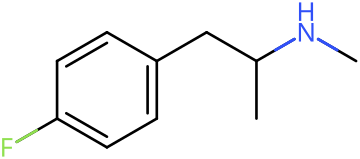
4-FMA Stats & Data
CNC(C)Cc1ccc(F)cc1YCWZPIHKUYZTFM-UHFFFAOYSA-NReceptor Profile
Receptor Actions
History & Culture
4-Fluoromethamphetamine first emerged in documented form when it was detected in legal high products sold in Japanese markets in 2006. Japan subsequently moved to regulate the compound in 2008, prohibiting its sale and possession with intent to distribute while stopping short of criminalizing simple possession for personal use. The substance entered the online research chemical market where it was sold alongside other fluorinated amphetamine analogues including 2-FA, 3-FA, and 4-FA. 4-FMA remained relatively obscure compared to its more popular cousin 4-FA until regulatory changes triggered a significant market shift. When 4-FA was made illegal in the Netherlands in 2017, 4-FMA gained popularity as a legal substitute due to their similar names and effects. By 2018, this transition became apparent in analyzed samples, with products purported to contain 4-FA increasingly found to contain 4-FMA and other fluorinated amphetamines instead. The availability of genuine 4-FA decreased sharply during this period, cementing 4-FMA's position as one of the more widely available fluorinated amphetamines in the research chemical market.
Toxicity
PsychonautWikiDo not use 4-FMA if you have a history of heart-related issues or experience severe headache after its use. We have been made aware of a report released by Trimbos-instituut and Nationaal Vergiftigingen Informatie Centrum (NVIC), describing incidents of strokes after an increased use of the closely related analogue 4-FA, and there is no reason this does not apply to 4-FMA as well. In addition to the common amphetamine-like effects (agitation, anxiety, tachycardia, hypertension, chest pain et al.), serious cardio- and cerebrovascular complications have been reported, including rhythm (sinus arrhythmia, ventricular extrasystoles (bigeminy), conduction disturbances) and acute cardiac failure.
Effect Profile
Curated + 1 ReportsStrong euphoria with moderate stimulation, mild empathy, low sensory enhancement
Strong euphoria with strong anxiety/jitters, moderate focus, mild stimulation
Tolerance & Pharmacokinetics
drugs.wikiTolerance Decay
Cross-Tolerances
Experience Report Analysis
ErowidDemographics
Gender Distribution
Too few reports for a chart: gender is known from 2 reports, and a split is drawn only from 20 reports or more. Counts are shown instead. Why 20?
- Male 2 of 2
Age Distribution
Reports Over Time
Legal Status
| Country | Status | Notes |
|---|---|---|
| Australia | Schedule 9 | Prohibited substance under the Poisons Standard. Defined as a substance which may be abused or misused, where manufacture, possession, sale or use should be prohibited by law except when required for medical or scientific research, or for analytical, teaching or training purposes with approval of health authorities. |
| Austria | Illegal (NPSG) | Controlled under the Neue-Psychoaktive-Substanzen-Gesetz (New Psychoactive Substances Act). Possession, production, and sale are prohibited. |
| Canada | Schedule I (analogue) | Controlled since 1996 as an analogue of methamphetamine. Falls under the Controlled Drugs and Substances Act with associated criminal penalties for possession, trafficking, and production. |
| China | Controlled substance | Designated a controlled substance as of October 2015 under national drug control legislation. |
| Finland | Scheduled (narcotic) | Listed in the government decree on narcotic substances, preparations and plants. Possession and distribution are illegal under Finnish narcotics law. |
| France | Not explicitly scheduled | As of December 2024, not specifically listed in controlled substance schedules. Exists in a legal grey area where possession may be permitted but regulatory status remains ambiguous. |
| Germany | Anlage II BtMG | Controlled under Schedule II of the Betäubungsmittelgesetz (Narcotics Act) since July 26, 2012. Manufacturing, possession, import, export, purchase, sale, procurement, and dispensing without license are prohibited. |
| Italy | Schedule I | Listed as a Schedule I controlled substance under Italian drug legislation. Production, sale, and possession are prohibited. |
| Japan | Controlled substance | First detected in legal highs sold in 2006. Since 2008, illegal to sell or possess with intent to distribute, though simple possession for personal use is not criminalized. |
| New Zealand | Schedule 3 (Class C) | Controlled as an amphetamine analogue under the Misuse of Drugs Act. Schedule 3 substances carry penalties for possession, supply, and manufacture. |
| Switzerland | Controlled (Verzeichnis E) | Specifically named as a controlled substance under Verzeichnis E of the Swiss narcotics regulations. Unauthorized handling is prohibited. |
| United Kingdom | Class A | Controlled under the Misuse of Drugs Act 1971, added through the 1977 amendment covering fluorinated amphetamine derivatives. Class A designation carries the most severe penalties including up to 7 years imprisonment for possession. |
| United States | Unscheduled (Analogue Act applies) | Not specifically scheduled at the federal level. However, as a structural analogue of methamphetamine, sale or possession could be prosecuted under the Federal Analogue Act when intended for human consumption. |