
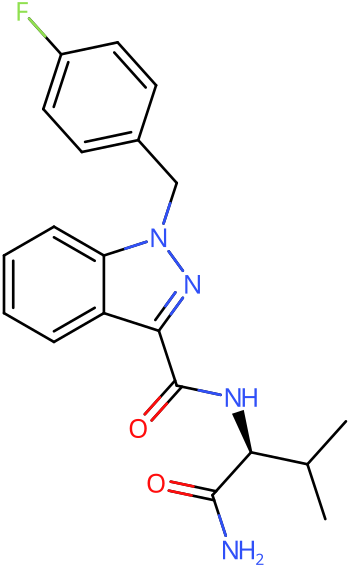
AB-FUBINACA Stats & Data
Fc1ccc(cc1)Cn1nc(C(=O)NC(C(C)C)C(O)=N)c2ccccc12AKOOIMKXADOPDA-QGZVFWFLSA-NReceptor Profile
Receptor Actions
History & Culture
AB-FUBINACA was initially synthesized by Pfizer in 2009 during research into novel analgesic compounds. The pharmaceutical company never advanced the substance to human clinical trials, and it was subsequently abandoned as a potential medication. The compound first appeared on the recreational drug market in 2012, when Japanese researchers identified it as an active ingredient in synthetic cannabinoid products being sold in that country. It was discovered alongside AB-PINACA, a structurally related compound that had not been previously documented in the scientific literature. AB-FUBINACA subsequently became one of the more prevalent synthetic cannabinoids circulating in recreational drug markets. In August 2018, AB-FUBINACA gained significant public attention following a mass overdose event in New Haven, Connecticut. Beginning on August 15, approximately 70 individuals overdosed in the vicinity of Yale University's campus after consuming adulterated synthetic cannabis products. By the end of that week, over 100 people had required emergency medical transport to local hospitals. Law enforcement subsequently arrested three individuals on charges related to dealing synthetic cannabis products containing AB-FUBINACA.
Subjective Effects
Physical
- Spontaneous tactile sensations: The body high of AB-FUBINACA may be described as a warm, soft, pleasurable, all-encompassing tingling sensation that spreads over the body after initial ingestion. It maintains a consistent presence that quickly rises with the onset and hits its limit once the peak has been reached before immediately dissipating. At high doses, this can become uncomfortably intense.
- Sedation: Generally, the effects on the user's energy levels are primarily sedating. This encourages one to relax, and (at higher doses) fall asleep. This can be suppressed by simply forcing oneself to engage in physical activities.
- Motor control loss: This substance causes a partial to moderate suppression of motor control which intensifies proportional to dose but rarely results in a complete inability to walk and perform basic movements.
- Appetite enhancement: As with many other cannabinoids, AB-FUBINACA causes an increase in appetite, known colloquially as "the munchies" in popular American and United Kingdom culture. Clinical studies and survey data have found that cannabis increases food enjoyment and interest in food. This is thought to be due to the way in which endocannabinoids in the hypothalamus activate cannabinoid receptors that are responsible for maintaining food intake.
- Changes in gravity: AB-FUBINACA can cause vertigo with which the environment appears to be spinning or oscillating. At moderate doses, it can spontaneously induce the sensation of falling, which can be overwhelming and uncomfortable.
- Perception of increased weight
- Perception of decreased weight
- Dehydration: This is known colloquially as "cotton mouth" in popular American and United Kingdom culture.
Cognitive
- Current mind state enhancement: The most prominent cognitive component of cannabinoids is the way in which they enhance the emotions one is already feeling proportional to dose. This can result in euphoria, extreme laughter, and increased immersion within tasks and activities, or it can result in anxiety and paranoia depending on the user's current mind state.
- Anxiety
- Paranoia: All cannabinoids are capable of inducing paranoia at high doses or with chronic administration.
- Thought connectivity
- Thought deceleration
- Conceptual thinking
- Information processing suppression
- Dream suppression
- Immersion enhancement
Sensory
- Enhancements
Forked from Subjective Effect Documentation work by Josie Kins, September 2015. Via dose.wiki (CC0).
Toxicity
PsychonautWikiThe toxicity and long-term health effects of recreational AB-FUBINACA use do not seem to have been studied in any scientific context and the exact toxic dosage is unknown. This is because AB-FUBINACA has very little history of human usage. Anecdotal evidence from people who have tried AB-FUBINACA within the community suggest that there do not seem to be any negative health effects attributed to simply trying this drug at low to moderate doses by itself and using it sparingly (but nothing can be completely guaranteed). Informal experiments have shown that overdose will cause physical discomfort including heart palpitations, vertigo and sedation at much lower than dangerous doses, usually causing the user to suffer large amounts of anxiety or to fall asleep.
Tolerance & Pharmacokinetics
drugs.wikiTolerance Decay
Experience Report Analysis
ErowidDemographics
Gender Distribution
Too few reports for a chart: gender is known from 2 reports, and a split is drawn only from 20 reports or more. Counts are shown instead. Why 20?
- Male 2 of 2
Age Distribution
Reports Over Time
Legal Status
| Country | Status | Notes |
|---|---|---|
| China | Controlled | Classified as a controlled substance since October 2015 under national drug control regulations. Manufacturing, trafficking, and possession are subject to legal penalties. |
| Finland | Banned | Scheduled in a government decree on psychoactive substances prohibited from the consumer market, effective 19 October 2017. Production, import, sale, and possession for sale are prohibited. |
| Germany | Anlage II BtMG | Listed as an Anlage II controlled substance under the Betäubungsmittelgesetz since November 2014. This classification permits restricted medical and scientific use under license. |
| United States | Schedule I | Designated as a Schedule I controlled substance in January 2014. Classified as having high abuse potential with no accepted medical use under the Controlled Substances Act. |
References
Data Sources
Cited References
- Banister et al. 2015: Pharmacology of Indole and Indazole Synthetic Cannabinoid Designer Drugs
- Erowid Experience Vaults: AB-FUBINACA
- NCBI: Detection and Characterization of the Effect of AB-FUBINACA and Its Metabolites in a Rat Model
- NCBI: Overview of Synthetic Cannabinoids ADB-FUBINACA and AMB-FUBINACA
- NCBI: The short-acting synthetic cannabinoid AB-FUBINACA induces physical dependence in mice
- PsychonautWiki: AB-FUBINACA
- Trecki et al. 2015: Synthetic Cannabinoid-Related Illnesses and Deaths
- Uchiyama et al. 2013: New cannabimimetic indazole derivatives identified as designer drugs
- WHO Expert Committee on Drug Dependence: AB-FUBINACA Critical Review
- NCBI: Pharmacology of Indole and Indazole Synthetic Cannabinoid Designer Drugs