
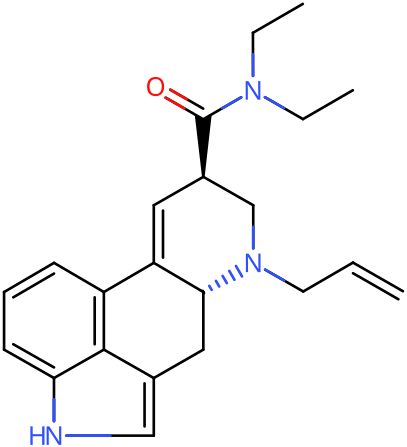
AL-LAD Stats & Data
C=CCN1CC(C=C2C1Cc1cnc3cccc2c13)C(=O)N(CC)CCJCQLEPDZFXGHHQ-QRIPLOBPSA-NReceptor Profile
Receptor Actions
History & Culture
AL-LAD was first synthesized and described in the scientific literature in 1976. The compound received further attention in 1984 when researchers Andrew J. Hoffman and David Nichols investigated it as part of a broader series of LSD analogues, which also included ETH-LAD and PRO-LAD. This academic interest culminated in 1997 when Alexander Shulgin documented the substance in his landmark book TiHKAL (Tryptamines I Have Known And Loved), providing a dose range of 80-160 µg and a duration of 6-8 hours. Shulgin characterized AL-LAD as "one of the several very potent compounds in a large series of nor-LSD analogues." Despite this early academic documentation, AL-LAD saw little to no recreational use until 2013, when it emerged on the online research chemical market. The compound quickly gained traction as a grey-market alternative to LSD, commonly marketed alongside other novel lysergamides such as 1P-LSD, ALD-52, and ETH-LAD. By 2015, the European Monitoring Centre for Drugs and Drug Addiction (EMCDDA) reported its presence in the European drug market for the first time, marking its transition from an obscure research compound to a recognized designer drug. The substance is sometimes referred to by the street name "Aladdin."
Subjective Effects
Physical
- Spontaneous tactile sensations: The 'body high' of AL-LAD can be described as proportionally intense in comparison to its accompanying visual and cognitive effects. It behaves as a euphoric, fast moving, sharp and location specific tingling sensation. For some it is manifested spontaneously at different unpredictable points throughout the trip, but for most it maintains a steady presence that rises with the onset and hits its limit once the peak has been reached. At moderate to high doses of AL-LAD, this sensation will usually hit its highest level and become so overwhelming that people find themselves writhing on the floor in complete pleasure.
- Stimulation: In terms of its effects on the physical energy levels of the tripper, AL-LAD is usually considered to be very energetic and stimulating without being forced. For example, when taken in any environment it will usually encourage physical activities such as running, walking, climbing or dancing.
- Nausea: Mild nausea is occasionally reported when consumed in moderate to high dosages and either passes instantly once the tripper has vomited or gradually fades by itself as the peak sets in.
- Enhancement of touch: Feelings of enhanced tactile sensation are consistently present at moderate levels throughout most AL-LAD trips. Once level 8A geometry is reached, an intense sensation of suddenly becoming aware of and being able to feel every single nerve ending across a person's entire body all at once is consistently present.
- Increased bodily control
Cognitive
In comparison to other psychedelics such as Psilocin, LSA and Ayahuasca, AL-LAD is significantly more stimulating and fast paced in terms of the specific style of thought stream which it produces and contains a large number of potential effects.
- Enhancement of current mind state
- Acceleration of thought
- Feelings of fascination, importance and awe
- Time distortion
- Introspection
- Déjà vu
- Multiple thought streams
- Removal of cultural filter
- Conceptual thinking
- Ego suppression, loss and death
- Thought loops
- Feelings of interdependent opposites
- Delusions
- States of unity and interconnectedness
Sensory
- Enhancements
- Distortions
- Hallucinations
- Visual drifting: (Melting, Breathing, Morphing and Flowing) - In comparison to other psychedelics, this effect can be described as highly detailed yet cartoon-like in appearance. The distortions are slow and smooth in motion and fleeting in their appearance.
- Tracers
- After images
- Depth Perception Distortions
- Symmetrical texture repetition
- Colour shifting
- Scenery slicing
- Increased visual acuity
- Enhancement of colour
- Enhanced pattern recognition
AL-LAD is capable of producing a full range of low and high level hallucinatory states in a fashion that is significantly less consistent and reproducible than that of many other commonly used psychedelics.
- Transformations
- Internal hallucinations: Although AL-LAD is technically capable of producing hallucinatory states in a fashion that is on par with psilocin or DMT in its vividness and intensity, these effects are extremely rare and inconsistent in comparison. Whilst traditional psychedelics such as LSA, Ayahuasca and Mescaline will induce internal hallucinations near consistently at level 5 geometry and above, AL-LAD will for most simply go straight into Level 8A visual geometry. On the rare occasion that they are induced however, they can be comprehensively described as lucid in believability, interactive in style, new experiences in content, autonomous in controllability and geometry-based in appearance.
Forked from Subjective Effect Documentation by Josie Kins, July 2014. Via dose.wiki (CC0).
Toxicity
PsychonautWikiThe toxicity and long-term health effects of recreational AL-LAD use do not seem to have been studied in any scientific context and the exact toxic dose is unknown. This is because AL-LAD is a research chemical with very little history of human usage. The body of anecdotal reports suggests that there are no negative health effects attributed to simply trying the substance by itself at low to moderate doses and using it very sparingly (but nothing can be completely guaranteed). Independent research should always be done to ensure that a combination of two or more substances is safe before consumption. As with other psychedelic substances, there are relatively few physical side effects that have been reported associated with acute AL-LAD exposure.
Overdose
The LD50 of AL-LAD is unknown. Adverse psychological reactions are common especially at higher dosages. Some of these include anxiety, delusions, panic attacks and more rarely seizures.
Effect Profile
Curated + 61 ReportsStrong visuals, headspace, and auditory effects with strong body load
Community Effects
TripSitTolerance & Pharmacokinetics
drugs.wikiTolerance Decay
Rapid tolerance accrues after a single experience, similar to LSD. Cross-tolerance across serotonergic lysergamides is partial; spacing experiences by 2+ weeks reduces tolerance-related dose escalation. Data are inferred from LSD literature plus user reports for AL-LAD.
Cross-Tolerances
Demographics
Gender Distribution
Age Distribution
Reports Over Time
Effect Analysis
Erowid + BluelightEffects aggregated from 61 experience reports (36 single-substance Erowid + 25 Bluelight)
Effect Sentiment Distribution
Confidence Distribution
Each bar is the share of reports mentioning the effect; its whisker, and the band on the rows below, is the 95% interval: where the share could plausibly be with other reports of the same kind.
Positive Effects 63
Adverse Effects 34
Show 14 more adverse effects
Show 25 neutral or unclassified mentions
Also reported in combinations. In the 39 AL-LAD reports where another drug was taken too, 2 (5.1%) mention hospital, emergency services or an overdose, 1 (2.6%) a seizure and 0 (0.0%) psychosis. In the 36 single-substance reports: 11.1%, 2.8% and 11.1%. These are not in the figures above: they cannot be put down to AL-LAD alone, and a mention is not always something that happened to the writer.
Dose-Response Correlation
How effect frequency changes across dose levels. Whiskers, and the numbers' hover text, give each figure's 95% interval.
Not drawn, too few reports (a dose tier needs 20): Oral Heavy (n=13). Why 20?
Dosage Distribution
Dose distribution from experience reports, one dose per report (the first listed). Doses above Q3 + 3×IQR, far above what people typically take, are left out of the median and range and listed under each route: most are real heavy doses or overdoses, not mistakes.
Oral
2 reports gave a dose above the typical range (2,200–5,000 µg), so they are not in the figures above. 2 of them mention hospital, emergency services or an overdose. Listing a dose here does not mean it is safe.
Sublingual
1 dose more than 50 times the median may be a typing or unit error and is not in the figures either: check the report.
Real-World Dose Distribution
ErowidFrom 61 of 73 recorded dose entries: those that state a weight (mg, g or µg), in routes with at least five of them. Values above Q3 + 3×IQR, far above what people typically take, are left out; they can include real heavy doses and overdoses, not only mistakes.
Oral (n=36)
Sublingual (n=21)
Common Combinations
Most co-occurring substances, as a share of all 75 reports filed under AL-LAD; whiskers are 95% intervals
Form / Preparation
Most common forms and preparations, as a share of the 57 reports that give one; whiskers are 95% intervals
Body-Weight Dosing
Dose per kg of body weight, one dose per report (the first listed), from reports giving a weight of 30–250 kg. Doses above Q3 + 3×IQR, far above what people typically take, are left out of the median and range and listed under each route.
Oral
2 reports gave a dose above the typical range (0.027–0.088 mg/kg), so they are not in the figures above. 2 of them mention hospital, emergency services or an overdose. Listing a dose here does not mean it is safe.
Show the reports
- 0.088 mg/kg · mentions hospital, emergency services or an overdose
- 0.027 mg/kg · mentions hospital, emergency services or an overdose
Unknown
Sublingual
Redose Patterns
Redosing behavior across 60 reports
Legal Status
| Country | Status | Notes |
|---|---|---|
| Austria | Unscheduled (potentially controlled as analogue) | Not specifically scheduled, but may fall under the Neue-Psychoaktive-Substanzen-Gesetz (NPSG) as a structural analogue of LSD. |
| Denmark | Illegal | Specifically named on the list of controlled substances as of August 25, 2015. |
| Finland | Banned | Listed in a government decree banning psychoactive substances from the consumer market. |
| France | Illegal | Prohibited under national drug control legislation. |
| Germany | NpSG controlled | Controlled under the Neue-psychoaktive-Stoffe-Gesetz (New Psychoactive Substances Act) since July 18, 2019. Production, import for market distribution, administration to others, and trading are punishable offenses. Possession is technically illegal but not subject to criminal penalty. |
| Japan | Controlled substance | Designated as a controlled substance effective February 28, 2020. |
| Latvia | Controlled (as analogue) | Although not officially scheduled by name, controlled as an LSD structural analogue under an amendment enacted June 1, 2015. |
| Sweden | Schedule I (Narcotic) | Added to the Narcotic Drugs Punishments Act under Schedule I (substances without accepted medical use) on January 26, 2016. Listed in Medical Products Agency regulation HSLF-FS 2015:35 under multiple names including 6-allyl-6-nor-LSD. |
| Switzerland | Illegal (Verzeichnis E) | Specifically named as a controlled substance under Verzeichnis E, effective December 1, 2015, as part of a broader scheduling of 21 novel psychoactive substances. |
| Turkey | Illegal | Prohibited under national drug control legislation as of February 2016. |
| United Kingdom | Class A | Specifically named in the Misuse of Drugs Act 1971 as a Class A controlled substance. The UK Advisory Council on the Misuse of Drugs recommended scheduling on June 10, 2014, notably without identifying any harm associated with its use. The ban was enacted January 6, 2015 via The Misuse of Drugs Act 1971 (Amendment) (No. 2) Order 2014. |
| United States | Unscheduled (Analogue Act applies) | Not specifically scheduled at the federal level. However, as a structural analogue of the Schedule I substance LSD, it may be prosecuted under the Federal Analogue Act when sold, possessed, or consumed for human consumption. Research and analytical use are not subject to prosecution under this framework. |
Harm Reduction
drugs.wikiAL-LAD is a lysergamide closely related to LSD, first synthesized in the 1970s and popularized as a research chemical in the 2010s. It is reported to produce a psychedelic experience similar to LSD but often described as more visually oriented, with a lighter, more euphoric, and less anxious character. It is usually sold on blotter paper and is active at microgram doses. There is little evidence of physical toxicity or long-term organ harm, but psychological risks (such as anxiety, panic, or precipitating mania/psychosis in vulnerable individuals) are possible, especially at high doses or in unsuitable settings. For drug checking, indole-positive reagents (Ehrlich) typically turn purple with lysergamides, and fresh LSD-family blotters fluoresce under UV; however, adulteration (e.g., adding tryptamine to mimic Ehrlich purple) can confound results—use multiple tests or a lab where possible. Avoid redosing for at least 3 hours; blotters vary in potency and occasionally contain unexpected substances with delayed onset. Store blotters cool, dark, and dry; UV light and heat accelerate degradation. Microgram potency makes precise measurement difficult—if handling liquid or powder, use volumetric dosing and label solutions clearly. AL-LAD is illegal in some jurisdictions.
References
Data Sources
Cited References
- Brandt et al. 2017: Return of the lysergamides Part II (DOI)
- Drug Users Bible: AL-LAD
- Hoffman & Nichols 1985: Synthesis and LSD-like discriminative stimulus properties (DOI)
- IsomerDesign: AL-LAD
- Shulgin: TiHKAL Entry #1 (AL-LAD)
- TripSit: Drug Combination Chart
- TripSit Factsheet: AL-LAD
- The Story of AL-LAD (TripSit)
Additional references
- TIHKAL #1 AL-LAD (dose, duration, qualitative)
- TripSit Wiki: AL-LAD (dose/duration summary, reagent)
- Isomer Design: AL-LAD synonyms/identifiers
- Erowid Crew Blog: On-site drug checking; Ehrlich and NBOMe vs lysergamides; UV fluorescence guidance
- Erowid Crew Blog: Tryptamine turns purple with Ehrlich (adulteration caution)
- Erowid: LSD glows under UV; UV light degrades LSD
- Erowid: LSD Dosage (blotter variability; practical cautions)
- Saferparty.ch warning: high-dose LSD blotter and guidance on test dosing/waiting
- Saferparty.ch guidance: potency varies; wait up to 3 hours before re-dose due to unexpected substances
- Erowid: LSD Interactions (lithium/tricyclics danger; SSRI/MAOI notes)
- Bluelight: Lithium and LSD seizure reports (community evidence)
- DrugUsersBible: AL-LAD overview/dose cross-check
- DrugBank: LSD half-life ~3 h (pharmacokinetic reference)
- DrugBank article: Human plasma PK after 1 µg/kg LSD; t1/2 ~5.1 h
- Erowid: EcstasyData ‘Analytical glimpses’ noting AL-LAD blotter ID in 2013
- Effect Index: Psychedelic cognitive/affective effect taxonomy (for subjective effects)
- Effect Index: Emotion intensification report linkage incl. AL-LAD
- Erowid: Liquid measurement technique (volumetric dosing)