
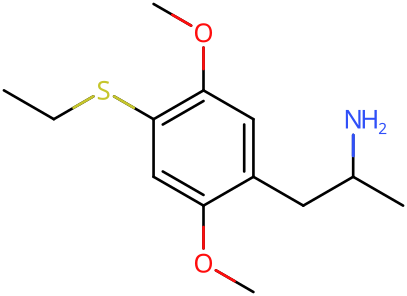
ALEPH-2 Stats & Data
MCYCODJKXUJSAT-UHFFFAOYSA-NPharmacology
DrugBankDescription
2,5-Dimethoxy-4-ethylthioamphetamine (ALEPH-2) is a phenylisopropylamine derivative with alleged anxiolytic and hallucinogenic properties.
Receptor Profile
Receptor Actions
History & Culture
ALEPH-2 was first introduced to the scientific literature by Alexander Shulgin in 1978 as part of his systematic exploration of phenethylamine derivatives. The compound belongs to the Aleph series, a family of sulfur-substituted psychedelic amphetamines that Shulgin developed and characterized. A more comprehensive account of ALEPH-2's synthesis, dosage, duration, and qualitative effects appeared in Shulgin's 1991 book PiHKAL (Phenethylamines I Have Known and Loved), where it was catalogued as entry #4. Despite this documentation, ALEPH-2 has remained an exceptionally rare compound with very limited human use reported in the decades since its initial characterization.
Effect Profile
CuratedModerate visuals with mild auditory effects and body load, low headspace
Mild focus with moderate anxiety/jitters, low stimulation and euphoria
Tolerance & Pharmacokinetics
drugs.wikiTolerance Decay
As with classical psychedelics, acute tolerance appears after a single robust session and decays over about 1–2 weeks. Exact kinetics for ALEPH‑2 are not characterized; values extrapolated from broader psychedelic literature and user reports. Data quality: anecdotal.
Cross-Tolerances
Experience Report Analysis
ErowidDemographics
Gender Distribution
Too few reports for a chart: gender is known from 1 report, and a split is drawn only from 20 reports or more. Counts are shown instead. Why 20?
- Male 1 of 1
Reports Over Time
Legal Status
| Country | Status | Notes |
|---|---|---|
| United States | Unscheduled | Not classified as a controlled substance at the federal level as of 2011. As an unscheduled compound, possession is not specifically prohibited under the Controlled Substances Act. However, as a structural analogue of controlled phenethylamines, the Federal Analogue Act may potentially apply if the substance is sold or possessed with intent for human consumption. |
Harm Reduction
drugs.wikiIdentity and mislabeling: ALEPH‑2 is extremely rare in circulation. Confirm identity with multi‑reagent testing and, ideally, laboratory drug checking (FTIR/GC‑MS) before ingesting; mis-sold DOx/NBOMe/2C‑x has been documented in the wild. Shulgin lists oral activity at approximately 4–8 mg with 8–16 h duration; due to steep, idiosyncratic dose–response, first assays should be conservative (≤2–3 mg) and no redosing for at least 3 h to avoid stacked overduration and overstimulation. Thio‑substituted phenethylamines (e.g., 2C‑T‑2/‑7) have a track record of unpredictable toxicity and wide interindividual sensitivity; avoid insufflation or parenteral routes because of local irritation and greater unpredictability. Cardiovascular load (tachycardia, vasoconstriction, BP elevation) and mydriasis/bruxism are common; those with cardiovascular, seizure, or significant psychiatric histories should avoid or use only with medical clearance. Potential weak reversible MAO‑A inhibition has been reported in vitro for para‑alkylthio amphetamines; combinations with MAOIs or potent serotonergics (e.g., MDMA, high‑dose tryptamines) increase the risk of hypertensive or serotonergic crises. Onset can be slow and deceptive; early redoses frequently overextend duration and intensity. Plan set/setting and recovery (quiet environment, light nutrition, electrolytes, and sleep hygiene) and anticipate insomnia late in the course; do not use alcohol to force sleep. If severe agitation, hyperthermia, chest pain, or continuous vomiting occur, seek urgent medical care and avoid taking additional substances to self‑treat. Because US mail‑in lab testing via DrugsData is on administrative pause (as of April 2025), consider local in‑person services listed via drugchecking community resources.
References
Data Sources
Cited References
- Acuna-Castillo et al., 2000 - ALEPH-2 is a 5-HT2A partial and 5-HT2C full agonist
- Acuna-Castillo et al., 2002 - Potency and efficacy at 5-HT2A/2C receptors
- Bluelight: ALEPH-2 discussion thread
- Bluelight: ALEPH-2 4.2mg trip report
- Bluelight: The Big and Dandy DOT/ALEPH-1 Thread
- DrugBank: 2,5-Dimethoxy-4-ethylthioamphetamine
- Erowid ALEPH-2 Experience: The Continuum Hypothesis
- Erowid: Online Books - PiHKAL #4 ALEPH-2
- PiHKAL #4 ALEPH-2 (isomerdesign mirror)
- PiHKAL.info - ALEPH-2 Chemical Data
- PubChem: 2,5-Dimethoxy-4-ethylthioamphetamine
- Reyes-Parada et al., 2019 - Review of amphetamine derivatives as MAO inhibitors
- Scorza et al., 1996 - Behavioral effects of ALEPH-2 in rodents
- Scorza et al., 1997 - Monoamine oxidase inhibitory properties of para-substituted amphetamines
- Acuna-Castillo et al., 2002 - Potency and efficacy at 5-HT2A/2C across PIAs (BJP)
- Bluelight: community caution on sulfur-substituted phenethylamines (DOT/ALEPH thread)
- PiHKAL Mirror: Pihkal
Additional references
- PiHKAL #4 ALEPH‑2 (public‑domain transcription)
- Isomer Design ALEPH‑2 metadata and cross‑refs
- Acuña‑Castillo et al., 2000 — ALEPH‑2 is a 5‑HT2A partial and 5‑HT2C full agonist (PubMed 11191631)
- Scorza et al., 1997 — Para‑substituted amphetamines can be reversible MAO‑A inhibitors (in vitro/in vivo) (PubMed 9393679)
- DrugBank DB13940 — 2,5‑Dimethoxy‑4‑ethylthioamphetamine drug card
- TripSit Drug Combinations — categories incl. MAOIs×DOx/amphetamines/MDMA flagged dangerous
- Bluelight DOT/Aleph thread — community cautions incl. MAO inhibition concern (anecdotal)
- Hi‑Ground harm‑reduction materials — reagent/DRC testing guidance and stimulant cautions
- Drug Checking Community — examples of local lab checking services (Toronto report)
- Erowid 2C‑T‑7 Vault — warnings about sulfur‑substituted phenethylamines, variability, insufflation harms