
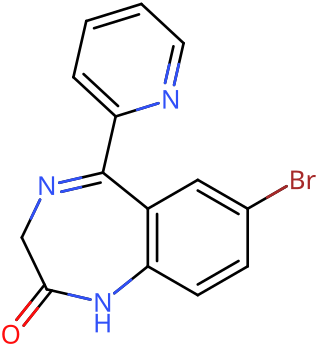
Bromazepam Stats & Data
VMIYHDSEFNYJSL-UHFFFAOYSA-NPharmacology
DrugBankDescription
One of the benzodiazepines that is used in the treatment of anxiety disorders. It is a Schedule IV drug in the U.S. and Canada and under the Convention on Psychotropic Substances. It is a intermediate-acting benzodiazepine.
Mechanism of Action
Bromazepam binds to the GABA-A receptor producing a conformational change and potentiating its inhibitory effects. Other neurotransmitters are not influenced.
Pharmacodynamics
Bromazepam is a lipophilic, long-acting benzodiazepine and with sedative, hypnotic, anxiolytic and skeletal muscle relaxant properties. It does not possess any antidepressant qualities. Bromazepam, like other benzodiazepines, presents a risk of abuse, misuse, and dependence. According to many psychiatric experts, Bromazepam has a greater abuse potential than other benzodiazepines because of fast resorption and rapid onset of action.
Metabolism
Hepatically, via oxidative pathways (via an enzyme belonging to the Cytochrome P450 family of enzymes). One of the main metabolites is 3-hydroxybromazepam. It is pharmacologically active and the half life is similar to that of the parent compound.
Absorption
Bioavailability is 84% following oral administration. The time to peak plasma level is 1 - 4 hours. Bromazepam is generally well absorbed after oral administration.
Indication
For the short-term treatment of insomnia, short-term treatment of anxiety or panic attacks, if a benzodiazepine is required, and the alleviation of the symptoms of alcohol- and opiate-withdrawal.
Elimination
Urine (69%), as metabolites
Receptor Profile
Receptor Actions
History & Culture
Bromazepam was developed by the Swiss pharmaceutical company Roche, receiving its patent in 1961. The compound was subsequently approved for medical use in 1974, entering the pharmaceutical market as an intermediate-acting anxiolytic medication. Like other benzodiazepines, bromazepam carries recognized concerns regarding misuse and diversion. Research conducted in France examining motor vehicle accidents involving psychotropic substances found that benzodiazepines—particularly diazepam, nordiazepam, and bromazepam—were among the most frequently detected drugs in drivers' blood when combined with alcohol. The substance has also been documented in connection with serious criminal activities, including cases of robbery, homicide, and sexual assault.
Bromazepam has a low toxicity relative to dose. However, it is potentially lethal when mixed with depressants like alcohol or opioids. It is strongly recommended that one use harm reduction practices.
Carcinogenicity
No indication of carcinogenicity to humans (not listed by IARC).
Effect Profile
Curated + 18 ReportsStrong anxiolysis with strong cognitive impairment, moderate euphoria, mild sedation
Tolerance & Pharmacokinetics
drugs.wikiNo tolerance chart. Our decay curves for these drugs were estimates, and a curve can make tolerance look longer-lasting than it is, which is the dangerous direction.
How fast tolerance to these drugs fades after a break has not been measured well enough to draw, so don't count on a dose you used to take still being safe: after time off, start with a much smaller amount and don't use alone. Mixing sedatives with each other, with alcohol or with opioids sharply raises the risk of a fatal overdose. If you've been using regularly, don't stop suddenly: withdrawal from benzodiazepines, alcohol or GHB/GBL can cause seizures or delirium, so get medical help to cut down gradually.
Sources: FRANK: benzodiazepines · Alcohol and Drug Foundation: GHB · FDA 2020: benzodiazepine boxed warning · FDA 2019: gabapentinoids and breathing · NHS: alcohol use disorder
Cross-Tolerances
Experience Report Analysis
ErowidDemographics
Gender Distribution
Age Distribution
Reports Over Time
Effect Analysis
ErowidEffects aggregated from 18 experience reports (18 single-substance Erowid)
Effect Sentiment Distribution
Confidence Distribution
Each bar is the share of reports mentioning the effect; its whisker, and the band on the rows below, is the 95% interval: where the share could plausibly be with other reports of the same kind.
Too few reports for bars: these effects come from 18 single-substance Erowid reports, and a bar is drawn only from 20 reports or more. With fewer, a percentage cannot tell a common effect from a rare one. Counts are shown instead. Why 20?
Positive Effects 3
Adverse Effects 1
Also reported in combinations. In the 7 Bromazepam reports where another drug was taken too, 0 mention hospital, emergency services or an overdose, 0 a seizure and 1 psychosis (too few reports for percentages). In the 18 single-substance reports: 1, 0 and 0. These are not in the figures above: they cannot be put down to Bromazepam alone, and a mention is not always something that happened to the writer.
Dosage Distribution
Dose distribution from experience reports, one dose per report (the first listed). Doses above Q3 + 3×IQR, far above what people typically take, are left out of the median and range and listed under each route: most are real heavy doses or overdoses, not mistakes.
Real-World Dose Distribution
ErowidFrom 23 of 25 recorded dose entries: those that state a weight (mg, g or µg), in routes with at least five of them. Values above Q3 + 3×IQR, far above what people typically take, are left out; they can include real heavy doses and overdoses, not only mistakes.
Oral (n=23)
Common Combinations
Most co-occurring substances, as a share of all 25 reports filed under Bromazepam; whiskers are 95% intervals
Form / Preparation
Most common forms and preparations, as a share of the 19 reports that give one
Too few reports for bars: these forms come from 19 reports, and a bar is drawn only from 20 reports or more. With fewer, a percentage cannot tell a common effect from a rare one. Counts are shown instead. Why 20?
- Pill / Tablet 19 of 19
Body-Weight Dosing
Dose per kg of body weight, one dose per report (the first listed), from reports giving a weight of 30–250 kg. Doses above Q3 + 3×IQR, far above what people typically take, are left out of the median and range and listed under each route.
1 report gave a dose above the typical range (0.706 mg/kg), so it is not in the figures above. Listing a dose here does not mean it is safe.
Show the report
- 0.706 mg/kg · another drug taken too
Redose Patterns
Redosing behavior across 21 reports
Benzodiazepine Equivalence
Bromazepam - 5-6mg's ~=10mg Diazepam.
Legal Status
| Country | Status | Notes |
|---|---|---|
| Canada | Schedule IV CDSA | Controlled under the Controlled Drugs and Substances Act. All benzodiazepines, including bromazepam, are regulated as Schedule IV substances requiring a prescription. |
| Czech Republic | Prescription only | Regulated as a prescription medication. Available only through licensed pharmacies with valid medical authorization. |
| Germany | Prescription only | Available by prescription only. Marketed under brand names including Bromazanil (Hexal). Not classified under Anlage listings of the Betäubungsmittelgesetz but regulated as a prescription-only medication. |
| Netherlands | List II (Opiumwet) | Scheduled on List II of the Opium Law. Preparation, possession, delivery, providing, and transport without authorization are prohibited. However, possession of small quantities for personal use is typically not prosecuted, and recreational use itself is not prohibited under Dutch law. |
| United States | Schedule IV | Controlled under the Controlled Substances Act as a Schedule IV depressant. Illegal to sell without a license and illegal to possess without a valid license or prescription. |
Harm Reduction
drugs.wikiBromazepam is a prescription benzodiazepine anxiolytic that positively modulates GABA-A receptors; it has an oral Tmax of about 1–4 hours and an elimination half-life around 10–20 hours, with an active metabolite (3-hydroxybromazepam). Using it with other CNS depressants (notably alcohol, opioids, GHB/GBL) markedly increases risk of profound sedation and respiratory depression; this combination is overrepresented in overdose data and should be avoided. Co-use with gabapentinoids or Z‑drugs adds sedation and psychomotor impairment; avoid or minimize doses and separate timing if medically unavoidable. Benzodiazepines impair driving and operating machinery; next‑day impairment can persist even when you ‘feel fine’, especially after night dosing or higher doses—do not drive within at least 8–12 hours of a strong dose. Older adults are more sensitive and have slower clearance, increasing falls, fractures, and confusion; doses should be lower and durations shorter. Dependence can develop with weeks of regular use; never stop suddenly after repeated use—taper gradually under medical supervision to avoid severe withdrawal, including seizures. Flumazenil can precipitate acute withdrawal and seizures in dependent or mixed‑overdose settings; its use requires specialist oversight. Avoid in severe respiratory disease, significant hepatic impairment, sleep apnea, or a history of substance use disorder unless closely supervised. In pregnancy or breastfeeding, benzodiazepines are generally avoided unless necessary; if dependent during pregnancy, guidelines favor gradual dose reduction using long‑acting benzodiazepines under specialist care rather than abrupt cessation. Illicit markets in Europe and elsewhere have widespread counterfeit benzodiazepine tablets containing potent ‘designer’ benzos or even synthetic opioids; only use medicine from a verified prescription supply to reduce poisoning risk. Anterograde amnesia, disinhibition, and paradoxical agitation can occur; take initial test doses in a safe setting and avoid decisions, conflict, or public settings while affected.
References
Data Sources
Cited References
Additional references
- DrugBank: Bromazepam (DB01558) – identification, Tmax, half‑life, metabolism, brands, interactions note (avoid alcohol)
- TripSit: Drug Combination Chart (benzos + alcohol/opioids/GHB flagged as dangerous)
- NCBI Bookshelf: Veterans, Prescription Opioids and Benzodiazepines, and Mortality (co‑prescribing associated with higher all‑cause mortality)
- AHRQ/NCBI: Opioid Treatments for Chronic Pain – harms of co‑prescribing (BZDs + opioids; gabapentinoids + opioids raise overdose risk)
- StatPearls/NCBI: Benzodiazepine Toxicity – mechanism, impairment, flumazenil cautions in dependence/overdose
- StatPearls/NCBI: Sodium Oxybate – concomitant CNS depressants (incl. benzodiazepines) can cause profound CNS/respiratory depression
- NCBI Bookshelf: Medications for Opioid Use Disorder – caution patients about overdose risk when benzodiazepines or alcohol are used concurrently with opioids
- NCBI Bookshelf: Discontinuation strategies for long‑term benzodiazepine use – dependence, withdrawal, need for supervised taper
- EUDA/EMCDDA: Designer benzodiazepines increasingly used to make counterfeit ‘Valium®/Xanax®’ tablets; severe poisoning risk, especially with other depressants
- EUDA Drug Market: New benzodiazepines often found in fake medicines; rising poisonings and deaths (polydrug context)