
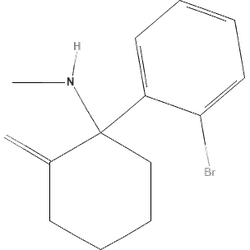
Bromoketamine Stats & Data
XPMMBFIMXKSQIQ-UHFFFAOYSA-NEffect Profile
CuratedStrong dissociative depth with strong motor impairment, mild mania, low insight
Tolerance & Pharmacokinetics
drugs.wikiTolerance Decay
Model is an approximation inferred from dissociative user patterns; tolerance builds quickly with day‑over‑day use and wanes over 1–3+ weeks. Avoid multi‑day binges to reduce urinary risk.
Cross-Tolerances
Harm Reduction
drugs.wiki• Market variability: products sold as “BDCK/bromoketamine” show inconsistent potency and may be adulterated or misidentified; rely on multi‑reagent testing plus lab checking when available; a Morris reagent alone cannot distinguish ketamine analogues and can be misleading.
• Intranasal causticity: many users report notable burn, congestion, and colored discharge with BDCK, suggesting greater nasal irritation than ketamine; use small lines, avoid repeated back‑to‑back bumps, and rinse with sterile saline after sessions.
• Very short plateau → redose pressure: BDCK’s compact peak often drives frequent redosing; set hard limits before starting and space doses by at least 60–120 min to reduce cumulative ataxia and accident risk.
• Bladder/biliary risk (inference from ketamine): chronic ketamine is linked to ulcerative cystitis and occasionally biliary tract injury; BDCK’s structural similarity justifies assuming comparable urological risk until proven otherwise. Hydrate, cap frequency (e.g., reserve to occasional sessions), and stop immediately if urinary urgency, pain, or hematuria emerge; seek medical evaluation.
• IM route harm reduction: avoid injecting non‑sterile powders. If choosing IM despite risks, dissolve in sterile water for injection, pass through a new 0.22 µm sterile filter into a sterile vial/syringe, clean skin, rotate sites, and never share equipment. Discard solutions promptly; if storing short‑term, use bacteriostatic water and maintain sterility.
• Set & setting and safety: dissociatives impair coordination and situational awareness; use in a hazard‑free environment, avoid driving or water/baths, and consider a sober sitter for strong doses.
• Respiratory aspiration risk with co‑depressants: mixing with alcohol/GHB/opioids markedly increases unconsciousness and vomiting risks; place any unconscious person in the recovery position and call emergency services if breathing is slow/irregular.
• Tolerance and spacing: dissociative tolerance builds rapidly and decays over 1–3+ weeks; spacing sessions reduces both dose escalation and urologic risk.
• Potency rough‑cut: BDCK is commonly described as ~0.5–0.7× racemic ketamine by weight intranasally, with a shorter, ‘floaty/warm’ effect profile and less profound dissociation at similar mg doses; variability is high across batches.
• Testing and identification: where available, use professional drug checking (GC‑MS/LC‑MS). Self‑testing has detection limits and may miss low‑level adulterants; interpret negative/ambiguous reagent results cautiously.
References
Cited references
- Isomer Design (Isomer Design): Bromoketamine identity and synonyms
- TripSit Drug Combinations: ketamine + CNS depressants (dangerous), benzodiazepines (caution), stimulants (caution)
- TripSit: Reducing Pain Caused by Insufflation (saline irrigation guidance)
- Erowid: Ketamine and Lower Urinary Tract Symptoms (KLUTS)
- LiverTox (NCBI Bookshelf): Ketamine—urinary and biliary tract injury with chronic/repeated use
- StatPearls (NCBI Bookshelf): Ketamine Toxicity—complications incl. ketamine‑induced ulcerative cystitis
- Erowid: Ketamine FAQ / Health pages (compulsive use, nasal damage, urinary risk)
- TripSit: Dissociatives—general harm‑reduction and safety
- Reddit r/dissociatives: user reports of short duration, high intranasal burn, large line sizes
- Reddit r/dissociatives: dosing discussions showing compact peak and frequent redosing
- Reddit r/researchchemicals: 2‑BDCK community announcement and basic identifiers
- Bluelight Harm Reduction: Micron filtering FAQ—0.22 μm sterile filtration and sterile practice
- Drugchecking.community (ODCC): Service & technology limitations (detection/quant limits)
- Reddit r/ReagentTesting: Morris reagent can’t uniquely ID ketamine analogues (needs more reagents)