
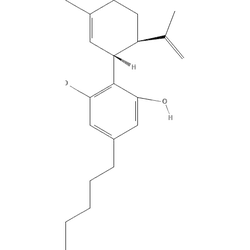
CBD Stats & Data
CCCCCc1cc(O)c(c(O)c1)C1C=C(C)CCC1C(C)=CQHMBSVQNZZTUGM-ZWKOTPCHSA-NPharmacology
DrugBankDescription
Cannabidiol, or CBD, is one of at least 85 active cannabinoids identified within the Cannabis plant. It is a major phytocannabinoid, accounting for up to 40% of the Cannabis plant's extract, that binds to a wide variety of physiological targets of the endocannabinoid system within the body. Although the exact medical implications are currently being investigated, CBD has shown promise as a therapeutic and pharmaceutical drug target. In particular, CBD has shown promise as an analgesic, anticonvulsant, muscle relaxant, anxiolytic, antipsychotic and has shown neuroprotective, anti-inflammatory, and antioxidant activity, among other currently investigated uses . CBD's exact place within medical practice is still currently hotly debated, however as the body of evidence grows and legislation changes to reflect its wide-spread use, public and medical opinion have changed significantly with regards to its usefulness in a number of medical conditions ranging from anxiety to epilepsy. From a pharmacological perspective, Cannabis' (and CBD's) diverse receptor profile explains its potential application for such a wide variety of medical conditions. Cannabis contains more than 400 different chemical compounds, of which 61 are considered cannabinoids, a class of compounds that act upon endogenous cannabinoid receptors of the body .
Mechanism of Action
The exact mechanism of action of CBD and THC is not currently fully understood. However, it is known that CBD acts on cannabinoid (CB) receptors of the endocannabinoid system, which are found in numerous areas of the body, including the peripheral and central nervous systems, including the brain. The endocannabinoid system regulates many physiological responses of the body including pain, memory, appetite, and mood. More specifically, CB1 receptors can be found within the pain pathways of the brain and spinal cord where they may affect CBD-induced analgesia and anxiolysis, and CB2 receptors have an effect on immune cells, where they may affect CBD-induced anti-inflammatory processes. CBD has been shown to act as a negative allosteric modulator of the cannabinoid CB1 receptor, the most abundant G-Protein Coupled Receptor (GPCR) in the body . Allosteric regulation of a receptor is achieved through the modulation of the activity of a receptor on a functionally distinct site from the agonist or antagonist binding site. The negative allosteric modulatory effects of CBD are therapeutically important as direct agonists are limited by their psychomimetic effects while direct antagonists are limited by their depressant effects .
Pharmacodynamics
Although the exact mechanism and magnitude of effects of THC and CBD are not fully understood, CBD has been shown to have analgesic, anticonvulsant, muscle relaxant, anxiolytic, neuroprotective, anti-oxidant, and anti-psychotic activity. This wide variety of effects is likely due to it's complex pharmacological mechanisms. In addition to binding to CB1 and CB2 receptors of the endocannabinoid system, there is evidence that CBD activates 5-HT1A serotonergic and TRPV1–2 vanilloid receptors, antagonizes alpha-1 adrenergic and µ-opioid receptors, inhibits synaptosomal uptake of noradrenaline, dopamine, serotonin and gaminobutyric acid and cellular uptake of anandamide, acts on mitochondria Ca2 stores, blocks low-voltage-activated (T-type) Ca2 channels, stimulates activity of the inhibitory glycine-receptor, and inhibits activity of fatty amide hydrolase (FAAH) .
Metabolism
THC and CBD are metabolized in the liver by a number of cytochrome P450 isoenzymes, including CYP2C9, CYP2C19, CYP2D6 and CYP3A4. They may be stored for as long as four weeks in the fatty tissues from which they are slowly released at sub-therapeutic levels back into the blood stream and metabolized via the renal and biliary systems. The main primary metabolite of CBD is 7-hydroxy-cannabidiol.
Absorption
Following a single buccal administration, maximum plasma concentrations of both CBD and THC typically occur within two to four hours. When administered buccally, blood levels of THC and other cannabinoids are lower compared with inhalation of smoked cannabis. The resultant concentrations in the blood are lower than those obtained by inhaling the same dose because absorption is slower, redistribution into fatty tissues is rapid and additionally some of the THC undergoes hepatic first pass metabolism to 11-OH-THC, a psycho-active metabolite. The CBD component of sublingual Sativex was found to have a Tmax of 1.63hr and a Cmax of 2.50ng/mL, while buccal Sativex was found to have a Tmax of 2.80hr and a Cmax of 3.02ng/mL.
Indication
When used in combination with delta-9-tetrahydrocannabinol as the product Sativex, cannabidiol was given a standard marketing authorization (ie. a Notice of Compliance (NOC)) by Health Canada for the following indications: 1) as adjunctive treatment for symptomatic relief of spasticity in adult patients with multiple sclerosis (MS) who have not responded adequately to other therapy and who demonstrate meaningful improvement during an initial trial of therapy ; Due to the need for confirmatory studies to verify the clinical benefit coupled with the promising nature of the clinical evidence, Sativex was also given a Notice of Compliance with Conditions (NOC/c) by Health Canada for the following indications: 1) as adjunctive treatment for the symptomatic relief of neuropathic pain in adult patients with multiple sclerosis; 2) as adjunctive analgesic treatment in adult patients with advanced cancer who experience moderate to severe pain during the highest tolerated dose of strong opioid therapy for persistent background pain .
Half-life
The CBD component of sublingual Sativex was found to have a half life (t1/2) of 1.44hr, while buccal Sativex was found to have a half life (t1/2) of 1.81hr.
Elimination
Elimination from plasma is bi-exponential with an initial half-life of one to two hours. The terminal elimination half-lives are of the order of 24 to 36 hours or longer. Sativex is excreted in the urine and faeces.
Volume of Distribution
Cannabinoids are distributed throughout the body; they are highly lipid soluble and accumulate in fatty tissue. The release of cannabinoids from fatty tissue is responsible for the prolonged terminal elimination half-life.
Measured Affinities
Guide to PHARMACOLOGYMeasured binding and functional data for cannabidiol, curated by the IUPHAR/BPS Guide to PHARMACOLOGY. Each row cites the paper it came from. Lower concentrations mean tighter binding — a value in the sub-nanomolar range indicates a very potent interaction.
| Target | Action | Measure | Value | Concentration | Species | Source |
|---|---|---|---|---|---|---|
| TRPA1 Trpa1 | Agonist | pEC50 | 6.32 | 478.63 nM | Rat | PMID 32880179 |
| Nav1.4 SCN4A | Channel blocker | pIC50 | 5.72 | 1,905 nM | Human | PMID 30219789 |
| Nav1.8 Scn10a | Channel blocker | pIC50 | 5.7 | 1,995 nM | Mouse | PMID 39835903 |
| TRPM8 Trpm8 | Antagonist | pIC50 | 5.55 | 2,818 nM | Rat | PMID 32880179 |
| Nav1.1 SCN1A | Channel blocker | pIC50 | 5.54 | 2,884 nM | Human | PMID 30219789 |
| Nav1.2 SCN2A | Channel blocker | pIC50 | 5.54 | 2,884 nM | Human | PMID 30219789 |
| Nav1.6 SCN8A | Channel blocker | pIC50 | 5.52 | 3,020 nM | Human | PMID 30219789 |
| Nav1.3 SCN3A | Channel blocker | pIC50 | 5.48 | 3,311 nM | Human | PMID 30219789 |
| TRPV2 Trpv2 | Activation | pEC50 | 5.43 | 3,715 nM | Rat | PMID 18550765 |
| TRPV3 Trpv3 | Activation | pEC50 | 5.43 | 3,715 nM | Rat | PMID 21726418 |
| Nav1.5 SCN5A | Channel blocker | pIC50 | 5.42 | 3,802 nM | Human | PMID 30219789 |
| Nav1.4 SCN4A | Channel blocker | pIC50 | 5 | 10,000 nM | Human | PMID 33836525 |
| Nav1.1 SCN1A | Channel blocker | pIC50 | 4.9 | 12,589 nM | Human | PMID 30219789 |
| TRPV2 TRPV2 | Activation | pEC50 | 4.5 | 31,623 nM | Human | PMID 18550765 |
| GPR18 GPR18 | Partial agonist | pEC50 | 4.29 | 51,286 nM | Human | PMID 21595653 |
| CB1 receptor CNR1 | Negative | - | — | — | Human | PMID 26218440 |
| GPR55 GPR55 | Antagonist | pIC50 | — | — | Human | — |
| Nav1.7 SCN9A | Channel blocker | pIC50 | — | — | Human | — |
Reading this. pKi, pEC50 and pIC50 are negative log molar values, so a higher number means a tighter interaction; the concentration column converts them for you. Values from non-human species are laboratory measurements and do not translate directly to human effect. Receptor affinity is not a dose — it describes what a molecule binds, not how much of it is safe to take.
Receptor data from the IUPHAR/BPS Guide to PHARMACOLOGY (v2026.2), licensed CC BY-SA 4.0. Matched to this substance by InChIKey.
According to clinical studies, cannabidiol is well-tolerated and shows little to no toxicity. In a 2011 literature review, CBD was found to not alter physiological parameters such as heart rate, blood pressure, and body temperature. Moreover, psychological and psychomotor functions are not adversely affected. Chronic use and high doses of up to 1500 mg per day have been repeatedly shown to be well tolerated by humans. As a result, it is considered to have a good safety profile.
Liver injury risk
Ambiguous (limited data)
Addiction & dependence
Cannabidiol is considered to have low abuse potential compared to THC and other recreational substances. Cannabidiol administration does not produce euphoria or other reinforcing effects and there is no evidence that use results in physical or psychological dependence.
Tolerance & Pharmacokinetics
drugs.wikiTolerance Decay
Experience Report Analysis
ErowidDemographics
Gender Distribution
Too few reports for a chart: gender is known from 16 reports, and a split is drawn only from 20 reports or more. Counts are shown instead. Why 20?
- Male 14 of 16
- Female 2 of 16
Age Distribution
Reports Over Time
Effect Analysis
ErowidEffects aggregated from 10 experience reports (10 single-substance Erowid)
Effect Sentiment Distribution
Confidence Distribution
Each bar is the share of reports mentioning the effect; its whisker, and the band on the rows below, is the 95% interval: where the share could plausibly be with other reports of the same kind.
Too few reports for bars: these effects come from 10 single-substance Erowid reports, and a bar is drawn only from 20 reports or more. With fewer, a percentage cannot tell a common effect from a rare one. Counts are shown instead. Why 20?
Positive Effects 2
Adverse Effects 2
Show 1 neutral or unclassified mention
Also reported in combinations. In the 6 CBD reports where another drug was taken too, 0 mention hospital, emergency services or an overdose, 0 a seizure and 2 psychosis (too few reports for percentages). In the 10 single-substance reports: 1, 0 and 0. These are not in the figures above: they cannot be put down to CBD alone, and a mention is not always something that happened to the writer.
Real-World Dose Distribution
ErowidFrom 21 of 28 recorded dose entries: those that state a weight (mg, g or µg), in routes with at least five of them. Values above Q3 + 3×IQR, far above what people typically take, are left out; they can include real heavy doses and overdoses, not only mistakes.
Oral (n=21)
Form / Preparation
Most common forms and preparations, as a share of the 11 reports that give one
Too few reports for bars: these forms come from 11 reports, and a bar is drawn only from 20 reports or more. With fewer, a percentage cannot tell a common effect from a rare one. Counts are shown instead. Why 20?
- Liquid 4 of 11
- Edible / Food 4 of 11
- Extract 3 of 11
Redose Patterns
Redosing behavior across 12 reports
Too few reports for a chart: redosing is known from 12 reports, and a split is drawn only from 20 reports or more. Counts are shown instead. Why 20?
- Single dose 12 of 12
- Redosed 0 of 12