
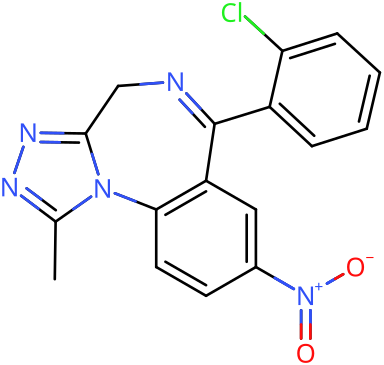
Clonazolam Stats & Data
O=N(=O)c1ccc2n3c(C)nnc3CN=C(c3ccccc3Cl)c2c1XJRGLCAWBRZUFC-UHFFFAOYSA-NInteraction Warnings
This combination can result in an increased risk of vomiting during unconsciousness and death from the resulting suffocation. If this occurs, users should attempt to fall asleep in the recovery position or have a friend move them into it.
It is dangerous to combine benzodiazepines with stimulants due to the risk of excessive intoxication. Stimulants decrease the sedative effect of benzodiazepines, which is the main factor most people consider when determining their level of intoxication. Once the stimulant wears off, the effects of benzodiazepines will be significantly increased, leading to intensified disinhibition as well as other effects.
History & Culture
Clonazolam was first synthesized in 1971 by The Upjohn Company, the pharmaceutical corporation that would later bring alprazolam (Xanax) to market. In the original research, the compound was described as the most active substance in the series of triazolobenzodiazepines tested. Despite this notable potency and coverage by patents, the drug was never developed for clinical use or marketed. The compound remained largely obscure until reports of its use as a research chemical began appearing online around 2013, making it one of the more recently emerged designer benzodiazepines. The European Monitoring Centre for Drugs and Drug Addiction was first notified of clonazolam's presence in the European Union in January 2015, following a report from Sweden. By 2016, detection of novel benzodiazepines had risen markedly across Europe, with over 300,000 tablets containing designer benzodiazepines—including clonazolam, diclazepam, etizolam, and flubromazolam—seized in 2015, nearly double the figure from the previous year. Clonazolam's extreme potency has made it a subject of particular concern within online drug communities. Early forum discussions frequently noted incidents of blackouts and the rapid development of dependence, establishing a reputation that distinguished it from other designer benzodiazepines in circulation. Its microgram-range activity led to distribution methods uncommon for benzodiazepines, with the substance appearing on blotter paper and in volumetrically prepared solutions rather than as raw powder.
Subjective Effects
Physical
The physical effects of clonazolam can be broken down into several components which progressively intensify proportional to dosage.
- Sedation: In terms of energy level alterations, this drug is extremely sedating and often results in an overwhelmingly lethargic state. At higher levels, this causes users to suddenly feel as if they are extremely sleep deprived and have not slept for days, forcing them to sit down and generally feel as if they are constantly on the verge of passing out instead of engaging in physical activities. This sense of sleep deprivation increases proportional to dosage and eventually becomes powerful enough to force a person into complete unconsciousness.
- Respiratory depression
- Dizziness
- Muscle relaxation
- Motor control loss
Cognitive
The cognitive effects of clonazolam can be broken down into several components which progressively intensify proportional to dosage. The general head space of clonazolam is described by many as one of intense sedation and decreased inhibition. It contains a large number of typical depressant cognitive effects. Paradoxical reactions to benzodiazepines such as increased seizures (in epileptics), aggression, increased anxiety, violent behavior, loss of impulse control, irritability and suicidal behavior sometimes occur (although they are rare in the general population, with an incidence rate below 1%). These paradoxical effects occur with greater frequency in recreational abusers, individuals with mental disorders, children, and patients on high-dosage regimes.
- Amnesia
- Anxiety suppression
- Thought deceleration
- Disinhibition
- Information processing suppression
- Euphoria
- Compulsive redosing
- Delusions of sobriety: This is the false belief that one is perfectly sober despite obvious evidence to the contrary such as severe cognitive impairment and an inability to fully communicate with others.
Forked from Subjective Effect Documentation by Josie Kins, September 2015. Via dose.wiki (CC0).
Toxicity
PsychonautWikiClonazolam likely has a low toxicity relative to dose. However, it is potentially lethal when mixed with depressants like alcohol or opioids. It is strongly recommended that one use harm reduction practices, such as volumetric dosing, when using this substance to ensure the accurate administration of the intended dose.
Effect Profile
Curated + 16 ReportsStrong anxiolysis with mild sedation and cognitive impairment, low euphoria
Tolerance & Pharmacokinetics
drugs.wikiNo tolerance chart. Our decay curves for these drugs were estimates, and a curve can make tolerance look longer-lasting than it is, which is the dangerous direction.
How fast tolerance to these drugs fades after a break has not been measured well enough to draw, so don't count on a dose you used to take still being safe: after time off, start with a much smaller amount and don't use alone. Mixing sedatives with each other, with alcohol or with opioids sharply raises the risk of a fatal overdose. If you've been using regularly, don't stop suddenly: withdrawal from benzodiazepines, alcohol or GHB/GBL can cause seizures or delirium, so get medical help to cut down gradually.
Sources: FRANK: benzodiazepines · Alcohol and Drug Foundation: GHB · FDA 2020: benzodiazepine boxed warning · FDA 2019: gabapentinoids and breathing · NHS: alcohol use disorder
Cross-Tolerances
Experience Report Analysis
ErowidDemographics
Gender Distribution
Age Distribution
Reports Over Time
Effect Analysis
ErowidEffects aggregated from 16 experience reports (16 single-substance Erowid)
Effect Sentiment Distribution
Confidence Distribution
Each bar is the share of reports mentioning the effect; its whisker, and the band on the rows below, is the 95% interval: where the share could plausibly be with other reports of the same kind.
Too few reports for bars: these effects come from 16 single-substance Erowid reports, and a bar is drawn only from 20 reports or more. With fewer, a percentage cannot tell a common effect from a rare one. Counts are shown instead. Why 20?
Positive Effects 3
Adverse Effects 3
Show 1 neutral or unclassified mention
Also reported in combinations. In the 12 Clonazolam reports where another drug was taken too, 2 mention hospital, emergency services or an overdose, 0 a seizure and 1 psychosis (too few reports for percentages). In the 16 single-substance reports: 4, 2 and 0. These are not in the figures above: they cannot be put down to Clonazolam alone, and a mention is not always something that happened to the writer.
Dosage Distribution
Dose distribution from experience reports, one dose per report (the first listed). Doses above Q3 + 3×IQR, far above what people typically take, are left out of the median and range and listed under each route: most are real heavy doses or overdoses, not mistakes.
1 report gave a dose above the typical range (5,000 µg), so it is not in the figures above. Listing a dose here does not mean it is safe.
1 dose more than 50 times the median may be a typing or unit error and is not in the figures either: check the report.
Real-World Dose Distribution
ErowidFrom 59 of 63 recorded dose entries: those that state a weight (mg, g or µg), in routes with at least five of them. Values above Q3 + 3×IQR, far above what people typically take, are left out; they can include real heavy doses and overdoses, not only mistakes.
Oral (n=41)
Rectal (n=5)
Sublingual (n=6)
Common Combinations
Most co-occurring substances, as a share of all 28 reports filed under Clonazolam; whiskers are 95% intervals
Form / Preparation
Most common forms and preparations, as a share of the 19 reports that give one
Too few reports for bars: these forms come from 19 reports, and a bar is drawn only from 20 reports or more. With fewer, a percentage cannot tell a common effect from a rare one. Counts are shown instead. Why 20?
- Pill / Tablet 9 of 19
- Liquid 6 of 19
- Powder / Crystals 3 of 19
Body-Weight Dosing
Dose per kg of body weight, one dose per report (the first listed), from reports giving a weight of 30–250 kg. Doses above Q3 + 3×IQR, far above what people typically take, are left out of the median and range and listed under each route.
1 dose more than 50 times the median may be a typing or unit error and is not in the figures either: check the report.
Show the report
Possibly a typing or unit error:
- 0.919 mg/kg · mentions hospital, emergency services or an overdose
Redose Patterns
Redosing behavior across 23 reports
Legal Status
| Country | Status | Notes |
|---|---|---|
| Australia | Schedule 9 | Classified as a Schedule 9 prohibited substance under federal law. Substances in this category are considered to have no recognized therapeutic value and high potential for misuse. |
| Canada | Schedule 4 | Listed under Schedule 4 of the Controlled Drugs and Substances Act, restricting possession and distribution without authorization. |
| Czech Republic | Schedule I (List 4) | Controlled under § 1, d), 2. of Nařízení vlády č. 463/2013 Sb. Use is restricted exclusively to limited research purposes or very limited therapeutic applications. |
| Germany | Anlage II BtMG | Controlled under the Betäubungsmittelgesetz (Narcotics Act) since November 11, 2021. Production and import with intent to distribute, administration to another person, possession, and trading are prohibited. |
| Japan | Controlled | Regulated under the Pharmaceutical Affairs Law. Possession and sale are illegal without authorization. |
| Netherlands | List 2 (Opiumwet) | Controlled as a List 2 substance under the Opium Law. Possession, production, and distribution are illegal. |
| Poland | NPS Class | Classified as a New Psychoactive Substance under Polish drug legislation. Possession and distribution are prohibited. |
| Russia | Schedule III | Listed as a Schedule III controlled substance since 2017. Subject to restrictions on production, distribution, and possession. |
| Sweden | Hazardous Substance | Classified as an addictive substance following a recommendation by Sweden's public health agency on June 1, 2015. Production, import, trading, and possession require special authorization. |
| Switzerland | Verzeichnis E | Specifically named as a controlled substance under Verzeichnis E (List E) of Swiss narcotics legislation. |
| United Kingdom | Class C | Classified as a Class C drug under the May 2017 amendment to the Misuse of Drugs Act 1971, alongside several other designer benzodiazepines. Possession, production, and supply are criminal offenses. |
| United States | Schedule I | Temporarily placed under Schedule I of the Controlled Substances Act effective July 26, 2023, following DEA consideration announced in December 2022. The temporary scheduling has been extended until July 26, 2026. Not FDA approved for human consumption. Several states enacted their own scheduling prior to federal action, including Virginia, Oregon, and Minnesota (since August 2020). |