
DET Stats & Data
[Cl-].CCN(CC)CCc1cnc2ccccc12.[H+]GHDJWZZXXNZUST-UHFFFAOYSA-NPharmacology
DrugBankDescription
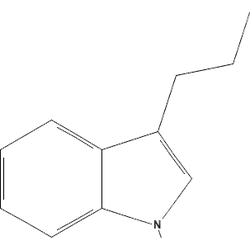
Diethyltryptamine (DET) is an orally active hallucinogenic agent and a substituted form of tryptamine.
Receptor Profile
Receptor Actions
History & Culture
DET was first synthesized in 1956 by Hungarian chemist Stephen Szára, with his findings published the following year. More systematic studies were subsequently conducted by Szára and colleagues, as well as independently by Böszörményi and colleagues. Despite being a close structural analog of DMT, DET has remained extremely uncommon with little history of human use outside of clinical research settings. The substance emerged during a period when researchers were investigating the transmethylation hypothesis—the theory that endogenous production of psychoactive agents might explain hallucinatory symptoms in certain psychiatric conditions. This was the era of "psychotomimesis," when scientists sought drugs that could reliably produce states resembling psychosis, hoping such models might inform treatment approaches for mental illness. It was during this period, in 1956, that Humphry Osmond proposed at a New York Academy of Sciences meeting the term "psychedelic" as a less pejorative alternative to existing terminology such as "psychotomimetic." Clinical studies with DET were conducted in the late 1950s and early 1960s under research conditions now recognized as ethically problematic. One study involved unemployed men from a depressed mining area who received intramuscular injections in a partially soundproofed clinic equipped with one-way mirrors and microphones for observation. Other early research was conducted at the Lexington, Kentucky Public Health Service Hospital—a facility that functioned primarily as a federal prison for drug offenders—using hospitalized patients, individuals with schizophrenia, people with alcohol dependence, and prisoners as research subjects.
Toxicity
PsychonautWikiThe toxicity and long-term health effects of recreational DET has not been studied in any scientific context and the exact toxic dose is unknown. This is because DET is a research chemical with a limited history of human usage. However, it is presumed to have a similar toxicity profile as DMT due to similarities in their chemical structure. Anecdotal reports from those who have tried DET suggests that there are no negative health effects attributed to simply trying the substance by itself at low to moderate doses and using it very sparingly (but nothing can be completely guaranteed). Independent research should always be done to ensure that a combination of two or more substances is safe before consumption.
Effect Profile
Curated + 7 ReportsStrong visuals and headspace with moderate body load
Duration Timeline
BluelightCommunity Effects
TripSitTolerance & Pharmacokinetics
drugs.wikiTolerance Decay
Cross-Tolerances
Experience Report Analysis
ErowidDemographics
Gender Distribution
Too few reports for a chart: gender is known from 13 reports, and a split is drawn only from 20 reports or more. Counts are shown instead. Why 20?
- Male 12 of 13
- Female 1 of 13
Age Distribution
Reports Over Time
Effect Analysis
ErowidEffects aggregated from 7 experience reports (7 single-substance Erowid)
Effect Sentiment Distribution
Confidence Distribution
Each bar is the share of reports mentioning the effect; its whisker, and the band on the rows below, is the 95% interval: where the share could plausibly be with other reports of the same kind.
Too few reports for bars: these effects come from 7 single-substance Erowid reports, and a bar is drawn only from 20 reports or more. With fewer, a percentage cannot tell a common effect from a rare one. Counts are shown instead. Why 20?
Positive Effects 4
Adverse Effects 1
Real-World Dose Distribution
ErowidFrom 14 of 20 recorded dose entries: those that state a weight (mg, g or µg), in routes with at least five of them. Values above Q3 + 3×IQR, far above what people typically take, are left out; they can include real heavy doses and overdoses, not only mistakes.
Smoked (n=6)
Oral (n=8)
Common Combinations
Most co-occurring substances, as a share of all 13 reports filed under DET
Too few reports for bars: these combinations come from 13 reports, and a bar is drawn only from 20 reports or more. With fewer, a percentage cannot tell a common effect from a rare one. Counts are shown instead. Why 20?
- Alcohol 5 of 13
Form / Preparation
Most common forms and preparations, as a share of the 12 reports that give one
Too few reports for bars: these forms come from 12 reports, and a bar is drawn only from 20 reports or more. With fewer, a percentage cannot tell a common effect from a rare one. Counts are shown instead. Why 20?
- Powder / Crystals 6 of 12
- Freebase 3 of 12
- Liquid 2 of 12
Redose Patterns
Redosing behavior across 13 reports
Too few reports for a chart: redosing is known from 13 reports, and a split is drawn only from 20 reports or more. Counts are shown instead. Why 20?
- Single dose 11 of 13
- Redosed 2 of 13
Legal Status
| Country | Status | Notes |
|---|---|---|
| Australia | Schedule 9 | Controlled under the Poisons Standard. Classified as a substance subject to abuse or misuse; manufacture, possession, sale, or use is prohibited except for approved medical or scientific research, analytical, teaching, or training purposes with Commonwealth and/or State or Territory Health Authority approval. |
| Canada | Schedule III (CDSA) | Controlled under the Controlled Drugs and Substances Act. Canadian scheduling differs significantly from the United States system in terms of penalties and associated restrictions. |
| Germany | Anlage I BtMG | Listed in Anlage I of the Betäubungsmittelgesetz (Narcotics Act) since January 24, 1974. Manufacturing, possession, import, export, purchase, sale, procurement, or dispensing without a license is prohibited. |
| Italy | Tabella I | Listed in Tabella I of the Tabelle delle sostanze stupefacenti e psicotrope (Tables of Narcotic and Psychotropic Substances). Possession, purchase, and sale are illegal. |
| New Zealand | Class A | Controlled as a Class A substance, the most restrictive category under New Zealand drug legislation, carrying the most severe penalties. |
| South Africa | Undesirable Dependence Producing Substance | Classified under the Drug and Drug Trafficking Act No. 140 of 1992 as an undesirable dependence-producing substance, subjecting it to criminal penalties for unauthorized possession or distribution. |
| Switzerland | Verzeichnis D | Specifically named as a controlled substance under Verzeichnis D of Swiss narcotics legislation. |
| United Kingdom | Class A / Schedule 1 | Controlled as a Class A, Schedule 1 substance under the Misuse of Drugs Act 1971. Purchasing or possessing without a Home Office license is illegal. |
| United States | Schedule I | Controlled under the Controlled Substances Act as a Schedule I hallucinogen, indicating high abuse potential and no accepted medical use. Manufacturing, buying, possessing, or distributing without a DEA license is a federal offense. |