
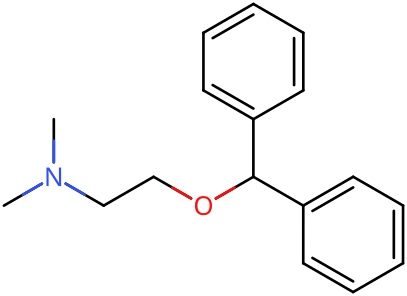
Diphenhydramine Stats & Data
CN(C)CCOC(c1ccccc1)c1ccccc1ZZVUWRFHKOJYTH-UHFFFAOYSA-NPharmacology
DrugBankDescription
Diphenhydramine - perhaps known most commonly as its brand name formulation Benadryl - is a first-generation H1 receptor antihistamine that is used extensively for the treatment of seasonal allergies, insect bites and stings, and rashes . However, it also has antiemetic, antitussive, hypnotic, and antiparkinson properties . As histamine receptors exist both peripherally and in the central nervous system, diphenhydramine has been shown to cause sedation due to its competitive antagonism of histamine H1 receptors within the central nervous system . While its use in allergy therapy can sometimes fall out of favor due to its sedative effect, diphenhydramine has been repurposed for use within many non-prescription over-the-counter sleep aids and cough-and-cold medications that have been marketed for "night time" use . Diphenhydramine is also used in combination with DB14132 as the anti-nausea drug DB00985 where it is utilized primarily for its antagonism of H1 histamine receptors within the vestibular system . Diphenhydramine has also been shown to be implicated in a number of neurotransmitter systems that affect behaviour including dopamine, norepinephrine, serotonin, acetylcholine, and opioid . As a result, diphenhydramine is being investigated for its anxiolytic and anti-depressant properties.
Mechanism of Action
Diphenhydramine predominantly works via the antagonism of H1 (Histamine 1) receptors . Such H1 receptors are located on respiratory smooth muscles, vascular endothelial cells, the gastrointestinal tract (GIT), cardiac tissue, immune cells, the uterus, and the central nervous system (CNS) neurons . When the H1 receptor is stimulated in these tissues it produces a variety of actions including increased vascular permeability, promotion of vasodilation causing flushing, decreased atrioventricular (AV) node conduction time, stimulation of sensory nerves of airways producing coughing, smooth muscle contraction of bronchi and the GIT, and eosinophilic chemotaxis that promotes the allergic immune response . Ultimately, diphenhydramine functions as an inverse agonist at H1 receptors, and subsequently reverses effects of histamine on capillaries, reducing allergic reaction symptoms . Moreover, since diphenhydramine is a first-generation antihistamine, it readily crosses the blood-brain barrier and inversely agonizes the H1 CNS receptors, resulting in drowsiness, and suppressing the medullary cough center . Furthermore, H1 receptors are similar to muscarinic receptors .
Pharmacodynamics
Diphenhydramine has anti-histaminic (H1-receptor), anti-emetic, anti-vertigo and sedative and hypnotic properties . The anti-histamine action occurs by blocking the spasmogenic and congestive effects of histamine by competing with histamine for H1 receptor sites on effector cells, preventing but not reversing responses mediated by histamine alone . Such receptor sites may be found in the gut, uterus, large blood vessels, bronchial muscles, and elsewhere . Anti-emetic action is by inhibition at the medullary chemoreceptor trigger zone . Anti-vertigo action is by a central antimuscarinic effect on the vestibular apparatus and the integrative vomiting center and medullary chemoreceptor trigger zone of the midbrain .
Metabolism
Diphenhydramine undergoes rapid and extensive first-pass metabolism . In particular, two successive N-demethylations occur wherein diphenhydramine is demethylated to N-desmethyldiphenhydramine (the N-desmethyl metabolite) and then this metabolite is itself demethylated to N,N-didesmethyldiphenhydramine (the N,N-didesmethyl metabolite) . Subsequently, acetyl metabolites like N-acetyl-N-desmethyldiphenhydramine are generated via the amine moiety of the N,N-didesmethyl metabolite . Additionally, the N,N-didesmethyl metabolite also undergoes some oxidation to generate the diphenylmethoxyacetic acid metabolite as well . The remaining percentage of a dose of administered diphenhydramine is excreted unchanged . The metabolites are further conjugated with glycine and glutamine and excreted in urine . Moreover, studies have determined that a variety of cytochrome P450 isoenzymes are involved in the N-demethylation that characterizes the primary metabolic pathway of diphenhydramine, including CYP2D6, CYP1A2, CYP2C9, and CYP2C19 . In particular, CYP2D6 demonstrates higher affinity catalysis with the diphenhydramine substrate than the other isoenzymes identified .
Absorption
Diphenhydramine is quickly absorbed after oral administration with maximum activity occurring in approximately one hour . The oral bioavailability of diphenhydramine has been documented in the range of 40% to 60%, and peak plasma concentration occurs about 2 to 3 hours after administration .
Indication
Diphenhydramine is a first-generation histamine H1 receptor antagonist (H1 antihistamine) that is widely available as a non-prescription, over-the-counter (OTC) medication. As an OTC medication, diphenhydramine is typically formulated as tablets and creams indicated for use in treating sneezing, runny nose, itchy/watery eyes, itching of nose or throat, insomnia, pruritis, urticaria, insect bites/stings, allergic rashes, and nausea . Additionally, when the use of oral diphenhydramine is impractical, there are also prescription-only formulations such as diphenhydramine injection products that are effective in adults and pediatric patients (other than premature infants and neonates) for: i) the amelioration of allergic reactions to blood or plasma, in anaphylaxis as an adjunct to epinephrine and other standard measures after acute allergic reaction symptoms have been controlled, and for other uncomplicated allergic conditions of the immediate type when oral therapy is impossible or contraindicated ; ii) the active treatment of motion sickness ; and iii) use in parkinsonism when oral therapy is impossible or contraindicated, as follows: parkinsonism in the elderly who are unable to tolerate more potent agents; mild cases of parkinsonism in other age groups, and in other cases of parkinsonism in combination with centrally acting anticholinergic agents .
Half-life
The elimination half-life ranges from 2.4-9.3 hours in healthy adults . The terminal elimination half-life is prolonged in liver cirrhosis .
Protein Binding
Some prescribing information records the protein binding of diphenhydramine as approximately 78% while others have suggested the medication is about 80 to 85% bound to plasma proteins.
Elimination
The metabolites of diphenhydramine are conjugated with glycine and glutamine and excreted in urine . Only about 1% of a single dose is excreted unchanged in urine . The medication is ultimately eliminated by the kidneys slowly, mainly as inactive metabolites .
Volume of Distribution
Diphenhydramine is widely distributed throughout the body, including the CNS . Following a 50 mg oral dose of diphenhydramine, the volume of distribution is in the range of 3.3 - 6.8 l/kg .
Clearance
Values for plasma clearance of a 50 mg oral dose of diphenhydramine has been documented as lying in the range of 600-1300 ml/min .
Receptor Profile
Receptor Actions
Receptor Binding
Measured Affinities
Guide to PHARMACOLOGYMeasured binding and functional data for diphenhydramine, curated by the IUPHAR/BPS Guide to PHARMACOLOGY. Each row cites the paper it came from. Lower concentrations mean tighter binding — a value in the sub-nanomolar range indicates a very potent interaction.
| Target | Action | Measure | Value | Concentration | Species | Source |
|---|---|---|---|---|---|---|
| H1 receptor HRH1 | Antagonist | pKi | 7.9 | 12.59 nM | Human | PMID 12065734 |
Reading this. pKi, pEC50 and pIC50 are negative log molar values, so a higher number means a tighter interaction; the concentration column converts them for you. Values from non-human species are laboratory measurements and do not translate directly to human effect. Receptor affinity is not a dose — it describes what a molecule binds, not how much of it is safe to take.
Receptor data from the IUPHAR/BPS Guide to PHARMACOLOGY (v2026.2), licensed CC BY-SA 4.0. Matched to this substance by InChIKey.
History & Culture
1943–1946
Diphenhydramine was discovered in 1943 by chemist George Rieveschl and his student Fred Huber during research into muscle relaxants at the University of Cincinnati. Huber performed the initial synthesis, after which Rieveschl partnered with pharmaceutical company Parke-Davis to conduct further testing. The company subsequently licensed the patent from Rieveschl, and in 1946 diphenhydramine became the first antihistamine to receive approval from the United States Food and Drug Administration for prescription use. The compound was initially available only by prescription, remaining so for several decades. It was not until the 1980s that diphenhydramine received approval for over-the-counter sale, making it widely accessible to the general public as a sleep aid and allergy medication under various brand names, most notably Benadryl.
1960s–present
During the 1960s, researchers discovered that diphenhydramine inhibits the reuptake of the neurotransmitter serotonin. This finding prompted investigations into compounds with similar pharmacological mechanisms but fewer adverse effects. This line of research ultimately contributed to the development of selective serotonin reuptake inhibitors, a class of antidepressants that would come to dominate psychiatric treatment. Fluoxetine, later marketed as Prozac, emerged from this research trajectory and became one of the most widely prescribed antidepressants in the world.
2020–present
In 2020, a dangerous trend dubbed the "Benadryl Challenge" emerged on the social media platform TikTok. The challenge encouraged participants to deliberately consume excessive quantities of diphenhydramine in order to induce and film the resulting deliriant effects. This trend has been implicated in multiple hospitalizations and at least two deaths. A related phenomenon involves the "Hat Man," a shadowy figure commonly reported by individuals experiencing diphenhydramine-induced delirium. Typically described as a dark silhouette wearing a wide-brimmed hat, this entity has become both an internet meme and a contemporary urban legend, frequently discussed in online communities dedicated to deliriant experiences.
Subjective Effects
Physical
The levels of dysphoria experienced, however, vary between people with a very small percentage of users reporting that they do not seem to experience them at all.
- Perception of increased weight: The first noticeable sensation is that of having an extremely heavy body, as if the gravity has been multiplied by a thousand. This makes it extremely difficult and uncomfortable to move.
- Spontaneous tactile sensations: Users commonly report all-encompassing, sharp and extremely painful jolts of electricity that spontaneously manifest themselves in a similar rhythm to hiccups.
- Motor control loss
- Sedation
- Physical fatigue
- Muscle cramps
- Muscle spasms
- Dehydration
- Nausea
- Dizziness
- Restless leg syndrome
- Abnormal heartbeat
- Frequent urination
- Difficulty urinating: This can be described as a feeling of concrete blocking your urethra and painfully conflicts with a frequent need to urinate.
- Increased heart rate
- Tactile hallucinations
- Photophobia
Cognitive
- Depression
- Anxiety
- Cognitive dysphoria
- Thought deceleration
- Emotion suppression
- Information processing suppression
- Amnesia
- Language suppression
- Time distortion
- Paranoia
- Dream potentiation
- Thought disorganization
- Memory suppression
- Feelings of impending doom
Sensory
- Auditory suppression
- Auditory hallucination
As for visual distortions and alterations, effects experienced are detailed below:
- Drifting: (melting, breathing, morphing and flowing) - In comparison to other hallucinogens, this effect can be described as intricate in complexity, jittery, slow and rigid in motion, static in their permanence, realistic in believability, and interactive in plasticity.
- Brightness alteration: It is not uncommon during DPH experiences for one's vision to become dark and gloomy in its brightness.
- Visual haze
- After images
The effects of DPH are extremely efficient at inducing delirious hallucinations which can be broken into the two categories described below:
- External hallucinations: (autonomous entities; settings, sceneries, and landscapes; alterations in perspective and scenarios and plots) - In comparison to other classes of hallucinogen, this effect occurs more frequently than that of any other at moderate to heavy dosages and is the defining feature of the experience. It can be comprehensively described through its variations as delirious in believability, autonomous in controllability and solid in style. The most common themes for these hallucinations include those of both everyday occurrences such as smoking phantom cigarettes, talking to people who are not there, insects and sinister, nightmarish experiences.
- Internal hallucinations: (autonomous entities; settings, sceneries, and landscapes; alterations in perspective and scenarios and plots) - In comparison to other classes of hallucinogen, this effect occurs briefly and spontaneously at moderate dosages but becomes progressively extended in its occurrence and duration proportional to dosage before eventually becoming all-encompassing. It can be comprehensively described through its variations as delirious in believability, interactive in style, equal in new experiences and memory replays in content, autonomous in controllability and solid in style.
- Peripheral information prediction
- Shadow people
- Unspeakable horrors
DPH does not enhance visual stimuli in the way that psychedelics do. Instead, they tend to degrade and decrease visual aptitude resulting in increasing hallucinations and degrading vision. These components are detailed below.
- Visual acuity suppression
- Pattern recognition suppression
- Vibrating vision
- Double vision
Forked from Subjective Effect Documentation work by Josie Kins, September 2015. Via dose.wiki (CC0).
The toxicity and long-term health effects of recreational diphenhydramine use have not been studied extensively. Diphenhydramine can be highly unpredictable, and the mechanism by which it produces hallucinations has the potential to result in serious injury, hospitalization, or death. Additionally, diphenhydramine puts users in a state where they have little control over their actions. Diphenhydramine can provoke bizarre and nonsensical behavior, which may put the user at risk. Anecdotal reports suggest that regular use of diphenhydramine can have profound effects on one's kidneys and bladder, with the potential to result in issues similar to that of ketamine cystitis.
LD50
LD50: 500 mg/kg (Oral, Rat) (A308)
Carcinogenicity
No indication of carcinogenicity to humans (not listed by IARC).
Liver injury risk
No documented concern
Overdose
The overdose threshold for diphenhydramine is commonly held to be around 1000 milligrams; however, sensitive individuals or individuals taking other drugs alongside it can overdose with less. The main effects of an overdose are similar to those of heavy doses. Effects include delirium, psychosis, anxiety, confusion, hypotension, dryness, urinary retention, dizziness, dilated pupils and increased heart rate.
Addiction & dependence
Diphenhydramine produces dependence with chronic use. In comparison to other hallucinogens, DPH has been reported to have significantly less abuse potential than other hallucinogens. Most people who try it do not wish to repeat the experience.
Tolerance & Pharmacokinetics
drugs.wikiTolerance Decay
Cross-Tolerances
Demographics
Gender Distribution
Age Distribution
Reports Over Time
Effect Analysis
Erowid + BluelightEffects aggregated from 309 experience reports (259 single-substance Erowid + 81 Bluelight)
Effect Sentiment Distribution
Confidence Distribution
Each bar is the share of reports mentioning the effect; its whisker, and the band on the rows below, is the 95% interval: where the share could plausibly be with other reports of the same kind.
Positive Effects 29
Adverse Effects 88
Show 65 more adverse effects
Show 22 neutral or unclassified mentions
Also reported in combinations. In the 104 Diphenhydramine reports where another drug was taken too, 19 (18.3%) mention hospital, emergency services or an overdose, 6 (5.8%) a seizure and 5 (4.8%) psychosis. In the 259 single-substance reports: 20.5%, 8.1% and 5.8%. These are not in the figures above: they cannot be put down to Diphenhydramine alone, and a mention is not always something that happened to the writer.
Dose-Response Correlation
How effect frequency changes across dose levels. Whiskers, and the numbers' hover text, give each figure's 95% interval.
Not drawn, too few reports (a dose tier needs 20): Oral Light (n=11). Why 20?
View data table
| Effect | Common (n=58) | Strong (n=45) | Heavy (n=43) |
|---|---|---|---|
| Anxiety | 46.6% (95% interval 34 to 59 percent) | 64.4% (95% interval 50 to 77 percent) | 62.8% (95% interval 48 to 76 percent) |
| Sedation | 53.4% (95% interval 41 to 66 percent) | 55.6% (95% interval 41 to 69 percent) | 34.9% (95% interval 22 to 50 percent) |
| Confusion | 22.4% (95% interval 14 to 35 percent) | 40.0% (95% interval 27 to 54 percent) | 48.8% (95% interval 35 to 63 percent) |
| Open-Eye Visuals | 41.4% (95% interval 30 to 54 percent) | 42.2% (95% interval 29 to 57 percent) | 44.2% (95% interval 30 to 59 percent) |
| Auditory Effects | 29.3% (95% interval 19 to 42 percent) | 42.2% (95% interval 29 to 57 percent) | 32.6% (95% interval 20 to 48 percent) |
| Visual Distortions | 41.4% (95% interval 30 to 54 percent) | 28.9% (95% interval 18 to 43 percent) | 32.6% (95% interval 20 to 48 percent) |
| Hospital | 5.2% (95% interval 2 to 14 percent) | 20.0% (95% interval 11 to 34 percent) | 37.2% (95% interval 24 to 52 percent) |
| Stimulation | 32.8% (95% interval 22 to 46 percent) | 35.6% (95% interval 23 to 50 percent) | 20.9% (95% interval 11 to 35 percent) |
| Nausea | 15.5% (95% interval 8 to 27 percent) | 31.1% (95% interval 20 to 46 percent) | 14.0% (95% interval 7 to 27 percent) |
| Music Enhancement | 31.0% (95% interval 21 to 44 percent) | 22.2% (95% interval 12 to 36 percent) | 11.6% (95% interval 5 to 24 percent) |
| Memory Suppression | 31.0% (95% interval 21 to 44 percent) | 28.9% (95% interval 18 to 43 percent) | 23.3% (95% interval 13 to 38 percent) |
| Color Enhancement | 17.2% (95% interval 10 to 29 percent) | 26.7% (95% interval 16 to 41 percent) | 30.2% (95% interval 19 to 45 percent) |
| Increased Heart Rate | 6.9% (95% interval 3 to 16 percent) | 11.1% (95% interval 5 to 24 percent) | 25.6% (95% interval 15 to 40 percent) |
| Motor Impairment | 19.0% (95% interval 11 to 31 percent) | 24.4% (95% interval 14 to 39 percent) | 7.0% (95% interval 2 to 19 percent) |
| Euphoria | 20.7% (95% interval 12 to 33 percent) | 17.8% (95% interval 9 to 31 percent) | 7.0% (95% interval 2 to 19 percent) |
Subjective Effect Ontology
Experience ReportsStructured effect tags extracted from 413 Erowid & Bluelight experience reports using a controlled vocabulary of 220+ canonical effects across 15 domains.
Auditory
Cognitive
Emotional
Motor
Visual
Dose–Effect Mapping
Experience ReportsHow reported effects shift across dose tiers, based on 259 single-substance experience reports. The shaded band on each bar is its 95% interval. An arrow (↑ ↓) marks a change between the lowest and highest tier that count an effect only when the gap is bigger than chance would explain; ~ means no clear change. How changes are called
Not drawn, too few reports (a dose tier needs 20): Oral Light (n=11). Why 20?
| Effect | Common (n=58) | Strong (n=45) | Heavy (n=43) | Change with dose |
|---|---|---|---|---|
| anxiety | (no clear change: +16 points from Common to Heavy, 95% interval −3 to +34) | |||
| sedation | (no clear change: −18 points from Common to Heavy, 95% interval −36 to +1) | |||
| confusion | (+26 points from Common to Heavy, 95% interval +8 to +43) | |||
| open-eye visuals | (no clear change: +3 points from Common to Heavy, 95% interval −16 to +22) | |||
| auditory effects | (no clear change: +3 points from Common to Heavy, 95% interval −14 to +21) | |||
| visual distortions | (no clear change: −9 points from Common to Heavy, 95% interval −26 to +10) | |||
| hospital | (+32 points from Common to Heavy, 95% interval +16 to +47) | |||
| stimulation | (no clear change: −12 points from Common to Heavy, 95% interval −28 to +6) | |||
| nausea | (no clear change: −2 points from Common to Heavy, 95% interval −15 to +14) | |||
| music enhancement | (−19 points from Common to Heavy, 95% interval −34 to −3) | |||
| memory suppression | (no clear change: −8 points from Common to Heavy, 95% interval −24 to +10) | |||
| color enhancement | (no clear change: +13 points from Common to Heavy, 95% interval −4 to +30) | |||
| increased heart rate | (+19 points from Common to Heavy, 95% interval +4 to +34) | |||
| motor impairment | (no clear change: −12 points from Common to Heavy, 95% interval −25 to +2) | |||
| euphoria | (no clear change: −14 points from Common to Heavy, 95% interval −27 to +1) | |||
| empathy | — | (no clear change: −12 points from Common to Strong, 95% interval −25 to +3) | ||
| dissociation | (no clear change: +0.2 points from Common to Heavy, 95% interval −13 to +15) | |||
| tactile enhancement | (no clear change: +11 points from Common to Heavy, 95% interval −1 to +25) | |||
| seizure | — | (no clear change: +10 points from Strong to Heavy, 95% interval −3 to +23) | ||
| closed-eye visuals | (no clear change: −4 points from Common to Heavy, 95% interval −17 to +10) |
Showing top 20 of 30 effects
Risk Escalation
Sentiment AnalysisAverage frequency of positive vs adverse effects across dose tiers. A tier's average is the mean share of the effects counted in that tier, not a share of reports, and its range is a deliberately wide 95% interval. A tier with more reports also counts rarer effects, which pulls its average down, so compare single effects in the breakdown rather than these averages. There, the shaded band on each bar is its 95% interval, and Change is marked up or down only when the gap between two tiers is bigger than chance would explain. How changes are called
Not drawn, too few reports (a dose tier needs 20): Light (n=11). Why 20?
View effect breakdown
Adverse Effects
| Effect | Common (n=58) | Strong (n=45) | Heavy (n=43) | Change |
|---|---|---|---|---|
| Anxiety | no clear change (no clear change: +16 points from Common to Heavy, 95% interval −3 to +34) | |||
| Confusion | +26 pts (+26 points from Common to Heavy, 95% interval +8 to +43) | |||
| Nausea | no clear change (no clear change: −2 points from Common to Heavy, 95% interval −15 to +14) | |||
| Memory Suppression | no clear change (no clear change: −8 points from Common to Heavy, 95% interval −24 to +10) | |||
| Increased Heart Rate | +19 pts (+19 points from Common to Heavy, 95% interval +4 to +34) | |||
| Motor Impairment | no clear change (no clear change: −12 points from Common to Heavy, 95% interval −25 to +2) | |||
| Seizure | — | no clear change (no clear change: +10 points from Strong to Heavy, 95% interval −3 to +23) | ||
| Pupil Dilation | — | no clear change (no clear change: +3 points from Strong to Heavy, 95% interval −11 to +17) | ||
| Muscle Tension | — | no clear change (no clear change: −6 points from Common to Strong, 95% interval −17 to +6) | ||
| Psychosis | no clear change (no clear change: +6 points from Common to Heavy, 95% interval −4 to +18) | |||
| Headache | no clear change (no clear change: −0.5 points from Common to Heavy, 95% interval −10 to +11) | |||
| Sweating | — | no clear change (no clear change: +0.3 points from Strong to Heavy, 95% interval −11 to +12) | ||
| Jaw Clenching | — | — | — |
Positive Effects
| Effect | Common (n=58) | Strong (n=45) | Heavy (n=43) | Change |
|---|---|---|---|---|
| Stimulation | no clear change (no clear change: −12 points from Common to Heavy, 95% interval −28 to +6) | |||
| Music Enhancement | −19 pts (−19 points from Common to Heavy, 95% interval −34 to −3) | |||
| Color Enhancement | no clear change (no clear change: +13 points from Common to Heavy, 95% interval −4 to +30) | |||
| Euphoria | no clear change (no clear change: −14 points from Common to Heavy, 95% interval −27 to +1) | |||
| Empathy | — | no clear change (no clear change: −12 points from Common to Strong, 95% interval −25 to +3) | ||
| Tactile Enhancement | no clear change (no clear change: +11 points from Common to Heavy, 95% interval −1 to +25) | |||
| Body High | no clear change (no clear change: −1 points from Common to Heavy, 95% interval −13 to +12) | |||
| Focus Enhancement | no clear change (no clear change: +3 points from Common to Heavy, 95% interval −9 to +17) | |||
| Introspection | — | — | — | |
| Pain Relief | — | — | — |
Dosage Distribution
Dose distribution from experience reports, one dose per report (the first listed). Doses above Q3 + 3×IQR, far above what people typically take, are left out of the median and range and listed under each route: most are real heavy doses or overdoses, not mistakes.
4 reports gave a dose above the typical range (2,000–3,200 mg), so they are not in the figures above. 2 of them mention hospital, emergency services or an overdose. Listing a dose here does not mean it is safe.
Real-World Dose Distribution
ErowidFrom 490 of 575 recorded dose entries: those that state a weight (mg, g or µg), in routes with at least five of them. Values above Q3 + 3×IQR, far above what people typically take, are left out; they can include real heavy doses and overdoses, not only mistakes.
Oral (n=486)
Common Combinations
Most co-occurring substances, as a share of all 363 reports filed under Diphenhydramine; whiskers are 95% intervals
Form / Preparation
Most common forms and preparations, as a share of the 272 reports that give one; whiskers are 95% intervals
Body-Weight Dosing
Dose per kg of body weight, one dose per report (the first listed), from reports giving a weight of 30–250 kg. Doses above Q3 + 3×IQR, far above what people typically take, are left out of the median and range and listed under each route.
3 reports gave a dose above the typical range (35.273–56.437 mg/kg), so they are not in the figures above. 2 of them mention hospital, emergency services or an overdose. Listing a dose here does not mean it is safe.
Show the reports
- 56.437 mg/kg · mentions hospital, emergency services or an overdose
- 38.136 mg/kg · mentions hospital, emergency services or an overdose
- 35.273 mg/kg
Redose Patterns
Redosing behavior across 298 reports
Legal Status
| Country | Status | Notes |
|---|---|---|
| Australia | Over-the-counter | Widely available without prescription at pharmacies. |
| Austria | Over-the-counter | Available without prescription. Sold under brand names such as Calmaben in 50mg tablet formulations. |
| Belgium | Over-the-counter | Available without prescription. Marketed under brand names including Nustasium in 50mg tablet form. |
| Brazil | Pharmacy-restricted | Not scheduled as a controlled substance but restricted to pharmacy sales. Availability as over-the-counter or prescription-only depends on formulation and concentration. Pure injectable forms are restricted to hospital environments for intravenous or intramuscular administration. |
| Bulgaria | Over-the-counter | Available without prescription. Sold under brand names including Calmaben and combination products such as APAP Night. |
| Canada | Over-the-counter | Freely available without prescription throughout the country. |
| Germany | Over-the-counter | Freely available without prescription at pharmacies throughout the country. |
| New Zealand | Pharmacy-only/Prescription | Controlled under the 'Sedating Antihistamines' category. Restricted to pharmacy sales or available by prescription, with more stringent controls than most other countries. |
| Poland | Uncontrolled (age-restricted) | Not classified as a controlled substance under Polish law. Sales restricted to individuals 18 years or older. Primarily found in sleep medication formulations rather than as a standalone antihistamine product. |
| South Africa | Schedule 2 (OTC) | Available over-the-counter under Schedule 2 of the South African classification system. Sold under brand names such as Betasleep in 50mg capsule formulations. |
| United Kingdom | Over-the-counter (age-restricted) | Available without prescription at pharmacies and retail outlets. Typically not sold to individuals under 16 years of age, though enforcement varies by retailer. |
| United States | Unscheduled (OTC) | Widely available over-the-counter as an FDA-approved medication. Legal to purchase, possess, and consume without a prescription or license. Sales for human consumption are regulated by the FDA, with each formulation requiring specific approval. |
| Zambia | Controlled substance | Illegal to possess and sell. The Zambian Drug Enforcement Commission actively enforces restrictions, and foreign nationals have been detained and charged with drug trafficking offenses for possessing over-the-counter medications containing diphenhydramine, even in small quantities. Passports may be confiscated and imprisonment is possible. |
References
Data Sources
Cited References
- Bluelight: Diphenhydramine Discussion
- Gray et al., 2015 - Cumulative Anticholinergic Use and Dementia
- Simons et al., 1990 - Diphenhydramine Pharmacokinetics in Different Age Groups
- StatPearls: Diphenhydramine
- StatPearls: Diphenhydramine Toxicity
- Gray et al., 2015 - Cumulative Anticholinergic Use and Dementia