
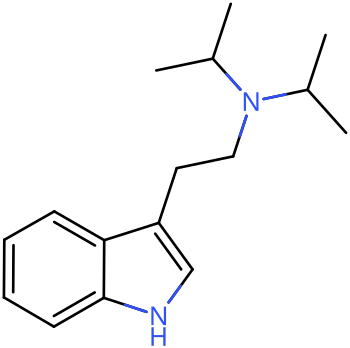
DiPT Stats & Data
ZRVAAGAZUWXRIP-UHFFFAOYSA-NReceptor Profile
Receptor Actions
History & Culture
1959–1997
DiPT was first characterized in the scientific literature by R.B. Barlow and colleagues in 1959. Alexander Shulgin began investigating the compound's effects in humans during the mid-1970s, with his initial findings dating to 1974 and basic properties disclosed in 1976. Shulgin published more detailed characterizations of DiPT alongside 5-MeO-DiPT in a 1980 journal article, followed by additional publications throughout the 1980s. A comprehensive synthesis and collection of human use reports appeared in Shulgin's 1997 book TiHKAL (Tryptamines I Have Known And Loved), which brought the compound to wider attention within the psychedelic research community. DiPT was subsequently encountered as a novel designer drug in Europe by 2005 and has since circulated online as a research chemical.
DiPT's unusual property of producing primarily auditory rather than visual effects has generated interest for potential neurological research applications. Shulgin speculated that the compound might serve as a valuable tool for studying the auditory system, potentially helping to locate the pitch-processing center of the brain if combined with imaging techniques such as positron emission tomography. A small study was conducted administering DiPT to two individuals with perfect pitch to investigate whether any systematic relationship existed between a note's actual pitch and the perceived pitch under the drug's influence. The results revealed no meaningful correlation, though they reinforced observations that the pitch decrease produced by DiPT is not linear and involves genuine harmonic distortion rather than a simple uniform pitch shift.
Subjective Effects
Sensory
- Enhancements
- Distortions
- Hallucinations
Forked from Subjective Effect Documentation work by Josie Kins, August 2016. Via dose.wiki (CC0).
Toxicity
PsychonautWikiThe toxicity and long-term health effects of recreational DiPT do not seem to have been studied in any scientific context and the exact toxic dose is unknown. This is because DiPT is a research chemical with very little history of human usage. Anecdotal reports from those who have tried DiPT suggests that there are no negative health effects attributed to simply trying the drug by itself at low to moderate doses and using it very sparingly (but nothing can be completely guaranteed). Independent research should always be done to ensure that a combination of two or more substances is safe before consumption. It is strongly recommended that one use harm reduction practices when using this drug.
Addiction & dependence
DiPT is not habit-forming and the desire to use it can actually decrease with use. It is most often self-regulating. Tolerance to the effects of DiPT is built almost immediately after ingestion.
Effect Profile
Curated + 70 ReportsStrong visuals and auditory effects with strong body load, mild headspace
Duration Timeline
BluelightTolerance & Pharmacokinetics
drugs.wikiTolerance Decay
Rapid tolerance typical of serotonergic psychedelics; spacing doses by 1–2 weeks minimizes attenuation. Model values are heuristic from community reports (anecdotal).
Cross-Tolerances
Demographics
Gender Distribution
Age Distribution
Reports Over Time
Effect Analysis
Erowid + BluelightEffects aggregated from 70 experience reports (46 single-substance Erowid + 24 Bluelight)
Effect Sentiment Distribution
Confidence Distribution
Each bar is the share of reports mentioning the effect; its whisker, and the band on the rows below, is the 95% interval: where the share could plausibly be with other reports of the same kind.
Positive Effects 36
Adverse Effects 28
Show 8 more adverse effects
Show 23 neutral or unclassified mentions
Also reported in combinations. In the 30 DiPT reports where another drug was taken too, 5 (16.7%) mention hospital, emergency services or an overdose, 1 (3.3%) a seizure and 0 (0.0%) psychosis. In the 46 single-substance reports: 2.2%, 2.2% and 0.0%. These are not in the figures above: they cannot be put down to DiPT alone, and a mention is not always something that happened to the writer.
Dosage Distribution
Dose distribution from experience reports, one dose per report (the first listed). Doses above Q3 + 3×IQR, far above what people typically take, are left out of the median and range and listed under each route: most are real heavy doses or overdoses, not mistakes.
1 report gave a dose above the typical range (250 mg), so it is not in the figures above. Listing a dose here does not mean it is safe.
Show the report
- 250 mg · another drug taken too
Real-World Dose Distribution
ErowidFrom 74 of 77 recorded dose entries: those that state a weight (mg, g or µg), in routes with at least five of them. Values above Q3 + 3×IQR, far above what people typically take, are left out; they can include real heavy doses and overdoses, not only mistakes.
Oral (n=56)
Insufflated (n=11)
Smoked (n=6)
Common Combinations
Most co-occurring substances, as a share of all 76 reports filed under DiPT; whiskers are 95% intervals
Form / Preparation
Most common forms and preparations, as a share of the 50 reports that give one; whiskers are 95% intervals
Body-Weight Dosing
Dose per kg of body weight, one dose per report (the first listed), from reports giving a weight of 30–250 kg. Doses above Q3 + 3×IQR, far above what people typically take, are left out of the median and range and listed under each route.
1 report gave a dose above the typical range (3.243 mg/kg), so it is not in the figures above. Listing a dose here does not mean it is safe.
Show the report
- 3.243 mg/kg · another drug taken too
Redose Patterns
Redosing behavior across 52 reports
Legal Status
| Country | Status | Notes |
|---|---|---|
| Germany | NpSG (Controlled) | Controlled under the Neue-psychoaktive-Stoffe-Gesetz (New Psychoactive Substances Act) as of July 18, 2019. Production, import with intent to distribute, administration to others, and trading are punishable offenses. Possession is prohibited but not subject to criminal penalties. |
| Japan | Designated Substance | Controlled as a Designated Substance (Shitei-Yakubutsu) under the Pharmaceutical Affairs Law. Both possession and sale are prohibited. |
| Latvia | Schedule I | Listed as a Schedule I controlled substance under national drug control legislation. |
| New Zealand | Class C | Classified as a Class C controlled substance due to its structural relationship to DMT, which is covered under analogue provisions in New Zealand drug law. |
| Sweden | Proposed for scheduling | Sweden's public health agency recommended classifying DiPT as a hazardous substance on May 15, 2019. Current legal status may have changed following this recommendation. |
| Switzerland | Uncontrolled | Not listed under Buchstabe A, B, C, or D of controlled substances legislation. May be considered legal to possess, though sale for human consumption could still raise regulatory issues. |
| United Kingdom | Class A | Controlled as a Class A substance under the Misuse of Drugs Act 1971 due to the tryptamine catch-all clause, which covers structurally related compounds. |
| United States | Unscheduled (Federal Analogue Act may apply) | Federally unscheduled, though it may be considered an analogue of DET or 5-MeO-DiPT under the Controlled Substances Act. Sales for human consumption or possession with intent to ingest could potentially be prosecuted under the Federal Analogue Act. Specifically listed as Schedule I in Florida and Louisiana (since June 2013). |
Harm Reduction
drugs.wikiDiPT is notable for its unique auditory distortions—often downward pitch-shifting and nonlinear harmonic distortion—while visual changes are usually mild compared with other psychedelics. The altered pitch/timbre can persist into the next day in some users; to protect hearing and reduce disorientation, avoid loud venues, high headphone volumes, and tasks requiring accurate sound localization or timing (e.g., driving). Onset can be subtle; avoid redosing during the first 2–3 hours as tolerance rises quickly and effects may surge later. People with seizure disorders, on lithium, or taking serotonergic drugs (SSRIs/SNRIs/TCAs, tramadol, DXM, 5-HTP) should avoid DiPT due to seizure or serotonin-toxicity concerns. Set/setting and a sober sitter are recommended—auditory scene distortions can impair communication and situational awareness. Use drug checking: reagent tests help confirm a tryptamine (e.g., Ehrlich), but laboratory confirmation via GC/MS (e.g., DrugsData) best verifies identity. Data on non‑oral ROAs are sparse; oral is the best-characterized and most predictable route.
References
Cited References
Additional references
- Erowid DiPT Vault
- Erowid/DrugsData project overview (GC/MS drug checking)
- The Drug Users Bible – Harm Reduction & Safety (allergy testing, combinations)
- Bluelight – Main LSD & Lithium thread (warning on seizures with psychedelics + lithium)
- Hi‑Ground (psychedelic HR: combinations; tramadol/seizure; cannabis/stimulants cautions)
- Reddit r/researchchemicals – DiPT trip report and Shulgin quote on nonlinear auditory distortion
- Reddit r/researchchemicals – DiPT threshold and duration observations