
DOB Stats & Data
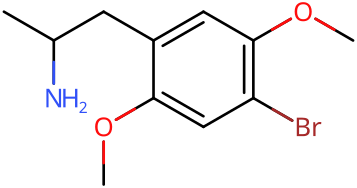
[Cl-].COc1cc(CC(C)N)c(OC)cc1Br.[H+]SPBBKPOIDQIWDZ-UHFFFAOYSA-NReceptor Profile
Receptor Actions
Measured Affinities
Guide to PHARMACOLOGYMeasured binding and functional data for brolamfetamine, curated by the IUPHAR/BPS Guide to PHARMACOLOGY. Each row cites the paper it came from. Lower concentrations mean tighter binding — a value in the sub-nanomolar range indicates a very potent interaction.
| Target | Action | Measure | Value | Concentration | Species | Source |
|---|---|---|---|---|---|---|
| 5-HT2A receptor Htr2a | Full agonist | pKi | 7.8 | 15.85 nM | Rat | PMID 9655845 |
| 5-HT2C receptor Htr2c | Full agonist | pKi | 6.6 | 251.19 nM | Rat | PMID 9282936 |
| 5-HT2A receptor HTR2A | Full agonist | pKi | — | — | Human | — |
| 5-HT2B receptor HTR2B | Full agonist | pKi | — | — | Human | — |
| 5-HT2C receptor HTR2C | Full agonist | pKi | — | — | Human | — |
Reading this. pKi, pEC50 and pIC50 are negative log molar values, so a higher number means a tighter interaction; the concentration column converts them for you. Values from non-human species are laboratory measurements and do not translate directly to human effect. Receptor affinity is not a dose — it describes what a molecule binds, not how much of it is safe to take.
Receptor data from the IUPHAR/BPS Guide to PHARMACOLOGY (v2026.2), licensed CC BY-SA 4.0. Matched to this substance by InChIKey.
History & Culture
1967–1971
DOB was first synthesized by Alexander Shulgin in 1967 as part of research examining how 4-position substitutions affect metabolic stability in phenethylamine compounds. The first published scientific report appeared in 1971, documenting toxicology findings and initial pharmacological observations. A clinical trial conducted at the University of Chile found that DOB enhanced intellectual and emotional thinking while increasing fluency and attention, with subjects maintaining full communication capabilities throughout the experience. The researchers concluded that the compound appeared potentially as useful an adjunct to psychotherapy as MDA, the empathogenic amphetamine that was receiving attention in therapeutic contexts at the time.
1976–1981
Throughout the 1970s and 1980s, DOB use was reported across multiple countries including Australia, Germany, Greece, New Zealand, the United Kingdom, and the United States. The substance became particularly prevalent in Australia, where it was first detected in 1976. Between 1976 and 1981, police seized DOB in Auckland, Sydney, Adelaide, and Brisbane, with the compound being confiscated more frequently than any other hallucinogen in Australia during this period. In contrast, it represented only approximately two percent of seized hallucinogens in the United Kingdom. Analysis of seized samples revealed significant inconsistency in dosing, with one batch showing concentrations ranging from 1.4 to 4.6 mg per unit. This variability, combined with the fact that DOB was typically sold as LSD or presented in similar formats, contributed to numerous overdose incidents. Multiple nonfatal and fatal cases were recorded, including one death of a young woman who snorted a large quantity after mistaking the substance for MDA and taking what would have been an appropriate dose for that compound.
1973–1991
DOB was placed into Schedule I of the United States Controlled Substances Act in 1973, just two years after the first scientific publication describing its effects. In 1986, the World Health Organization proposed and recommended the international nonproprietary name brolamfetamine for the compound, registering it officially as an anorexiant despite its primary recognition as a hallucinogen. Comprehensive documentation of DOB did not appear until the 1991 publication of PiHKAL (Phenethylamines I Have Known And Loved) by Alexander Shulgin. This work provided detailed information about the compound's synthesis, dosage ranges, duration, and qualitative effects. Shulgin's research also revealed an unusual pharmacological characteristic: DOB accumulates first in lung tissue, remaining there for several hours before brain levels increase, suggesting metabolic conversion may occur in pulmonary tissue before the active compound reaches the central nervous system—a finding consistent with the substance's characteristically slow onset and prolonged duration.
In contemporary contexts, DOB continues to see limited use as a recreational drug and entheogen. In 2005, authorities in São Paulo, Brazil received samples of gelatin capsules containing approximately 1.5 mg of DOB, with similar capsules reported from multiple sources connected to rave party scenes. The substance is now rarely encountered through specialized online vendors and is more commonly found in street distribution as misrepresented LSD, as its microgram-range potency allows it to be applied to similar-sized blotter paper.
Subjective Effects
Physical
The physical effects of DOB can be broken down into five components all of which progressively intensify proportional to dosage.
- Spontaneous tactile sensations: The body high of DOB is manifested as somewhat intense in comparison to most classical psychedelics. The sensation itself can be described as a constantly present yet somewhat mild energetic pins and needles sensation that encompasses a person's entire body. It is usually static in its position and felt over every square inch of the skin as if it was coming from behind the user's body. Occasionally however it manifests itself in the form of a continuously shifting tingling sensation that travels up and down the body in spontaneous waves.
- Stimulation: In terms of its effects on the physical energy levels of the tripper, DOB is usually considered to be extremely stimulating at levels which do not become overwhelming and are encouraged instead of forced. This results in a shakiness and unsteadiness of the hands at high dosages but encourages trippers to move around, run, dance, climb and generally engage in physical activities.
- Enhancement of touch: Feelings of enhanced tactile sensation are consistently present at moderate levels throughout most DOB trips.
- Nausea: Mild to extreme nausea is reported when consumed in moderate to high dosages and either passes once the tripper has vomited or gradually fades by itself as the peak sets in.
- Vasoconstriction: This effect is usually only present at higher dosages but can be particularly uncomfortable.
Cognitive
The head space of DOB is described by many as one of mental stimulation and a powerful enhancement of a person's current mental state. Many users report that it may not be as deep as other traditional psychedelics such as LSD or Psilocin and that it is comparatively empty in terms of its insightfulness.
- Introspection: This component is consistently manifested only in the context of a non-social setting in which the user is alone.
- Increased empathy, love and sociability: This component is inconsistently manifested only in the context of social settings in which one is within the company of others. These feelings of sociability, love and empathy are a little weaker and less sharp than those found on substances such as MDMA and 2C-B but still prove strong enough to provide long lasting therapeutic effects.
- Acceleration of thought
- Time distortion
- Feelings of fascination, importance and awe
- Conceptual thinking
- Enhancement of current mind state
- Ego suppression, loss and death
Sensory
- Enhancements
- Distortions
- Hallucinations
DOB presents a full and complete array of possible visual distortions.
- Visual drifting: (Melting, Flowing, Breathing and morphing) - In comparison to other psychedelics, this effect can be described as highly detailed, slow and smooth in motion, static in their appearance and unrealistic/cartoon-like in style.
- Tracers
- After images
- Texture repetition
- Colour shifting
- Scenery slicing
DOB presents a full and complete array of possible visual enhancements.
- Increased visual acuity
- Enhancement of colour
- Enhanced pattern recognition
DOB is capable of producing a full range of low and high level hallucinatory states in a fashion that is significantly less consistent and reproducible than that of many other commonly used psychedelics.
- External hallucinations
- Internal hallucinations: Although DOB is technically capable of producing hallucinatory states in a fashion that is on par with psilocin or DMT in its vividness and intensity, in comparison, these effects are extremely rare and inconsistent. Whilst traditional psychedelics such as LSA, Ayahuasca and Mescaline will induce internal hallucinations near consistently at level 5 geometry and above, DOB will for most simply go straight into Level 7A visual geometry.
Forked from Subjective Effect Documentation by Josie Kins, April 2014. Via dose.wiki (CC0).
Toxicity
PsychonautWikiThe toxicity and long-term health effects of recreational DOB use do not seem to have been studied in any scientific context and the exact toxic dose is unknown. This is because DOB is a research chemical with very little history of human usage. Anecdotal reports from those who have tried DOB suggests that there are no negative health effects attributed to simply trying the substance by itself at low to moderate doses and using it very sparingly (but nothing can be completely guaranteed). Independent research should always be done to ensure that a combination of two or more substances is safe before consumption. It is strongly recommended that one use harm reduction practices when using this substance.
Effect Profile
Curated + 56 ReportsStrong visuals, headspace, and auditory effects with strong body load
Strong stimulation and euphoria with strong anxiety/jitters, mild focus
Community Effects
TripSitTolerance & Pharmacokinetics
drugs.wikiTolerance Decay
Pattern broadly mirrors other serotonergic psychedelics: acute tolerance develops rapidly, partial tolerance persists about a week, and baseline typically returns within 2–3 weeks, though the long duration of DOB can make perceived tolerance more variable.
Cross-Tolerances
Demographics
Gender Distribution
Age Distribution
Reports Over Time
Effect Analysis
Erowid + BluelightEffects aggregated from 56 experience reports (35 single-substance Erowid + 21 Bluelight)
Effect Sentiment Distribution
Confidence Distribution
Each bar is the share of reports mentioning the effect; its whisker, and the band on the rows below, is the 95% interval: where the share could plausibly be with other reports of the same kind.
Positive Effects 44
Adverse Effects 37
Show 17 more adverse effects
Show 29 neutral or unclassified mentions
Also reported in combinations. In the 24 DOB reports where another drug was taken too, 4 (16.7%) mention hospital, emergency services or an overdose, 2 (8.3%) a seizure and 3 (12.5%) psychosis. In the 35 single-substance reports: 17.1%, 5.7% and 2.9%. These are not in the figures above: they cannot be put down to DOB alone, and a mention is not always something that happened to the writer.
Dosage Distribution
Dose distribution from experience reports, one dose per report (the first listed). Doses above Q3 + 3×IQR, far above what people typically take, are left out of the median and range and listed under each route: most are real heavy doses or overdoses, not mistakes.
Real-World Dose Distribution
ErowidFrom 34 of 70 recorded dose entries: those that state a weight (mg, g or µg), in routes with at least five of them. Values above Q3 + 3×IQR, far above what people typically take, are left out; they can include real heavy doses and overdoses, not only mistakes.
Sublingual (n=6)
Oral (n=28)
Common Combinations
Most co-occurring substances, as a share of all 59 reports filed under DOB; whiskers are 95% intervals
Form / Preparation
Most common forms and preparations, as a share of the 41 reports that give one; whiskers are 95% intervals
Body-Weight Dosing
Dose per kg of body weight, one dose per report (the first listed), from reports giving a weight of 30–250 kg. Doses above Q3 + 3×IQR, far above what people typically take, are left out of the median and range and listed under each route.
Redose Patterns
Redosing behavior across 43 reports
Legal Status
| Country | Status | Notes |
|---|---|---|
| Australia | Schedule II | Listed as a Schedule II controlled substance under Australian drug legislation. |
| Austria | Illegal (SMG) | Prohibited under the Suchtmittelgesetz (SMG). Possession, production, and sale are illegal without authorization. |
| Canada | Schedule I (CDSA) | Controlled under Schedule I of the Controlled Drugs and Substances Act due to its status as an amphetamine analogue. |
| Germany | Anlage I BtMG | Listed in Anlage I of the Betäubungsmittelgesetz since September 1, 1984. Manufacturing, possession, import, export, purchase, sale, and dispensing are prohibited without a license. |
| Latvia | Schedule I | Classified as a Schedule I controlled substance under Latvian drug control legislation. |
| Netherlands | Lijst I (Opiumwet) | Classified as a Lijst 1 substance under the Opium Act, categorizing it as a hard drug. Production, distribution, and possession are prohibited. |
| New Zealand | Class A (Schedule I) | Controlled as a Schedule I (Class A) substance. Additionally qualifies as an analogue under the catch-all provisions in Schedule 3 (Class C) of New Zealand's drug laws. |
| Poland | Controlled | Listed as a controlled substance under Polish drug legislation. Possession, production, and distribution are prohibited. |
| Romania | Controlled (high-risk) | Classified as a controlled substance and designated as a high-risk drug under Romanian law. |
| Switzerland | Controlled (Verzeichnis D) | Specifically named as a controlled substance under Verzeichnis D of Swiss narcotics legislation. |
| United Kingdom | Class A (Schedule 1) | Controlled as a Class A, Schedule 1 substance under the Misuse of Drugs Act 1971. Selling, buying, or possessing without a license is illegal. |
| United States | Schedule I | Classified as a Schedule I hallucinogen under the Controlled Substances Act. Manufacturing, purchasing, possessing, or distributing without a DEA license is illegal. |
Harm Reduction
drugs.wikiDOB is a potent, long-acting psychedelic amphetamine with active doses in the low milligram range; accurate milligram measurement or volumetric dosing is essential to reduce overdose risk. The onset is slow (often 1–3 hours), so redosing too early is a common error—waiting at least 3–4 hours before any redose materially lowers the chance of an overly strong experience. Severe peripheral vasoconstriction is a known toxicity at high doses; a published JAMA case linked DOB ingestion to diffuse arterial spasm requiring vasodilator treatment—seek urgent care if extremities become cold, numb, discolored, or intensely painful. Cardiovascular strain (tachycardia, hypertension) is common; those with vascular disease, Raynaud’s, hypertension, or cardiac risk should avoid DOB or take extra caution. Because DOB is sometimes found on blotters or mis-sold as LSD/other psychedelics, drug checking is strongly advised; when identity is uncertain, take a partial dose and wait several hours because some adulterants (including DOx) have much later onsets than LSD. The duration (often 18–30 hours) and residual stimulation can disrupt sleep into the next day; plan set/setting, obligations, and hydration/nutrition accordingly. Avoid combinations with other stimulants or vasoconstrictors (e.g., decongestants) to reduce additive blood pressure/vasospasm risks. Lithium coadministration with classical psychedelics has been repeatedly cautioned against in harm-reduction charts due to seizure risk; this combination should be avoided. MAOI co-use is high risk because DOB is serotonergic and stimulating; hypertensive crises or serotonin toxicity are possible even at typical doses. Alcohol may mask coming-up anxiety but can worsen dehydration and blood pressure; given the long duration, postponing alcohol until well after the peak (or avoiding it) improves safety. Given variance in street samples, start with a light dose even if prior experiences felt manageable; inter-batch potency and individual sensitivity can differ. If severe agitation, chest pain, or signs of limb ischemia occur, do not delay seeking medical care and disclose suspected DOB/‘DOx’ use so clinicians can monitor and manage vasospasm effectively.
References
Data Sources
Cited References
- Bowen et al. 1983 - Diffuse Vascular Spasm with DOB
- Parrish et al. 2005 - Differential phospholipase C activation by 5-HT2A agonists
- Shulgin & Shulgin - PiHKAL #62: DOB
- Shulgin - DOB and Other Possible Prodrugs
- TripSit: Drug Combinations Chart
- Erowid: 2C-B FAQ (DOB section)
- IsomerDesign: PiHKAL entry for DOB
- Erowid Reference: Effective Dose
- PiHKAL Mirror: Pihkal
Additional references
- Erowid DOB Vault (overview, dose/duration, cautions)
- Isomer Design: DOB index entry (names, identifiers, literature links)
- JAMA case: Diffuse vascular spasm associated with 4-bromo-2,5-dimethoxyamphetamine ingestion (DOB)
- Saferparty.ch LSD warnings: advise waiting 3 hours after dosing due to later-onset adulterants (relevant to DOx on blotter)
- Erowid Experience Vaults search page including ‘DOC (sold as LSD)’ (misrepresentation evidence)
- TripSit Wiki Factsheets (data/API and combinations chart project; general interaction framework)
- Bluelight thread referencing TripSit Drug Combinations chart (community HR source for combinations incl. lithium warning)
- Effect Index: Duration terminology (for structured timelines)