
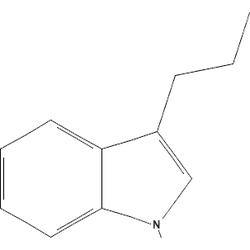
DPT Stats & Data
[Cl-].CCCN(CCC)CCc1cnc2ccccc12.[H+]AIAASKTUEVUIQM-UHFFFAOYSA-NReceptor Profile
Receptor Actions
Receptor Binding
History & Culture
1950–1968
DPT was first synthesized in 1950, with initial pharmacological testing conducted in dogs by 1954. The compound was formally described in scientific literature by 1959, and human trials during the 1960s confirmed its hallucinogenic properties. By 1968, DPT had been identified as a novel designer drug.
1973–1979
Formal therapeutic research with DPT was first reported in 1973, when investigators began exploring low intramuscular doses ranging from 15 to 30 milligrams as an adjunct to psychotherapy for patients with alcohol dependence. The compound's capacity to enhance memory recall, promote emotional expressiveness, and facilitate self-exploration—combined with its reliably short duration of action—made it an attractive candidate for therapeutic settings. Concurrent research examined higher intramuscular doses of 75 to 125 milligrams to facilitate peak experiences in terminally ill cancer patients. Stanislav Grof was among the researchers involved in these clinical trials. While preliminary findings showed some promise, the research program was never sufficiently developed to establish definitive conclusions regarding therapeutic efficacy. This work received mainstream media attention through a CBS 60 Minutes segment broadcast in the late 1970s.
1980–present
Beginning in the 1980s, reports of DPT use emerged that were largely connected to the Temple of the True Inner Light, a New York City-based religious organization that developed as an offshoot of the Native American Church. The Temple adopted DPT as its primary sacrament, referring to the compound as "a powerful Angel of the Host" and "the true flesh of God." The organization's theology holds that DPT and other entheogens represent physical manifestations of the divine. Congregants receive their communion through either smoking or oral consumption of the sacrament. Despite maintaining a public profile, the organization has reportedly operated without interference from federal drug enforcement agencies. The Temple represents a notable instance of sustained ceremonial use of a synthetic psychedelic compound within an organized religious framework in the United States.
Subjective Effects
Physical
At light to moderate doses, there is often a slight sense of anaesthetization and relaxation. As the dose increases, perceptions of heart rate increase and body tremors and loss of muscle control are often reported. DPT can range from strong euphoria and erotiscism to nausea and dysphoria even within the same trip.
- Spontaneous tactile sensations: The "body high" of DPT is generally more prominent to that of the better known DMT. There is often the sensation of limbs feeling disconnected from the body, a force pinning the body to the surface on which it lay and body tremors which can often make the user feel aware of but not in control of their body.
- Changes in gravity: At higher doses, physical feelings of moving through spaces at quick speeds or being pinned down are common.
- Headaches
- Motor control loss
- Muscle spasms
- Nausea
- Physical euphoria
- Wakefulness
Cognitive
- Emotion enhancement
- Memory suppression
- Ego death
- Novelty enhancement
- Personal bias suppression
- Rejuvenation
- Subconscious communication
- Unity and interconnectedness
Sensory
- Drifting: (Melting, breathing, morphing and flowing)
- After images
- Colour replacement
- Colour shifting
- Recursion
- Scenery slicing
- Symmetrical texture repetition
- Tracers
- Colour enhancement
- Pattern recognition enhancement
- Acuity enhancement
DPT produces a full range of high level hallucinatory states in a fashion that is more consistent and reproducible than that of any other commonly used psychedelic.
- Machinescapes
- Transformations
- Internal hallucinations: (Autonomous entities; settings, sceneries, and landscapes; alterations in perspective and scenarios and plots)
Forked from Subjective Effect Documentation by Josie Kins, July 2016. Via dose.wiki (CC0).
Toxicity
PsychonautWikiThe toxicity and long-term health effects of recreational DPT do not seem to have been studied in any scientific context and the exact toxic dose is unknown. This is because DPT is a research chemical with very little history of human usage. There has been one death associated with the use DPT and seizures, but the dose is unknown. Anecdotal reports from those who have taken DPT suggests that negative health effects are not likely to occur from simply trying it by itself at low to moderate doses and using it sparingly (although nothing can be guaranteed). Independent research should always be done to ensure that a combination of two or more substances is safe before consumption.
Effect Profile
Curated + 199 ReportsStrong visuals, headspace, and auditory effects with strong body load
Duration Timeline
BluelightEmpirical Duration
Erowid ReportsMedian times after the dose that Erowid reports state. A curve is drawn only when reports state all four points (onset, peak begins, comedown begins, back to baseline) and the medians fall in that order. No point is estimated from another.
Community Effects
TripSitTolerance & Pharmacokinetics
drugs.wikiTolerance Decay
General serotonergic psychedelic pattern inferred from community and classic literature: substantial tolerance for several days with return towards baseline over 1–2 weeks. DMT shows atypical rapid tolerance dynamics; DPT likely follows the more typical pattern due to its longer duration. Data quality: mixed (anecdotal + extrapolation).
Cross-Tolerances
Demographics
Gender Distribution
Age Distribution
Reports Over Time
Effect Analysis
Erowid + BluelightEffects aggregated from 193 experience reports (143 single-substance Erowid + 56 Bluelight)
Effect Sentiment Distribution
Confidence Distribution
Each bar is the share of reports mentioning the effect; its whisker, and the band on the rows below, is the 95% interval: where the share could plausibly be with other reports of the same kind.
Positive Effects 67
Adverse Effects 68
Show 45 more adverse effects
Show 28 neutral or unclassified mentions
Also reported in combinations. In the 65 DPT reports where another drug was taken too, 7 (10.8%) mention hospital, emergency services or an overdose, 1 (1.5%) a seizure and 6 (9.2%) psychosis. In the 143 single-substance reports: 7.7%, 5.6% and 7.0%. These are not in the figures above: they cannot be put down to DPT alone, and a mention is not always something that happened to the writer.
Dose-Response Correlation
How effect frequency changes across dose levels. Whiskers, and the numbers' hover text, give each figure's 95% interval.
View data table
| Effect | Light (n=29) | Common (n=27) | Strong (n=22) |
|---|---|---|---|
| Visual Distortions | 79.3% (95% interval 62 to 90 percent) | 74.1% (95% interval 55 to 87 percent) | 90.9% (95% interval 72 to 98 percent) |
| Music Enhancement | 69.0% (95% interval 51 to 83 percent) | 48.1% (95% interval 31 to 66 percent) | 40.9% (95% interval 23 to 61 percent) |
| Anxiety | 51.7% (95% interval 34 to 69 percent) | 66.7% (95% interval 48 to 81 percent) | 63.6% (95% interval 43 to 80 percent) |
| Color Enhancement | 34.5% (95% interval 20 to 53 percent) | 44.4% (95% interval 28 to 63 percent) | 50.0% (95% interval 31 to 69 percent) |
| Dissociation | 24.1% (95% interval 12 to 42 percent) | 22.2% (95% interval 11 to 41 percent) | 45.5% (95% interval 27 to 65 percent) |
| Confusion | 13.8% (95% interval 6 to 31 percent) | 44.4% (95% interval 28 to 63 percent) | 36.4% (95% interval 20 to 57 percent) |
| Euphoria | 41.4% (95% interval 26 to 59 percent) | 29.6% (95% interval 16 to 48 percent) | 27.3% (95% interval 13 to 48 percent) |
| Nausea | 17.2% (95% interval 8 to 34 percent) | 18.5% (95% interval 8 to 37 percent) | 40.9% (95% interval 23 to 61 percent) |
| Stimulation | 34.5% (95% interval 20 to 53 percent) | 40.7% (95% interval 24 to 59 percent) | 31.8% (95% interval 16 to 53 percent) |
| Auditory Effects | 37.9% (95% interval 23 to 56 percent) | 29.6% (95% interval 16 to 48 percent) | 18.2% (95% interval 7 to 38 percent) |
| Empathy | 27.6% (95% interval 15 to 46 percent) | 37.0% (95% interval 22 to 56 percent) | 18.2% (95% interval 7 to 38 percent) |
| Closed-Eye Visuals | 34.5% (95% interval 20 to 53 percent) | 29.6% (95% interval 16 to 48 percent) | 31.8% (95% interval 16 to 53 percent) |
| Muscle Tension | 31.0% (95% interval 17 to 49 percent) | 11.1% (95% interval 4 to 28 percent) | — |
| Introspection | 20.7% (95% interval 10 to 38 percent) | 29.6% (95% interval 16 to 48 percent) | 13.6% (95% interval 5 to 33 percent) |
| Increased Heart Rate | 20.7% (95% interval 10 to 38 percent) | 18.5% (95% interval 8 to 37 percent) | 13.6% (95% interval 5 to 33 percent) |
Subjective Effect Ontology
Experience ReportsStructured effect tags extracted from 258 Erowid & Bluelight experience reports using a controlled vocabulary of 220+ canonical effects across 15 domains.
Auditory
Emotional
Visual
Dose–Effect Mapping
Experience ReportsHow reported effects shift across dose tiers, based on 143 single-substance experience reports. The shaded band on each bar is its 95% interval. An arrow (↑ ↓) marks a change between the lowest and highest tier that count an effect only when the gap is bigger than chance would explain; ~ means no clear change. How changes are called
| Effect | Light (n=29) | Common (n=27) | Strong (n=22) | Change with dose |
|---|---|---|---|---|
| visual distortions | (no clear change: +12 points from Light to Strong, 95% interval −10 to +30) | |||
| music enhancement | (−28 points from Light to Strong, 95% interval −50 to −1) | |||
| anxiety | (no clear change: +12 points from Light to Strong, 95% interval −15 to +36) | |||
| color enhancement | (no clear change: +16 points from Light to Strong, 95% interval −11 to +40) | |||
| dissociation | (no clear change: +21 points from Light to Strong, 95% interval −4 to +44) | |||
| confusion | (no clear change: +23 points from Light to Strong, 95% interval −1 to +45) | |||
| euphoria | (no clear change: −14 points from Light to Strong, 95% interval −37 to +12) | |||
| nausea | (no clear change: +24 points from Light to Strong, 95% interval −1 to +46) | |||
| stimulation | (no clear change: −3 points from Light to Strong, 95% interval −26 to +23) | |||
| auditory effects | (no clear change: −20 points from Light to Strong, 95% interval −41 to +6) | |||
| empathy | (no clear change: −9 points from Light to Strong, 95% interval −30 to +15) | |||
| closed-eye visuals | (no clear change: −3 points from Light to Strong, 95% interval −26 to +23) | |||
| muscle tension | — | (no clear change: −20 points from Light to Common, 95% interval −40 to +2) | ||
| introspection | (no clear change: −7 points from Light to Strong, 95% interval −27 to +15) | |||
| increased heart rate | (no clear change: −7 points from Light to Strong, 95% interval −27 to +15) | |||
| time distortion | (no clear change: −7 points from Light to Strong, 95% interval −27 to +15) | |||
| ego dissolution | (no clear change: +1 points from Light to Strong, 95% interval −20 to +23) | |||
| focus enhancement | — | (no clear change: −4 points from Light to Strong, 95% interval −23 to +18) | ||
| body high | (no clear change: −5 points from Light to Strong, 95% interval −23 to +16) | |||
| sedation | (no clear change: +3 points from Light to Strong, 95% interval −15 to +24) |
Showing top 20 of 33 effects
Risk Escalation
Sentiment AnalysisAverage frequency of positive vs adverse effects across dose tiers. A tier's average is the mean share of the effects counted in that tier, not a share of reports, and its range is a deliberately wide 95% interval. A tier with more reports also counts rarer effects, which pulls its average down, so compare single effects in the breakdown rather than these averages. There, the shaded band on each bar is its 95% interval, and Change is marked up or down only when the gap between two tiers is bigger than chance would explain. How changes are called
View effect breakdown
Adverse Effects
| Effect | Light (n=29) | Common (n=27) | Strong (n=22) | Change |
|---|---|---|---|---|
| Anxiety | no clear change (no clear change: +12 points from Light to Strong, 95% interval −15 to +36) | |||
| Confusion | no clear change (no clear change: +23 points from Light to Strong, 95% interval −1 to +45) | |||
| Nausea | no clear change (no clear change: +24 points from Light to Strong, 95% interval −1 to +46) | |||
| Muscle Tension | — | no clear change (no clear change: −20 points from Light to Common, 95% interval −40 to +2) | ||
| Increased Heart Rate | no clear change (no clear change: −7 points from Light to Strong, 95% interval −27 to +15) | |||
| Psychosis | — | no clear change (no clear change: +7 points from Light to Strong, 95% interval −11 to +27) | ||
| Memory Suppression | — | no clear change (no clear change: +4 points from Light to Common, 95% interval −12 to +22) | ||
| Thought Loops | — | — | — | |
| Pupil Dilation | — | — | — | |
| Seizure | — | no clear change (no clear change: +2 points from Light to Strong, 95% interval −14 to +22) | ||
| Motor Impairment | — | no clear change (no clear change: +2 points from Common to Strong, 95% interval −16 to +21) | ||
| Headache | — | — | — | |
| Sweating | — | — | — | |
| Jaw Clenching | — | — | — |
Positive Effects
| Effect | Light (n=29) | Common (n=27) | Strong (n=22) | Change |
|---|---|---|---|---|
| Visual Distortions | no clear change (no clear change: +12 points from Light to Strong, 95% interval −10 to +30) | |||
| Music Enhancement | −28 pts (−28 points from Light to Strong, 95% interval −50 to −1) | |||
| Color Enhancement | no clear change (no clear change: +16 points from Light to Strong, 95% interval −11 to +40) | |||
| Euphoria | no clear change (no clear change: −14 points from Light to Strong, 95% interval −37 to +12) | |||
| Stimulation | no clear change (no clear change: −3 points from Light to Strong, 95% interval −26 to +23) | |||
| Empathy | no clear change (no clear change: −9 points from Light to Strong, 95% interval −30 to +15) | |||
| Closed-Eye Visuals | no clear change (no clear change: −3 points from Light to Strong, 95% interval −26 to +23) | |||
| Introspection | no clear change (no clear change: −7 points from Light to Strong, 95% interval −27 to +15) | |||
| Focus Enhancement | — | no clear change (no clear change: −4 points from Light to Strong, 95% interval −23 to +18) | ||
| Body High | no clear change (no clear change: −5 points from Light to Strong, 95% interval −23 to +16) | |||
| Open-Eye Visuals | no clear change (no clear change: +7 points from Light to Strong, 95% interval −11 to +27) | |||
| Tactile Enhancement | no clear change (no clear change: −1 points from Light to Strong, 95% interval −19 to +19) | |||
| Creativity Enhancement | — | — | — |
Dosage Distribution
Dose distribution from experience reports, one dose per report (the first listed). Doses above Q3 + 3×IQR, far above what people typically take, are left out of the median and range and listed under each route: most are real heavy doses or overdoses, not mistakes.
Insufflated
Intramuscular
Oral
Smoked
Real-World Dose Distribution
ErowidFrom 260 of 273 recorded dose entries: those that state a weight (mg, g or µg), in routes with at least five of them. Values above Q3 + 3×IQR, far above what people typically take, are left out; they can include real heavy doses and overdoses, not only mistakes.
Rectal (n=14)
Insufflated (n=170)
Oral (n=16)
Intramuscular (n=27)
Smoked (n=26)
Intravenous (n=7)
Common Combinations
Most co-occurring substances, as a share of all 208 reports filed under DPT; whiskers are 95% intervals
Form / Preparation
Most common forms and preparations, as a share of the 167 reports that give one; whiskers are 95% intervals
Body-Weight Dosing
Dose per kg of body weight, one dose per report (the first listed), from reports giving a weight of 30–250 kg. Doses above Q3 + 3×IQR, far above what people typically take, are left out of the median and range and listed under each route.
Insufflated
1 report gave a dose above the typical range (4.753 mg/kg), so it is not in the figures above. It mentions hospital, emergency services or an overdose. Listing a dose here does not mean it is safe.
Show the report
- 4.753 mg/kg · mentions hospital, emergency services or an overdose
Smoked
2 reports gave a dose above the typical range (1.186–1.575 mg/kg), so they are not in the figures above. Listing a dose here does not mean it is safe.
Show the reports
- 1.575 mg/kg
- 1.186 mg/kg · another drug taken too
Oral
Intramuscular
Redose Patterns
Redosing behavior across 170 reports
Legal Status
| Country | Status | Notes |
|---|---|---|
| Belgium | Schedule I equivalent | Listed in Belgium's most restrictive controlled substance category, approximately equivalent to Schedule II under the United States system. Manufacturing, distribution, and possession are prohibited. |
| Germany | NpSG (Neue-psychoaktive-Stoffe-Gesetz) | Controlled under the New Psychoactive Substances Act as of July 18, 2019. Production and importation with intent to market, administration to others, and trading are criminally punishable. Possession is prohibited but not subject to criminal penalty. |
| Greece | Controlled substance | Became a controlled substance on February 18, 2003 under national drug legislation. |
| Japan | Designated Substance (Shitei-Yakubutsu) | Controlled under the Pharmaceutical Affairs Law. Possession and sale are prohibited. |
| Latvia | Schedule I | Classified as a Schedule I controlled substance under national drug legislation. Possession, distribution, and production are illegal. |
| New Zealand | Class C | Controlled as a Class C substance due to its structural relationship to DMT, which is explicitly scheduled. The analogue provisions extend control to structurally similar tryptamines. |
| Portugal | Table II-A | Listed in Table II-A of the controlled substances tables alongside substances such as MDMA and LSD. Production and trafficking remain illegal; personal possession of small quantities is decriminalized under Portuguese drug policy. |
| Sweden | Narcotic substance | Classified as a narcotic substance on January 26, 2016 following its sale as a designer drug. Manufacturing, trade, and possession are prohibited. |
| Switzerland | Verzeichnis E | Specifically named as a controlled substance under Verzeichnis E (Schedule E) of Swiss narcotics legislation. Unauthorized possession, production, and distribution are prohibited. |
| United Kingdom | Class A | Controlled under the Misuse of Drugs Act 1971 through the tryptamine catch-all clause, which covers compounds structurally derived from tryptamine by substitution at the nitrogen atom of the sidechain with alkyl substituents. Class A classification carries the most severe penalties for possession, production, and distribution. |
| United States | Federally unscheduled (state exceptions) | DPT remains unscheduled at the federal level, meaning possession, purchase, and distribution are generally legal under federal law. However, several states have independently scheduled the substance: Florida classifies it as Schedule I, Maine lists it as Schedule X, and Oklahoma has placed it in Schedule I. The Federal Analogue Act may apply if sold for human consumption. |
Harm Reduction
drugs.wikiHarm‑reduction relevant facts and warnings: 1) Dosage and time-course are strongly route-dependent; the widely-circulated 1–2 h total duration is only true for smoked freebase—insufflated and IM commonly last 3–4 h with 2–4 h after-effects. Plan set, setting, and sitter time accordingly. 2) Smoked/vaporized use requires the freebase; DPT salts (e.g., HCl) are unsuitable for vaporization and may decompose under heat. Do not attempt to smoke salts. 3) Nasal administration often causes significant burning, tearing, and congestion; splitting doses, gentle saline rinses post‑session, and avoiding damaged mucosa may reduce harm, but the irritation can still be severe. Experienced users and Erowid’s primer emphasize the substance can be physically and psychologically intense even at seemingly modest insufflated doses. 4) Intramuscular use should only be attempted with sterile technique: use new sterile syringes/needles, sterile diluent, appropriate filtration, skin prep, and never share or reuse injection equipment. Rotate sites and avoid intravenous injection. Community injection HR guides stress these basics to reduce infection and tissue injury. 5) Individual sensitivity varies widely; steep dose–response is reported. Start low, especially with new batches or ROAs. Erowid collations and TIHKAL describe effective IM ranges as low as 15–30 mg and very challenging experiences above ~50–75 mg. 6) Combining DPT with MAOIs (or MAOI‑like drugs) can unpredictably potentiate effects and increase risk of hypertensive or serotonergic crises; avoid this combination. TripSit’s combo guidance flags MAOIs with psychedelics as dangerous. 7) DXM and tramadol are unsafe with serotonergic psychedelics due to seizure and serotonin syndrome risk; avoid. 8) Lithium has a history of severe adverse reactions with classical psychedelics (including seizures); although data are LSD‑focused, prudence dictates avoiding lithium with DPT. 9) DPT appears weakly active orally; if taken this way, expect slower onset, higher dose requirements, more nausea/body‑load, and longer after‑effects. Many prefer non‑oral ROAs for more predictable results. 10) Verify identity: indole tryptamines generally react purple with Ehrlich reagent, which confirms an indole but not the specific compound; only lab testing can confirm identity and purity. 11) Psychological effects can be extremely intense (ego dissolution, fear, tremor); a trusted sober sitter, quiet environment, and clear intention reduce risk of panic and accidents. Erowid’s primer explicitly cautions that DPT is not for casual/recreational mindsets. 12) Tolerance: like other serotonergic psychedelics, acute tolerance develops rapidly and cross‑tolerance with other psychedelics is expected; many harm‑reduction sources recommend at least 1–2 weeks between substantial experiences for baseline sensitivity. DMT may be an exception, but DPT’s longer action suggests ordinary psychedelic tolerance patterns. This guideline is precautionary. 13) Cardiovascular stimulation (transient increases in heart rate/blood pressure), tremor, nausea, and anxiety are commonly reported; those with significant cardiovascular, seizure, or severe psychiatric histories should avoid or take extra precautions in clinical settings. This is a cautious extrapolation from psychedelic HR literature and DPT user reports. 14) Statements sometimes seen online that DPT is “less prone to lasting psychological trauma than LSD or psilocybin” are not evidence-based; reports span from blissful to profoundly challenging. Treat DPT as at least as psychologically powerful as other classic psychedelics.
References
Data Sources
Cited References
- Erowid: DPT Vault
- Fantegrossi et al. 2008 - Hallucinogen-like effects of DPT (DOI)
- Grof et al. 1973 - DPT as an Adjunct in Psychotherapy of Alcoholics (DOI)
- Li et al. 2007 - Behavioral effects of dipropyltryptamine in rats (DOI)
- Richards et al. 1977 - The Peak Experience Variable in DPT-Assisted Psychotherapy (DOI)
- Smith et al. 2014 - Tolerance and Cross-Tolerance to Hallucinogens (DOI)
- Bluelight: DPT Discussion
Additional references
- Erowid DPT Main Vault
- Erowid DPT Dosage Page
- Erowid DPT Primer
- TIHKAL #9 DPT (Shulgin)
- PubChem CID 6091 – N,N-Dipropyltryptamine
- TripSit Drug Combinations (general psychedelics + MAOIs/DXM/tramadol cautions)
- Bluelight Injection HR Megathread (sterile technique basics)
- Erowid LSD Interactions – Lithium warning (extrapolated caution to DPT)
- Erowid Crew Blog – Ehrlich reagent and indole reactions