
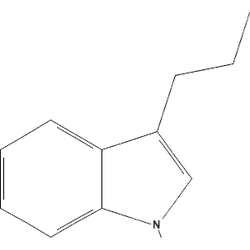
EPT Stats & Data
CCCN(CC)CCc1cnc2ccccc12LCDYRMYSOIVPRS-UHFFFAOYSA-NReceptor Profile
Receptor Actions
History & Culture
EPT's original synthesis date remains unknown. The compound first appeared for sale on the online research chemical market in 2016, emerging as what appears to be an entirely novel product of clandestine drug design rather than a compound derived from academic or pharmaceutical research. Unlike many psychedelic tryptamines, EPT was not included in Alexander Shulgin's influential book "TiHKAL" (Tryptamines I Have Known and Loved), and the substance has no documentation in the scientific literature. EPT remains a rarely encountered psychedelic with a very limited history of human use. The compound has been identified in illicit products in Japan, though it has otherwise received minimal attention within either research contexts or broader psychedelic culture.
Toxicity
PsychonautWikiThe toxicity and long-term health effects of recreational EPT use have not been studied in any scientific context and the exact toxic dose is unknown. This is because EPT is a research chemical with a very limited history of human usage. Anecdotal evidence suggests that there are no negative health effects attributed to simply trying EPT by itself at low to moderate doses and using it very sparingly (but nothing can be completely guaranteed). Independent research should always be done to ensure that a combination of two or more substances is safe before consumption. It is strongly recommended that one use harm reduction practices when using this substance.
Addiction & dependence
Anecdotal reports suggest that EPT does not produce dependence and has low abuse potential. It is believed to be similar in this respect to other unsubstituted tryptamines like DMT, DET, and MET. Unlike DMT, tolerance to the effects of EPT appears to form almost immediately after ingestion.
Effect Profile
Curated + 1 ReportsStrong visuals and auditory effects with mild body load, low headspace
Duration Timeline
BluelightCommunity Effects
TripSitTolerance & Pharmacokinetics
drugs.wikiTolerance Decay
Cross-Tolerances
Experience Report Analysis
ErowidDemographics
Gender Distribution
Too few reports for a chart: gender is known from 2 reports, and a split is drawn only from 20 reports or more. Counts are shown instead. Why 20?
- Male 1 of 2
- Female 1 of 2
Age Distribution
Reports Over Time
Legal Status
| Country | Status | Notes |
|---|---|---|
| Germany | Controlled (NpSG) | Regulated under the Neue-psychoaktive-Stoffe-Gesetz (New Psychoactive Substances Act) since July 18, 2019. Production, import with intent to distribute, administration to others, and trading are criminal offenses. Personal possession is prohibited but not subject to criminal penalties. |
| Italy | Schedule I | Listed as a controlled substance under Tabella I of Italian drug legislation. Possession, production, and distribution are prohibited. |
| Switzerland | Uncontrolled | Not listed under Buchstabe A, B, C, or D of the Swiss controlled substances regulations. Currently considered legal, though this status may change. |
| United Kingdom | Class A | Controlled under the Misuse of Drugs Act 1971 as a result of the tryptamine catch-all clause, which encompasses tryptamine derivatives regardless of individual scheduling. Class A substances carry the most severe penalties, including up to 7 years imprisonment for possession and life imprisonment for supply. |
| United States | Unscheduled | Not specifically scheduled under federal law. However, due to structural similarity to DMT (a Schedule I substance), it may be subject to prosecution under the Federal Analogue Act if sold for human consumption or used for illicit purposes. Legal status may vary by state. |