
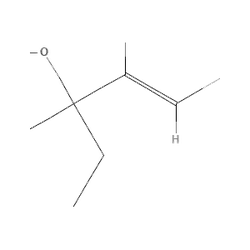
Ethchlorvynol Stats & Data
ZEHYJZXQEQOSON-AATRIKPKSA-NPharmacology
DrugBankDescription
Ethchlorvynol is a sedative and hypnotic drug. It has been used to treat insomnia, but has been largely superseded and is only offered where an intolerance or allergy to other drugs exists.
Mechanism of Action
Although the exact mechanism of action is unknown, ethchlorvynol appears to depress the central nervous system in a manner similar to that of barbiturates. Barbiturates bind at a distinct binding sites associated with a Cl- ionopore at the GABAA receptor, increasing the duration of time for which the Cl- ionopore is open. The post-synaptic inhibitory effect of GABA in the thalamus is, therefore, prolonged.
Pharmacodynamics
Ethchlorvynol is a sedative drug and schedule IV (USA) controlled substance. It produces cerebral depression, however the exact mechanism of action is not known.
Metabolism
About 90% of a dose is metabolized in the liver. Some ethchlorvynol may also be metabolized in the kidneys. Ethchlorvynol and metabolites undergo extensive enterohepatic recirculation.
Absorption
Rapidly absorbed from gastrointestinal tract.
Indication
Used for short-term hypnotic therapy in the management of insomnia for periods of up to one week in duration; however, this medication generally has been replaced by other sedative-hypnotic agents.
Half-life
Plasma half-life is approximately 10 to 20 hours, terminal half-life is 21-100 hours.
Although the exact mechanism of action is unknown, ethchlorvynol appears to depress the central nervous system in a manner similar to that of barbiturates. Barbiturates bind at a distinct binding sites associated with a Cl<sup>-</sup> ionopore at the GABA<sub>A</sub> receptor, increasing the duration of time for which the Cl<sup>-</sup> ionopore is open.
Carcinogenicity
No indication of carcinogenicity to humans (not listed by IARC).
Toxicity (DrugBank)
Symptoms of overdose include thrombocytopenia.
Health effects (PubChem excerpts)
They cause slurred speech, disorientation and "drunken" behavior. They are physically and psychologically addictive.
Experience Report Analysis
ErowidDemographics
Gender Distribution
Too few reports for a chart: gender is known from 2 reports, and a split is drawn only from 20 reports or more. Counts are shown instead. Why 20?
- Male 2 of 2
Age Distribution
Reports Over Time
Form / Preparation
Most common forms and preparations, as a share of the 2 reports that give one
Too few reports for bars: these forms come from 2 reports, and a bar is drawn only from 20 reports or more. With fewer, a percentage cannot tell a common effect from a rare one. Counts are shown instead. Why 20?
- Capsule 2 of 2