
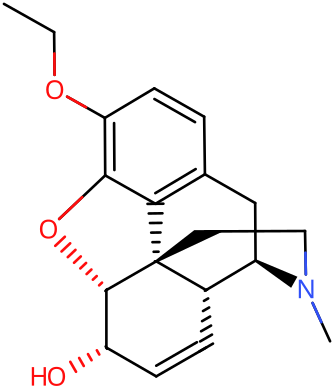
Ethylmorphine Stats & Data
CCOc1ccc2CC3N(C)CCC45C3C=CC(O)C5Oc1c24OGDVEMNWJVYAJL-LEPYJNQMSA-NPharmacology
DrugBankDescription
A narcotic analgesic and antitussive. It is metabolized in the liver by ethylmorphine-N-demethylase and used as an indicator of liver function. It is not marketed in the US but is approved for use in various countries around the world. In the US it is a schedule II drug (single-entity) and schedule III drug (in combination products).
Mechanism of Action
Ethylmorphine is metabolized by the liver enzyme cytochrome P450 2D6 to morphine. The precise mechanism of the analgesic action of morphine is unknown. However, specific CNS opiate receptors have been identified and likely play a role in the expression of analgesic effects. Morphine first acts on the mu-opioid receptors. The mechanism of respiratory depression involves a reduction in the responsiveness of the brain stem respiratory centers to increases in carbon dioxide tension and to electrical stimulation. It has been shown that morphine binds to and inhibits GABA inhibitory interneurons. These interneurons normally inhibit the descending pain inhibition pathway. So, without the inhibitory signals, pain modulation can proceed downstream.
Pharmacodynamics
Ethylmorphine is metabolized by the enzyme cytochrome P450 2D6 to morphine. Morphine is a narcotic pain management agent indicated for the relief of pain in patients who require opioid analgesics for more than a few days. Morphine interacts predominantly with the opioid mu-receptor. These mu-binding sites are discretely distributed in the human brain, with high densities in the posterior amygdala, hypothalamus, thalamus, nucleus caudatus, putamen, and certain cortical areas. They are also found on the terminal axons of primary afferents within laminae I and II (substantia gelatinosa) of the spinal cord and in the spinal nucleus of the trigeminal nerve. In clinical settings, morphine exerts its principal pharmacological effect on the central nervous system and gastrointestinal tract. Its primary actions of therapeutic value are analgesia and sedation. Morphine appears to increase the patient's tolerance for pain and to decrease discomfort, although the presence of the pain itself may still be recognized. In addition to analgesia, alterations in mood, euphoria and dysphoria, and drowsiness commonly occur. Opioids also produce respiratory depression by direct action on brain stem respiratory centers.
Metabolism
After ingestion, ethylmorphine is converted to morphine in the human liver by the CYP450-isozyme CYP2D6, similarly to codeine.
Indication
Ethylmorphine is an analgesic used for pain relief.
Receptor Profile
Receptor Actions
History & Culture
Ethylmorphine is a semi-synthetic opioid first synthesized by the pharmaceutical company Merck in 1884. It was developed as a weaker alternative to morphine for therapeutic applications. By the early twentieth century, the compound had found a specialized role in ophthalmic medicine under the trade name Dionine, employed to treat inflammatory conditions of the eye. A 1904 publication described an ethylmorphine preparation as "a new ocular analgesic," establishing its early medical utility in this specialized application. Commercial marketing of ethylmorphine began in France in 1953 through the pharmaceutical company Houde, with subsequent introduction to Norwegian and Spanish markets in 1960. The substance has since evolved to become primarily used as an antitussive agent, available in various cough preparation formulations across certain European countries, including syrups such as Cocillana, Cosylan, and Solvipect comp., as well as tablet formulations like Tussipax.
Subjective Effects
Physical
The cognitive effects of ethylmorphine can be broken down into several components which progressively intensify proportional to dosage. The general head space of codeine is described by many as one of intense euphoria, relaxation, anxiety suppression and pain relief.
- Pain relief: This component is subjectively different from other anaesthetics as it does not necessarily remove the pain entirely while still remaining equal in terms of its effectiveness. Instead of directly suppressing pain, these substances simply dull the perceived sensation and cover it up with feelings of physical and emotional pleasure.
- Euphoria: This particular substance can be considered as less intense in its physical euphoria when compared with that of morphine or diacetylmorphine (heroin) due to the upper limit of how much can be converted into its active form through metabolism.
- Itchiness
- Respiratory depression
- Constipation
- Cough suppression
- Difficulty urinating
- Nausea
- Stomach cramps
- Sedation
- Pupil constriction
- Salivation
Cognitive
The physical effects of ethylmorphine can be broken down into several components which progressively intensify proportional to dosage.
- Euphoria: Like codeine, this particular substance can be considered as less intense in its cognitive euphoria when compared with that of morphine or diacetylmorphine (heroin) due to the upper limit of how much can be converted into its active form through metabolism. It is still, however, capable of extreme intensity and overwhelming bliss at heavier dosages with a low tolerance. The sensation itself can be described as powerful and overwhelming feeling of emotional bliss, contentment, love and happiness.
- Anxiety suppression
- Compulsive redosing
Forked from Subjective Effect Documentation by Josie Kins, September 2015. Via dose.wiki (CC0).
Toxicity
PsychonautWikiEthylmorphine has a low toxicity relative to dose. However, despite its relatively low toxicity for an opioid, at least one death has been attributed to oral consumption of ethylmorphine alone, without the presence of other depressants. As with all opioids, long-term effects can vary but can include diminished libido, apathy and memory loss. It is also potentially lethal when mixed with depressants like alcohol or benzodiazepines. It is strongly recommended that one use harm reduction practices when using this drug.
Effect Profile
Curated + 3 ReportsStrong euphoria and pain relief with moderate itching/nausea, mild sedation
Tolerance & Pharmacokinetics
drugs.wikiNo tolerance chart. Our decay curves for opioids were estimates, and a curve can make tolerance look longer-lasting than it is, which is the dangerous direction.
Opioid tolerance drops fast when you stop, and even a few days off can be enough, so a dose that used to be normal can now stop your breathing. Overdose deaths rise sharply after prison, detox or leaving treatment, and tolerance also falls during a hospital stay. After any break, start with a much smaller amount, try a test dose first, don't use alone, and keep naloxone within reach. Alcohol, benzodiazepines, gabapentinoids and other sedatives make an opioid overdose much more likely.
Sources: FRANK: heroin · National Harm Reduction Coalition · WHO: opioid overdose · Merrall et al. 2010 · Binswanger et al. 2007 · Strang et al. 2003 · FDA 2019: gabapentinoids and breathing
Experience Report Analysis
ErowidDemographics
Gender Distribution
Too few reports for a chart: gender is known from 4 reports, and a split is drawn only from 20 reports or more. Counts are shown instead. Why 20?
- Male 4 of 4
Age Distribution
Reports Over Time
Form / Preparation
Most common forms and preparations, as a share of the 3 reports that give one
Too few reports for bars: these forms come from 3 reports, and a bar is drawn only from 20 reports or more. With fewer, a percentage cannot tell a common effect from a rare one. Counts are shown instead. Why 20?
- Pill / Tablet 2 of 3
Legal Status
| Country | Status | Notes |
|---|---|---|
| France | Available over-the-counter (in certain preparations) | Preparations combining ethylmorphine (10mg) with codeine (10mg), such as Tussipax tablets, are reportedly available without prescription. |
| Germany | Anlage II BtMG | Controlled under Anlage II of the Betäubungsmittelgesetz. Manufacturing, importing, possessing, selling, or transferring without license is prohibited. An exception exists for preparations containing up to 2.5% or 100mg per unit, which may be prescribed using narcotic prescription forms. |
| Norway | Prescription Class B | Cough syrups containing ethylmorphine (such as Cosylan at 1.7mg/mL and Solvipect comp. at 2.5mg/mL) are available by prescription and commonly used for dry cough treatment. |
| Russia | Schedule II | Classified as a Schedule II controlled substance under Russian drug control legislation. |
| Sweden | Prescription drug | Available as a prescription medication. Cough preparations containing ethylmorphine (e.g., Cocillana-Etyfin at 2.5mg/mL and Lepheton combination products) require a prescription. |
| Switzerland | Verzeichnis A (controlled) | Specifically listed as a controlled substance under Verzeichnis A. Medical use is permitted. Certain preparations fall under Verzeichnis C, with some exceptions. |
| United Kingdom | Class B | Controlled under the Misuse of Drugs Act 1971 as a Class B substance, the same classification as codeine. However, unlike codeine, no legal pharmaceutical preparations containing ethylmorphine are currently available. |
| United States | Schedule II/III/V (varies by preparation) | Pure ethylmorphine is Schedule II. Combination products containing no more than 3mg/mL (or 15mg per dosage unit with non-narcotic ingredients) are Schedule III. Preparations with 1mg/mL or less are Schedule V. Despite this scheduling structure paralleling codeine, no ethylmorphine preparations are currently marketed for medical use. |
References
Cited References
- Biotransformation and Pharmacokinetics Study (British Journal of Clinical Pharmacology)
- DrugBank: Ethylmorphine
- Erowid: Ethylmorphine Vault
- Evidence for CYP450 2D6 and 3A4 Role in Metabolism (British Journal of Clinical Pharmacology)
- TripSit: Ethylmorphine Factsheet
- Biotransformation and Pharmacokinetics Study (PMC)