
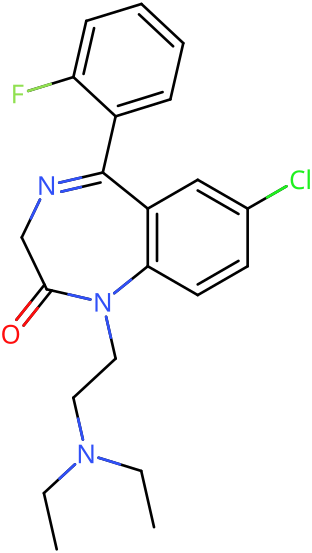
Flurazepam Stats & Data
SAADBVWGJQAEFS-UHFFFAOYSA-NPharmacology
DrugBankDescription
A benzodiazepine derivative used mainly as a hypnotic.
Mechanism of Action
Flurazepam binds to an allosteric site on GABA-A receptors. Binding potentiates the action of GABA on GABA-A receptors by opening the chloride channel within the receptor, causing chloride influx and hyperpolarization.
Pharmacodynamics
Flurazepam, a benzodiazepine derivative, is a hypnotic agent which does not appear to decrease dream time as measured by rapid eye movements (REM). Furthermore, it decreases sleep latency and number of awakenings for a consequent increase in total sleep time.
Metabolism
Flurazepam is rapidly metabolized and is excreted primarily in the urine. Both hydroxyethyl flurazepam (the major metabolite) and N-desalkyl flurazepam are active. The N-desalkyl metabolite is slowly excreted in the urine as the conjugated form
Absorption
Flurazepam hydrochloride is rapidly (30 minutes) absorbed from the gastrointestinal tract
Indication
For short-term and intermittent use in patients with recurring insomnia and poor sleeping habits
Half-life
The mean apparent half-life of flurazepam is 2.3 hours. The half life of elimination of N1-des-alkyl- flurazepam ranged from 47 to 100 hours
Elimination
Flurazepam is rapidly metabolized and is excreted primarily in the urine. Less than 1% of the dose is excreted in the urine as N1-desalkyl-flurazepam.
Receptor Profile
Receptor Actions
Receptor Binding
Benzodiazepines bind nonspecifically to bezodiazepine receptors BNZ1, which mediates sleep, and BNZ2, which affects affects muscle relaxation, anticonvulsant activity, motor coordination, and memory. As benzodiazepine receptors are thought to be coupled to gamma-aminobutyric acid-A (GABAA) receptors, this enhances the effects of GABA by increasing GABA affinity for the GABA receptor.
Carcinogenicity
No indication of carcinogenicity to humans (not listed by IARC).
Toxicity (DrugBank)
Coma, confusion, low blood pressure, sleepiness
Health effects (PubChem excerpts)
They cause slurred speech, disorientation and "drunken" behavior. They are physically and psychologically addictive.
Effect Profile
Curated + 8 ReportsStrong anxiolysis with strong cognitive impairment, moderate euphoria, mild sedation
Tolerance & Pharmacokinetics
drugs.wikiNo tolerance chart. Our decay curves for these drugs were estimates, and a curve can make tolerance look longer-lasting than it is, which is the dangerous direction.
How fast tolerance to these drugs fades after a break has not been measured well enough to draw, so don't count on a dose you used to take still being safe: after time off, start with a much smaller amount and don't use alone. Mixing sedatives with each other, with alcohol or with opioids sharply raises the risk of a fatal overdose. If you've been using regularly, don't stop suddenly: withdrawal from benzodiazepines, alcohol or GHB/GBL can cause seizures or delirium, so get medical help to cut down gradually.
Sources: FRANK: benzodiazepines · Alcohol and Drug Foundation: GHB · FDA 2020: benzodiazepine boxed warning · FDA 2019: gabapentinoids and breathing · NHS: alcohol use disorder
Experience Report Analysis
ErowidDemographics
Gender Distribution
Too few reports for a chart: gender is known from 11 reports, and a split is drawn only from 20 reports or more. Counts are shown instead. Why 20?
- Female 1 of 11
- Male 10 of 11
Age Distribution
Reports Over Time
Real-World Dose Distribution
ErowidFrom 11 of 11 recorded dose entries: those that state a weight (mg, g or µg), in routes with at least five of them. Values above Q3 + 3×IQR, far above what people typically take, are left out; they can include real heavy doses and overdoses, not only mistakes.
Oral (n=11)
Form / Preparation
Most common forms and preparations, as a share of the 5 reports that give one
Too few reports for bars: these forms come from 5 reports, and a bar is drawn only from 20 reports or more. With fewer, a percentage cannot tell a common effect from a rare one. Counts are shown instead. Why 20?
- Pill / Tablet 3 of 5
Benzodiazepine Equivalence
Flurazepam - 15-30mg's ~=10mg Diazepam.
Harm Reduction
drugs.wikiFlurazepam is rapidly absorbed but acts as a prodrug to N-desalkylflurazepam, which has a very long elimination half-life (roughly 47–100 hours), so effects can accumulate across nights and significantly impair next-day cognition, coordination, and reaction time. Driving impairment and increased accident risk are documented with benzodiazepines in general, and risk rises sharply if alcohol is also used; avoid driving or operating machinery not only the night of dosing but also the next day if residual sedation is present. Older adults eliminate benzodiazepines more slowly and face higher risks of falls, confusion, and amnesia; use the lowest dose possible and avoid long-acting hypnotics in this group where alternatives exist. Combining flurazepam with opioids or alcohol greatly increases the risk of life‑threatening respiratory depression; if any opioids are in use, do not take flurazepam and ensure naloxone availability in the household. Avoid combining with other CNS depressants such as GHB/GBL, barbiturates, or sedating antihistamines; even cannabis can meaningfully increase psychomotor impairment. People with pre‑existing respiratory disorders (e.g., OSA, COPD) are more susceptible to hypoventilation at sedative doses; medical oversight is advised, and flurazepam is generally a poor choice in these settings. Physical dependence can develop within weeks; never stop abruptly after repeated use—coordinate a slow, individualized taper with a clinician to mitigate severe withdrawal and seizure risk. In breastfeeding, flurazepam is generally not preferred due to long-acting metabolites and a report of infant sedation during multi‑drug exposure; if used, infants should be monitored for excessive drowsiness and poor feeding. In overdose, supportive care is first-line; flumazenil is typically avoided outside select scenarios because it can precipitate seizures—particularly in benzodiazepine‑tolerant patients or mixed TCA overdoses. Due to widespread circulation of counterfeit ‘benzodiazepine’ tablets (sometimes containing potent nitazene opioids), avoid non‑pharmacy sources; if exposure is possible, use drug‑checking services where available and never mix with depressants. Space doses by at least 24–48 hours and avoid ‘booster’ redoses at night; apparent early wear‑off can reflect redistribution, while the active metabolite persists and will compound next-day effects.
References
Cited References
Additional references
- DrugBank: Flurazepam
- TripSit Wiki: Benzodiazepines (half-life/dose table; flurazepam 15–30 mg; [40–250 h] active metabolite range)
- NCBI PubMed review: Pharmacokinetics of benzodiazepine hypnotics (desalkylflurazepam long half-life, accumulation)
- NCBI PubMed review: Pharmacokinetic properties of benzodiazepine hypnotics
- EUDA (EMCDDA) drug profile: Benzodiazepines (elderly risk, driving impairment; alcohol synergy; opioid synergy)
- NCBI PDQ Sleep Disorders (caution in respiratory disorders; longer half-life linked to residual impairment)
- LactMed: Flurazepam (breastfeeding caution; infant sedation case during multi‑drug exposure)
- StatPearls: Flumazenil (seizure risk in chronic BZD users; avoid in TCA co‑ingestion)
- EUDA European Drug Report/Spotlights: Fake medicines/nitazenes mis‑sold as benzodiazepines (2023–2024 signals)
- TripSit: Drug combinations chart (additive sedation with cannabis; red flags for depressant–depressant combos)