
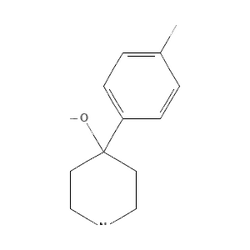
Haloperidol Stats & Data
LNEPOXFFQSENCJ-UHFFFAOYSA-NPharmacology
DrugBankDescription
Haloperidol is a high potency first-generation (typical) antipsychotic and one of the most frequently used antipsychotic medications used worldwide. While haloperidol has demonstrated pharmacologic activity at a number of receptors in the brain, it exerts its antipsychotic effect through its strong antagonism of the dopamine receptor (mainly D2), particularly within the mesolimbic and mesocortical systems of the brain. Haloperidol is indicated for the treatment of the manifestations of several psychotic disorders including schizophrenia, acute psychosis, Tourette syndrome, and other severe behavioural states. It is also used off-label for the management of chorea associated with Huntington's disease and for the treatment of intractable hiccups as it is a potent antiemetic. Dopamine-antagonizing medications such as haloperidol are though to improve psychotic symptoms and states that are caused by an over-production of dopamine, such as schizophrenia, which is theorized to be caused by a hyperdopaminergic state within the limbic system of the brain. Use of the first-generation antipsychotics (including haloperidol) is considered highly effective for the management of the "positive" symptoms of schizophrenia including hallucinations, hearing voices, aggression/hostility, disorganized speech, and psychomotor agitation.
Mechanism of Action
While haloperidol has demonstrated pharmacologic activity at a number of receptors in the brain, it exerts its antipsychotic effect through its strong antagonism of the dopamine receptor (mainly D2), particularly within the mesolimbic and mesocortical systems of the brain. Schizophrenia is theorized to be caused by a hyperdopaminergic state within the limbic system of the brain. Dopamine-antagonizing medications such as haloperidol, therefore, are thought to improve psychotic symptoms by halting this over-production of dopamine. The optimal clinical efficacy of antipsychotics is associated with the blockade of approximately 60 % - 80 % of D2 receptors in the brain. While the exact mechanism is not entirely understood, haloperidol is known to inhibit the effects of dopamine and increase its turnover. Traditional antipsychotics, such as haloperidol, bind more tightly than dopamine itself to the dopamine D2 receptor, with dissociation constants that are lower than that for dopamine. It is believed that haloperidol competitively blocks post-synaptic dopamine (D2) receptors in the brain, eliminating dopamine neurotransmission and leading to the relief of delusions and hallucinations that are commonly associated with psychosis. It acts primarily on the D2-receptors and has some effect on 5-HT2 and α1-receptors, with negligible effects on dopamine D1-receptors. The drug also exerts some blockade of α-adrenergic receptors of the autonomic system.
Pharmacodynamics
Use of the first-generation antipsychotics (including haloperidol) is considered highly effective for the management of the "positive" symptoms of schizophrenia including hallucinations, hearing voices, aggression/hostility, disorganized speech, and psychomotor agitation. However, this class is limited by the development of movement disorders such as drug-induced parkinsonism, akathisia, dystonia, and tardive dyskinesia, and other side effects including sedation, weight gain, and prolactin changes. Compared to the lower-potency first-generation antipsychotics such as DB00477, DB01624, DB00623, and DB01403, haloperidol typically demonstrates the least amount of side effects within class, but demonstrates a stronger disposition for causing extrapyramidal symptoms (EPS). Low‐potency medications have a lower affinity for dopamine receptors so that a higher dose is required to effectively treat symptoms of schizophrenia. In addition, they block many receptors other than the primary target (dopamine receptors), such as cholinergic or histaminergic receptors, resulting in a higher incidence of side effects such as sedation, weight gain, and hypotension. The balance between the wanted drug effects on psychotic symptoms and unwanted side effects are largely at play within dopaminergic brain pathways affected by haloperidol.
Metabolism
Haloperidol is extensively metabolised in the liver with only about 1% of the administered dose excreted unchanged in urine. In humans, haloperidol is biotransformed to various metabolites, including p-fluorobenzoylpropionic acid, 4-(4-chlorophenyl)-4-hydroxypiperidine, reduced haloperidol, pyridinium metabolites, and haloperidol glucuronide. In psychiatric patients treated regularly with haloperidol, the concentration of haloperidol glucuronide in plasma is the highest among the metabolites, followed, in rank order, by unchanged haloperidol, reduced haloperidol and reduced haloperidol glucuronide. The drug is thought to be metabolized primarily by oxidative N-dealkylation of the piperidine nitrogen to form fluorophenylcarbonic acids and piperidine metabolites (which appear to be inactive), and by reduction of the butyrophenone carbonyl to the carbinol, forming _hydroxyhaloperidol_. The enzymes involved in the biotransformation of haloperidol include cytochrome P450 (CYP) including CYP3A4 and CYP2D6, carbonyl reductase and uridine di-phosphoglucose glucuronosyltransferase enzymes. The greatest proportion of the intrinsic hepatic clearance of haloperidol is performed by glucuronidation and followed by the reduction of haloperidol to reduced haloperidol and by CYP-mediated oxidation. In studies of cytochrome-mediated disposition in vitro, CYP3A4 appears to be the major isoform of the enzyme responsible for the metabolism of haloperidol in humans.
Absorption
Haloperidol is a highly lipophilic compound and is extensively metabolized in humans, which may cause a large interindividual variability in its pharmacokinetics. Studies have found a wide variance in pharmacokinetic values for orally administered haloperidol with 1.7-6.1 hours reported for time to peak plasma concentration (tmax), 14.5-36.7 hours reported for half-life (t1⁄2), and 43.73 μg/L•h range 14.89-120.96 μg/L•h reported for AUC. Haloperidol is well-absorbed from the gastrointestinal tract when ingested orally, however, the first-pass hepatic metabolism decreases its oral bioavailability to 40 - 75%. After intramuscular administration, the time to peak plasma concentration (tmax) is 20 minutes in healthy individuals or 33.8 minutes in patients with schizophrenia, with a mean half-life of 20.7 hours. Bioavailability following intramuscular administration is higher than that for oral administration. Administration of haloperidol decanoate (the depot form of haloperidol for long-term treatment) in sesame oil results in slow release of the drug for long-term effects. The plasma concentrations of haloperidol gradually rise, reaching its peak concentration at about 6 days after the injection, with an apparent half-life of about 21 days. Steady-state plasma concentrations are achieved after the third or fourth dose.
Indication
Haloperidol is indicated for a number of conditions including for the treatment of schizophrenia, for the manifestations of psychotic disorders, for the control of tics and vocal utterances of Tourette’s Disorder in children and adults, for treatment of severe behavior problems in children of combative, explosive hyperexcitability (which cannot be accounted for by immediate provocation). Haloperidol is also indicated in the short-term treatment of hyperactive children who show excessive motor activity with accompanying conduct disorders consisting of some or all of the following symptoms: impulsivity, difficulty sustaining attention, aggressivity, mood lability, and poor frustration tolerance. Haloperidol should be reserved for these two groups of children only after failure to respond to psychotherapy or medications other than antipsychotics.
Half-life
Following oral administration, the half-life was found to be 14.5-36.7 hours. Following intramuscular injection, mean half-life was found to be 20.7 hours.
Protein Binding
Studies have found that free fraction of haloperidol in human plasma is 7.5-11.6%. This was found to be comparable among healthy adults, young adults, elderly patients with schizophrenia, and even in patients with liver cirrhosis.
Elimination
In radiolabeling studies, approximately 30% of the radioactivity is excreted in the urine following a single oral administration of 14C-labelled haloperidol, while 18% is excreted in the urine as haloperidol glucuronide, demonstrating that haloperidol glucuronide is a major metabolite in the urine as well as in plasma in humans.
Volume of Distribution
The apparent volume of distribution was found to range from 9.5-21.7 L/kg. This high volume of distribution is in accordance with its lipophilicity, which also suggests free movement through various tissues including the blood-brain barrier.
Clearance
Following intravenous administration, the plasma or serum clearance (CL) was found to be 0.39-0.708 L/h/kg (6.5 to 11.8 ml/min/kg). Following oral administration, clearance was found to be 141.65 L/h (range 41.34 to 335.80 L/h). Haloperidol clearance after extravascular administration ranges from 0.9-1.5 l/h/kg, however this rate is reduced in poor metabolizers of C_YP2D6_ enzyme. Reduced CYP2D6 enzyme activity may result in increased concentrations of haloperidol. The inter-subject variability (coefficient of variation, %) in haloperidol clearance was estimated to be 44% in a population pharmacokinetic analysis in patients with schizophrenia . Genetic polymorphism of CYP2D6 has been demonstrated to be an important source of inter-patient variability in the pharmacokinetics of haloperidol and may affect therapeutic response and incidence of adverse effects.
Measured Affinities
Guide to PHARMACOLOGYMeasured binding and functional data for haloperidol, curated by the IUPHAR/BPS Guide to PHARMACOLOGY. Each row cites the paper it came from. Lower concentrations mean tighter binding — a value in the sub-nanomolar range indicates a very potent interaction.
| Target | Action | Measure | Value | Concentration | Species | Source |
|---|---|---|---|---|---|---|
| D2 receptor Drd2 | Antagonist | pKi | 8.3 | 5.01 nM | Rat | PMID 1975644 |
| 5-HT2A receptor Htr2a | Antagonist | pKi | 7.4 | 39.81 nM | Rat | PMID 9655845 |
| D3 receptor Drd3 | Antagonist | pKi | 7 | 100 nM | Rat | PMID 1975644 |
| 5-HT1D receptor HTR1D | Antagonist | pKi | 6.6 | 251.19 nM | Human | PMID 8935801 |
| 5-HT7 receptor Htr7 | Antagonist | pKi | 6.3 | 501.19 nM | Mouse | PMID 8394987 |
| D5 receptor DRD5 | Antagonist | pKi | 6.3 | 501.19 nM | Human | PMID 1826762 |
| Kv10.1 KCNH1 | Channel blocker | pIC50 | 6.2 | 630.96 nM | Human | PMID 12522086 |
| Kir3.2 Kcnj6 | Antagonist | pEC50 | 4.1 | 79,433 nM | Mouse | PMID 10780978 |
| 5-HT1A receptor HTR1A | Antagonist | pKi | — | — | Human | — |
| 5-HT2A receptor HTR2A | Antagonist | pKi | — | — | Human | — |
| 5-HT2B receptor HTR2B | Antagonist | pKi | — | — | Human | PMID 9459568 |
| 5-HT7 receptor Htr7 | Antagonist | pKi | — | — | Rat | — |
| 5-HT7 receptor HTR7 | Antagonist | pKi | — | — | Human | PMID 9298538 |
| D1 receptor DRD1 | Antagonist | pKi | — | — | Human | — |
| D2 receptor DRD2 | Antagonist | pKi | — | — | Human | — |
| D3 receptor DRD3 | Antagonist | pKi | — | — | Human | — |
| D4 receptor DRD4 | Antagonist | pKi | — | — | Human | — |
| H1 receptor HRH1 | Antagonist | pKi | — | — | Human | — |
| TAS2R10 TAS2R10 | Agonist | - | — | — | Human | PMID 20022913 |
Reading this. pKi, pEC50 and pIC50 are negative log molar values, so a higher number means a tighter interaction; the concentration column converts them for you. Values from non-human species are laboratory measurements and do not translate directly to human effect. Receptor affinity is not a dose — it describes what a molecule binds, not how much of it is safe to take.
Receptor data from the IUPHAR/BPS Guide to PHARMACOLOGY (v2026.2), licensed CC BY-SA 4.0. Matched to this substance by InChIKey.
Haloperidol can have serious side effects at higher dosages, such as risk of having severe extrapyramidal symptoms and muscle rigidity, which can last for hours. Both typical and atypical antipsychotics can cause tardive dyskinesia. Rates are lower with the atypicals at 3.9% as opposed to the typicals at 5.5%. Switching to these atypicals is an option to minimize symptoms of tardive dyskinesia caused by other atypicals. It is strongly recommended that one use harm reduction practices when using this drug.
LD50
LD50: 128 mg/kg (Oral, Rat)LD50: 71 mg/kg (Oral, Mouse)LD50: 90 mg/kg (Oral, Dog)LD50: 165 mg/kg (Oral, Rat)
Carcinogenicity
No indication of carcinogenicity to humans (not listed by IARC).
Liver injury risk
Low concern (rare serious cases reported)
Tolerance & Pharmacokinetics
drugs.wikiTolerance Decay
Experience Report Analysis
ErowidDemographics
Gender Distribution
Too few reports for a chart: gender is known from 9 reports, and a split is drawn only from 20 reports or more. Counts are shown instead. Why 20?
- Male 8 of 9
- Female 1 of 9
Age Distribution
Reports Over Time
Effect Analysis
ErowidEffects aggregated from 5 experience reports (5 single-substance Erowid)
Effect Sentiment Distribution
Confidence Distribution
Each bar is the share of reports mentioning the effect; its whisker, and the band on the rows below, is the 95% interval: where the share could plausibly be with other reports of the same kind.
Too few reports for bars: these effects come from 5 single-substance Erowid reports, and a bar is drawn only from 20 reports or more. With fewer, a percentage cannot tell a common effect from a rare one. Counts are shown instead. Why 20?
Positive Effects 2
Adverse Effects 1
Also reported in combinations. In the 4 Haloperidol reports where another drug was taken too, 4 mention hospital, emergency services or an overdose, 0 a seizure and 1 psychosis (too few reports for percentages). In the 5 single-substance reports: 0, 1 and 1. These are not in the figures above: they cannot be put down to Haloperidol alone, and a mention is not always something that happened to the writer.
Real-World Dose Distribution
ErowidFrom 10 of 13 recorded dose entries: those that state a weight (mg, g or µg), in routes with at least five of them. Values above Q3 + 3×IQR, far above what people typically take, are left out; they can include real heavy doses and overdoses, not only mistakes.
Oral (n=8)
Form / Preparation
Most common forms and preparations, as a share of the 5 reports that give one
Too few reports for bars: these forms come from 5 reports, and a bar is drawn only from 20 reports or more. With fewer, a percentage cannot tell a common effect from a rare one. Counts are shown instead. Why 20?
- Pill / Tablet 5 of 5