
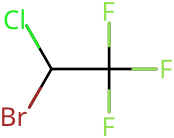
Halothane Stats & Data
BCQZXOMGPXTTIC-UHFFFAOYSA-NPharmacology
DrugBankDescription
A nonflammable, halogenated, hydrocarbon anesthetic that provides relatively rapid induction with little or no excitement. Analgesia may not be adequate. nitrous oxide is often given concomitantly. Because halothane may not produce sufficient muscle relaxation, supplemental neuromuscular blocking agents may be required. (From AMA Drug Evaluations Annual, 1994, p178)
Mechanism of Action
Halothane causes general anaethesia due to its actions on multiple ion channels, which ultimately depresses nerve conduction, breathing, cardiac contractility. Its immobilizing effects have been attributed to its binding to potassium channels in cholinergic neurons. Halothane's effect are also likely due to binding to NMDA and calcium channels, causing hyperpolarization.
Pharmacodynamics
Halothane is a general inhalation anesthetic used for induction and maintenance of general anesthesia. It reduces the blood pressure and frequently decreases the pulse rate and depresses respiration. It induces muscle relaxation and reduces pains sensitivity by altering tissue excitability. It does so by decreasing the extent of gap junction mediated cell-cell coupling and altering the activity of the channels that underlie the action potential.
Metabolism
Halothane is metabolized in the liver, primarily by CYP2E1, and to a lesser extent by CYP3A4 and CYP2A6.
Indication
For the induction and maintenance of general anesthesia
Measured Affinities
Guide to PHARMACOLOGYMeasured binding and functional data for halothane, curated by the IUPHAR/BPS Guide to PHARMACOLOGY. Each row cites the paper it came from. Lower concentrations mean tighter binding — a value in the sub-nanomolar range indicates a very potent interaction.
| Target | Action | Measure | Value | Concentration | Species | Source |
|---|---|---|---|---|---|---|
| Kir3.2 | Antagonist | pIC50 | 4.2 | 63,096 nM | None | PMID 11455015 |
| K2P5.1 KCNK5 | Activator | pIC50 | 3.7 | 199,526 nM | Human | PMID 10839924 |
| Kv2.1 Kcnb1 | Channel blocker | pEC50 | 3.5 | 316,228 nM | Rat | PMID 8638845 |
| TRPM3 TRPM3 | Antagonist | pIC50 | 3.28 | 524,807 nM | Human | PMID 31987857 |
| K2P3.1 Kcnk3 | Positive | pEC50 | 3 | 1,000,000 nM | Rat | — |
| K2P10.1 KCNK10 | Activator | - | — | — | Human | PMID 10880510 |
| K2P12.1 KCNK12 | Inhibitor | - | — | — | Human | PMID 25148687 |
| K2P13.1 KCNK13 | Inhibitor | - | — | — | Human | PMID 25148687 |
| K2P2.1 KCNK2 | Activator | - | — | — | Human | PMID 10321245 |
| K2P3.1 KCNK3 | Activator | - | — | — | Human | PMID 20519544 |
| K2P9.1 KCNK9 | Activator | - | — | — | Human | PMID 11886861 |
Reading this. pKi, pEC50 and pIC50 are negative log molar values, so a higher number means a tighter interaction; the concentration column converts them for you. Values from non-human species are laboratory measurements and do not translate directly to human effect. Receptor affinity is not a dose — it describes what a molecule binds, not how much of it is safe to take.
Receptor data from the IUPHAR/BPS Guide to PHARMACOLOGY (v2026.2), licensed CC BY-SA 4.0. Matched to this substance by InChIKey.
Halothane causes general anaethesia due to its actions on multiple ion channels, which ultimately depresses nerve conduction, breathing, cardiac contractility. Its immobilizing effects have been attributed to its binding to potassium channels in cholinergic neurons.
Carcinogenicity
No indication of carcinogenicity to humans (not listed by IARC).
Toxicity (DrugBank)
Toxic effects of halothane include malignant hyperthermia and hepatitis.
Health effects (PubChem excerpts)
Damage or injury to the liver.
Tolerance & Pharmacokinetics
drugs.wikiNo tolerance chart. Our decay curves for these drugs were estimates, and a curve can make tolerance look longer-lasting than it is, which is the dangerous direction.
How fast tolerance to these drugs fades after a break has not been measured well enough to draw, so don't count on a dose you used to take still being safe: after time off, start with a much smaller amount and don't use alone. Mixing sedatives with each other, with alcohol or with opioids sharply raises the risk of a fatal overdose. If you've been using regularly, don't stop suddenly: withdrawal from benzodiazepines, alcohol or GHB/GBL can cause seizures or delirium, so get medical help to cut down gradually.
Sources: FRANK: benzodiazepines · Alcohol and Drug Foundation: GHB · FDA 2020: benzodiazepine boxed warning · FDA 2019: gabapentinoids and breathing · NHS: alcohol use disorder
Experience Report Analysis
ErowidDemographics
Gender Distribution
Too few reports for a chart: gender is known from 1 report, and a split is drawn only from 20 reports or more. Counts are shown instead. Why 20?
- Male 1 of 1