
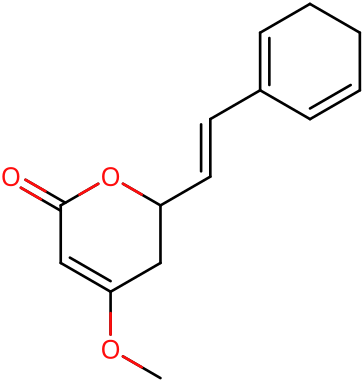
Kava Stats & Data
OMNGEVNATYFZGG-BQYQJAHWSA-NPharmacology
DrugBankReceptor Profile
Receptor Actions
Receptor Binding
History & Culture
Kava originated in northern Vanuatu, where it was domesticated by farmers approximately 3,000 years ago through selective cultivation. The plant was subsequently spread eastward by the Austronesian Lapita culture into the rest of Polynesia, becoming endemic to Oceania while remaining absent from other Austronesian groups. The beverage reached Hawaii but could not establish itself in New Zealand due to the colder climate. In memory of the kava plants they brought with them and unsuccessfully attempted to cultivate, the Māori gave the name kawa-kawa to another Piperaceae species (M. excelsum). The Māori word "kawa" also came to mean "ceremonial protocol," reflecting the stylized consumption practices typical of Polynesian societies. Kava consumption is believed to be the reason betel nut chewing, otherwise ubiquitous among Austronesian peoples, was abandoned in Oceania.
Kava has been consumed in Pacific Island communities for over three millennia in religious, political, cultural, and social contexts, typically prepared as a beverage. Throughout the Pacific, the plant is treated with great respect and holds an important place in local cultures, though each society has developed its own distinct traditions alongside shared practices. In Fiji, formal yaqona ceremonies accompany significant social, political, and religious functions, usually involving a ritual presentation of bundled roots as a sevusevu (gift) followed by communal drinking. In precolonial Hawaii, the Aliʻi (kings) coveted the Moʻi variety for its strong cerebral effects, attributed to a predominant concentration of the kavalactone kavain. This sacred cultivar was restricted exclusively to royalty, with commoners forbidden from experiencing it on pain of death. In Vanuatu, the nakamal serves as the traditional central meeting place and cultural hub where kava consumption facilitates communal gathering, dialogue, and the exchange of knowledge across generations. In many Pacific communities, kava functions as a replacement for alcohol and is consumed throughout the day, particularly before spiritual rituals and social gatherings. Historically, it has been recognized as an entheogen of Pacific Island and Polynesian communities, playing an important role in various spiritual and ritualistic rites.
1778–present
Western interest in kava began with Captain Cook's voyages to the Pacific islands in 1778, though the beverage was initially regarded as inferior to alcohol. During the 18th and 19th centuries, Christian missionaries made efforts to prohibit kava drinking, which inadvertently led to changes in preparation methods. Historically, the beverage had been made exclusively from fresh kava root; in response to missionary restrictions, preparation from dried kava emerged as an alternative practice. In recent decades, facilitated largely by the internet, kava has become available to users worldwide and has been adopted by increasing numbers of people outside the Pacific region. Nakamals and kava bars now exist in many countries, where the beverage can be consumed in a social setting similar to traditional practices. As a major traditional producer, Vanuatu has introduced legislation focused on regulating the quality of its kava exports rather than restricting domestic availability.
Toxicity
PsychonautWikiStudies have shown that kava can and will induce a low level of hepatic apoptosis similar to how paracetamol affects the liver and also can affect hepatic enzymes. Because of this, certain medications can make kava unsuitable and even dangerous for some users. Noble kava root alone can not, without consuming very large amounts of the substance, induce toxic levels and no overdose has ever been recorded. The consumption of 'noble' kava root has very low toxicity, however consumption 'tudei' kava and the stems and leaves of kava plants may increase the risk of liver damage.
Demographics
Gender Distribution
Age Distribution
Reports Over Time
Effect Analysis
Erowid + BluelightEffects aggregated from 129 experience reports (123 single-substance Erowid + 6 Bluelight)
Effect Sentiment Distribution
Confidence Distribution
Each bar is the share of reports mentioning the effect; its whisker, and the band on the rows below, is the 95% interval: where the share could plausibly be with other reports of the same kind.
Rows resting on fewer than 20 reports show a count (“3 of 7”) instead of a bar. Why 20?
Positive Effects 22
Adverse Effects 7
Show 7 neutral or unclassified mentions
Also reported in combinations. In the 65 Kava reports where another drug was taken too, 2 (3.1%) mention hospital, emergency services or an overdose, 0 (0.0%) a seizure and 0 (0.0%) psychosis. In the 123 single-substance reports: 3.3%, 0.0% and 0.8%. These are not in the figures above: they cannot be put down to Kava alone, and a mention is not always something that happened to the writer.
Dose-Response Correlation
How effect frequency changes across dose levels. Whiskers, and the numbers' hover text, give each figure's 95% interval.
Not drawn, too few reports (a dose tier needs 20): Oral Heavy (n=18). Why 20?
Dosage Distribution
Dose distribution from experience reports, one dose per report (the first listed). Doses above Q3 + 3×IQR, far above what people typically take, are left out of the median and range and listed under each route: most are real heavy doses or overdoses, not mistakes.
Real-World Dose Distribution
ErowidFrom 86 of 290 recorded dose entries: those that state a weight (mg, g or µg), in routes with at least five of them. Values above Q3 + 3×IQR, far above what people typically take, are left out; they can include real heavy doses and overdoses, not only mistakes.
Oral (n=84)
Common Combinations
Most co-occurring substances, as a share of all 188 reports filed under Kava; whiskers are 95% intervals
Form / Preparation
Most common forms and preparations, as a share of the 162 reports that give one; whiskers are 95% intervals
Body-Weight Dosing
Dose per kg of body weight, one dose per report (the first listed), from reports giving a weight of 30–250 kg. Doses above Q3 + 3×IQR, far above what people typically take, are left out of the median and range and listed under each route.
4 reports gave a dose above the typical range (121.429–408.497 mg/kg), so they are not in the figures above. Listing a dose here does not mean it is safe.
Show the reports
- 408.497 mg/kg
- 240 mg/kg · another drug taken too
- 216.179 mg/kg
- 121.429 mg/kg
Redose Patterns
Redosing behavior across 168 reports
Legal Status
| Country | Status | Notes |
|---|---|---|
| Australia | Regulated | Governed by the National Code of Kava Management since June 2007. Commercial importation is prohibited except for medical or scientific purposes. Individuals aged 18 or older may bring up to 2 kg in accompanied baggage for personal use. |
| Brazil | Legal | Kava is sold in herb shops without specific regulatory controls. Recreational use is reportedly uncommon. |
| Canada | Restricted (commercial sale banned) | Health Canada issued a stop order in August 2002 prohibiting the sale of kava products for human consumption. All kava-containing products including beverages and supplements are banned from commercial sale. However, personal purchase and importation from foreign vendors is not illegal for Canadian citizens. |
| Ethiopia | Legal | Kava products are available for purchase without age restrictions. |
| France | Banned for sale | Kava supplements and products are prohibited from commercial sale. The raw plant Piper methysticum may reportedly still be available through herbalists. |
| Germany | Restricted | Following multiple reported cases of liver toxicity, including fatalities and transplants, regulations were tightened. Kava preparations are now required to be sold only in significantly diluted formulations. |
| Israel | Uncertain | Legal status remains unclear due to conflicting reports. Some sources indicate kava is legal to possess, import, and sell, while others suggest it may be prohibited. |
| Netherlands | Banned for sale | Kava-containing products have been prohibited from general sale since January 2003. |
| New Zealand | Legal | Kava supplements are widely available and sold at grocery stores without significant restriction. |
| Norway | Prescription only | While not specifically scheduled as a controlled substance, the national health council classifies kava as a prescription medication due to its psychoactive properties, restricting availability to pharmacies only. |
| Sweden | Banned for sale (import permitted) | Commercial sale of kava within Sweden is prohibited. Personal importation for individual use is permitted. |
| Switzerland | Restricted | Kavalactone-containing pharmaceutical products such as Laitan have been banned from sale in pharmacies. |
| United Kingdom | Restricted (medicinal products banned) | Under Statutory Instrument 2002 No.3170 (The Medicines for Human Use (Kava-kava) (Prohibition) Order 2002), selling, supplying, or importing medicinal products containing kava for human consumption is prohibited. Personal possession remains legal, and importation for non-consumption purposes is permitted. |
| United States | Unscheduled | Kava remains legal for sale, possession, and ingestion. While the FDA previously raised concerns regarding potential liver toxicity, these remarks have since been archived and no scheduling action was taken. The substance is widely available in health food stores as liquid extracts and capsules. |
| Vanuatu | Regulated (export quality) | As a major traditional producer, Vanuatu has enacted legislation focusing on regulating the quality of kava exports rather than restricting domestic availability. |
References
Data Sources
Cited References
- Chua et al. 2016: Kavain GABA-A Receptor Potentiation
- Drug Science: Kava
- Erowid: Kava Vault
- Li & Ramzan 2010: Ethanol and Kava Hepatotoxicity
- Ligresti et al. 2012: Yangonin CB1 Receptor Activity
- Magura et al. 1997: Kava Sodium Channel Inhibition
- Wikipedia: Kavalactone
- DrugBank Article: Liver toxicity of Kava