
LSA Stats & Data
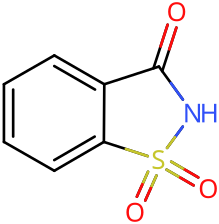
C1=CC=C2C(=C1)C(=O)NS2(=O)=OCVHZOJJKTDOEJC-UHFFFAOYSA-NReceptor Profile
Receptor Actions
History & Culture
The use of LSA-containing morning glory seeds by indigenous peoples of Mexico and Latin America dates back to pre-Columbian times. Seeds from Ipomoea corymbosa (known as ololiuhqui) and Ipomoea tricolor (tlitliltzin) were employed in shamanic rituals across the region for centuries. The first formal ethnobotanical documentation of this practice came from Richard Schultes in 1941, who described the traditional use of morning glory seeds by Mexican Native Americans going back to the Aztec period. In 1960, Don Thomes MacDougall expanded on this research, reporting that certain Zapotec communities consumed the seeds as sacraments, sometimes alongside Rivea corymbosa, another morning glory species containing similar lysergamide alkaloids. Notably, Argyreia nervosa (Hawaiian baby woodrose), despite being a potent source of LSA, was not traditionally employed for entheogenic purposes in its native India. The psychoactive properties of this plant were first brought to wider attention in the 1960s.
1947–present
LSA was first tested for psychoactive effects in humans by Swiss chemist Albert Hofmann in 1947—notably before the compound was known to occur naturally in plants. In self-experiments using intramuscular administration of a 500 microgram dose, Hofmann reported experiencing a drowsy, dream-like condition with difficulty maintaining focused thought. After a brief period of sleep, the effects resolved completely within approximately five hours. These early observations have contributed to ongoing questions about whether LSA alone accounts for the full psychoactive profile of morning glory seeds and Hawaiian baby woodrose. Anecdotal reports suggest that the effects of pure synthetic LSA differ somewhat from experiences produced by consuming these plant materials, which contain multiple lysergamide alkaloids rather than a single active compound.
While Argyreia nervosa was not traditionally used as a psychoactive substance, the root of the plant has an established place in Ayurvedic medicine. It is regarded as a tonic for the nervous system and brain, traditionally taken as a rejuvenating preparation and aphrodisiac believed to enhance cognitive function. Other documented traditional applications include treatments for conditions such as chronic ulcers, diabetes, anemia, urinary difficulties, and various cerebral disorders. The plant has also been used as an appetizer, cardiotonic, and general restorative, with traditional attributions of anti-inflammatory, immunomodulatory, and antimicrobial properties.
Subjective Effects
Physical
- Spontaneous tactile sensations: The body high of LSA can be described as a mild yet pleasurable, soft tingling sensation. This is largely noticed in high doses and is accompanied by strong waves of physical euphoria which are usually manifested spontaneously at different unpredictable points throughout the trip but can also maintain a consistent presence.
- Physical euphoria
- Nausea
- Vasoconstriction
Cognitive
The head space of LSA is described by many as extremely relaxing yet lucid and clear headed in its style when compared to other commonly used psychedelics such as LSD or Psilocin. Although it is primarily sedating, it is accompanied by fast paced bursts of thought.
- Connectivity of thought
- Introspection
- Acceleration of thought
- Enhancement of current mind state
- Feelings of fascination, importance and awe
- Conceptual thinking
- Ego suppression, loss and death
- Time distortion
- Direct communication with the subconscious
- Déjà vu
Sensory
The visual effects of LSA are mostly present when large doses have been consumed.
- Enhancements
- Distortions
- Hallucinations
Visual distortions and alterations are significantly more simplistic than open eye distortions found with other psychedelics.
- Visual drifting: (Melting, Flowing, Breathing and Morphing) - In comparison to other psychedelics, this effect can be described as mild but highly detailed yet cartoon-like in appearance. They are fast yet smooth in motion and fleeting in their permanence. This is an inconsistently manifested effect with some never reporting such distortions.
- Colour shifting
- Increased visual acuity
- Enhancement of colours
- Enhanced pattern recognition
LSA produces a full range of high level hallucinatory states in a fashion that is very consistent when taken in large doses.
- External hallucinations: These are extremely common within LSA and partially follow the content of the user's current thought process.
- Internal hallucinations: (Autonomous entities; settings, sceneries, and landscapes; alterations in perspective and scenarios and plots) - These are more common than external hallucinations and can be described as progressive in realistic-ness, autonomous in controllability and solid in style.
Forked from Subjective Effect Documentation by Josie Kins, September 2013. Via dose.wiki (CC0).
The toxicity and long-term health effects of recreational LSA use have not been studied in any scientific context and the exact toxic dose is unknown. Anecdotal evidence suggests that there are no negative health effects attributed to simply trying LSA by itself at low to moderate doses and using it very sparingly (but nothing can be completely guaranteed). Independent research should always be done to ensure that a combination of two or more substances is safe before consumption. It is strongly recommended that one use harm reduction practices when using this substance.
Carcinogenicity
Group 3: Not classifiable as to its carcinogenicity to humans
Addiction & dependence
LSA is considered to be non-addictive with a low abuse potential. There are no literature reports of successful attempts to train animals to self-administer LSA, an animal model predictive of abuse liability, indicating that it does not possess the necessary pharmacology to either initiate or maintain dependence. There is virtually no withdrawal syndrome when use is stopped.
Effect Profile
Curated + 686 ReportsStrong visuals, headspace, and auditory effects with strong body load
Duration Timeline
BluelightEmpirical Duration
Erowid ReportsMedian times after the dose that Erowid reports state. A curve is drawn only when reports state all four points (onset, peak begins, comedown begins, back to baseline) and the medians fall in that order. No point is estimated from another.
Community Effects
TripSitTolerance & Pharmacokinetics
drugs.wikiTolerance Decay
Cross-Tolerances
Demographics
Gender Distribution
Age Distribution
Reports Over Time
Effect Analysis
Erowid + BluelightEffects aggregated from 609 experience reports (559 single-substance Erowid + 127 Bluelight)
Effect Sentiment Distribution
Confidence Distribution
Each bar is the share of reports mentioning the effect; its whisker, and the band on the rows below, is the 95% interval: where the share could plausibly be with other reports of the same kind.
Positive Effects 72
Adverse Effects 64
Show 42 more adverse effects
Show 29 neutral or unclassified mentions
Also reported in combinations. In the 283 LSA reports where another drug was taken too, 27 (9.5%) mention hospital, emergency services or an overdose, 3 (1.1%) a seizure and 9 (3.2%) psychosis. In the 559 single-substance reports: 8.4%, 1.1% and 3.6%. These are not in the figures above: they cannot be put down to LSA alone, and a mention is not always something that happened to the writer.
Dose-Response Correlation
How effect frequency changes across dose levels. Whiskers, and the numbers' hover text, give each figure's 95% interval.
View data table
| Effect | Heavy (n=84) |
|---|---|
| Nausea | 66.7% (95% interval 56 to 76 percent) |
| Visual Distortions | 60.7% (95% interval 50 to 70 percent) |
| Music Enhancement | 40.5% (95% interval 31 to 51 percent) |
| Color Enhancement | 39.3% (95% interval 30 to 50 percent) |
| Euphoria | 38.1% (95% interval 28 to 49 percent) |
| Anxiety | 38.1% (95% interval 28 to 49 percent) |
| Sedation | 34.5% (95% interval 25 to 45 percent) |
| Stimulation | 32.1% (95% interval 23 to 43 percent) |
| Empathy | 29.8% (95% interval 21 to 40 percent) |
| Closed-Eye Visuals | 27.4% (95% interval 19 to 38 percent) |
| Confusion | 27.4% (95% interval 19 to 38 percent) |
| Auditory Effects | 27.4% (95% interval 19 to 38 percent) |
| Pupil Dilation | 27.4% (95% interval 19 to 38 percent) |
| Open-Eye Visuals | 21.4% (95% interval 14 to 31 percent) |
| Muscle Tension | 19.0% (95% interval 12 to 29 percent) |
Subjective Effect Ontology
Experience ReportsStructured effect tags extracted from 892 Erowid & Bluelight experience reports using a controlled vocabulary of 220+ canonical effects across 15 domains.
Auditory
Cognitive
Emotional
Gastrointestinal
Motor
Selfhood
Somatic
Tactile
Visual
Dose–Effect Mapping
Experience ReportsHow reported effects shift across dose tiers, based on 559 single-substance experience reports. The shaded band on each bar is its 95% interval. An arrow (↑ ↓) marks a change between the lowest and highest tier that count an effect only when the gap is bigger than chance would explain; ~ means no clear change. How changes are called
Limited tier coverage — most reports fall within the Heavy range. Effects at other dose levels may not be represented.
| Effect | Heavy (n=84) | Change with dose |
|---|---|---|
| nausea | ||
| visual distortions | ||
| music enhancement | ||
| color enhancement | ||
| euphoria | ||
| anxiety | ||
| sedation | ||
| stimulation | ||
| empathy | ||
| closed-eye visuals | ||
| confusion | ||
| auditory effects | ||
| pupil dilation | ||
| open-eye visuals | ||
| muscle tension | ||
| introspection | ||
| tactile enhancement | ||
| dissociation | ||
| body high | ||
| headache |
Showing top 20 of 32 effects
Dosage Distribution
Dose distribution from experience reports, one dose per report (the first listed). Doses above Q3 + 3×IQR, far above what people typically take, are left out of the median and range and listed under each route: most are real heavy doses or overdoses, not mistakes.
4 reports gave a dose above the typical range (25,000–39,600 mg), so they are not in the figures above. Listing a dose here does not mean it is safe.
Real-World Dose Distribution
ErowidFrom 229 of 1281 recorded dose entries: those that state a weight (mg, g or µg), in routes with at least five of them. Values above Q3 + 3×IQR, far above what people typically take, are left out; they can include real heavy doses and overdoses, not only mistakes.
Oral (n=220)
Common Combinations
Most co-occurring substances, as a share of all 842 reports filed under LSA; whiskers are 95% intervals
Form / Preparation
Most common forms and preparations, as a share of the 656 reports that give one; whiskers are 95% intervals
Body-Weight Dosing
Dose per kg of body weight, one dose per report (the first listed), from reports giving a weight of 30–250 kg. Doses above Q3 + 3×IQR, far above what people typically take, are left out of the median and range and listed under each route.
3 reports gave a dose above the typical range (393.701–472.441 mg/kg), so they are not in the figures above. Listing a dose here does not mean it is safe.
Show the reports
- 472.441 mg/kg · another drug taken too
- 433.996 mg/kg
- 393.701 mg/kg
Redose Patterns
Redosing behavior across 683 reports
Legal Status
| Country | Status | Notes |
|---|---|---|
| Australia | Prohibited (state legislation) | Consumption of LSA-containing materials is prohibited under state legislation in most Australian states. Control may vary between individual states and territories. |
| Canada | Not scheduled | LSA is not listed in the Controlled Drugs and Substances Act and possession is not illegal. However, sale for human consumption is likely prohibited. Plants containing LSA are not controlled. |
| Netherlands | Controlled | Listed as a controlled substance. Possession, distribution, and production without a license is illegal. |
| New Zealand | Controlled (chemical form) | Chemical LSA is controlled as a drug. However, morning glory plants and seeds remain legal to possess, cultivate, buy, and distribute. Commercial seeds are reportedly treated with deterrents and packaging includes warnings against consumption. |
| Poland | Uncertain (plants uncontrolled) | The legal status of LSA as a pure chemical remains unclear, but LSA-containing plants appear to be uncontrolled. |
| Sweden | Controlled | Scheduled for control as of May 1, 2007, alongside several other substances including 2C-T-4, DXM, and DOI. |
| United Kingdom | Class A | Classified as a Class A substance under the Misuse of Drugs Act 1971, categorized as a precursor to LSD. Class A carries the most severe penalties for possession and supply. |
References
Cited References
- Bluelight: The Big & Dandy LSA Thread
- Drugs-Forum: LSA Wiki
- Erowid: LSA Dosage
- Erowid: LSA Effects
- Erowid: LSA Vault
- Klinke et al. 2010: LSA Intoxication Cases (DOI)
- Lysergic Acid Amide (LSA), an LSD Analog: Systematic Review (MDPI, 2025)
- Paulke et al. 2013: Analysis of LSA in Human Serum and Urine (DOI)
- PsychonautWiki: LSA
- TripSit Wiki: LSA
- Wikipedia: Ergine