
PCP Stats & Data
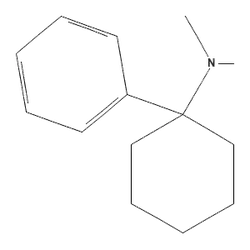
C1CCN(CC1)C1(CCCCC1)c1ccccc1JTJMJGYZQZDUJJ-UHFFFAOYSA-NInteraction Warnings
This combination is not advised because PCP has been reported to cause extreme psychological disturbances such as psychosis and mania at a significantly higher rate than other dissociatives.
This combination is not advised because PCP has been reported to cause extreme psychological disturbances such as psychosis and mania at a significantly higher rate than other dissociatives.
Pharmacology
DrugBankDescription
A hallucinogen formerly used as a veterinary anesthetic, and briefly as a general anesthetic for humans. Phencyclidine is similar to ketamine in structure and in many of its effects. Like ketamine, it can produce a dissociative state. It exerts its pharmacological action through inhibition of NMDA receptors (receptors, N-methyl-D-aspartate). As a drug of abuse, it is known as PCP and Angel Dust.
Mechanism of Action
The N-methyl-D-Aspartate (NMDA) receptor, a type of ionotropic receptor, is found on the dendrites of neurons and receives signals in the form of neurotransmitters. It is a major excitatory receptor in the brain. Normal physiological function requires that the activated receptor fluxes positive ions through the channel part of the receptor. PCP enters the ion channel from the outside of the neuron and binds, reversibly, to a site in the channel pore, blocking the flux of positive ions into the cell. PCP therefore inhibits depolarization of neurons and interferes with cognitive and other functions of the nervous system.
Pharmacodynamics
Phencyclidine works primarily as an NMDA receptor antagonist, which blocks the activity of the NMDA Receptor.
Receptor Profile
Receptor Actions
History & Culture
1926–1978
Phencyclidine was first synthesized in 1926 by German chemist Arthur Kötz and his student Paul Merkel during research involving Grignard reactions with piperidinocyclohexancarbonitrile compounds. The compound remained largely unexplored until 1956, when chemist H. Victor Maddox independently synthesized it and the pharmaceutical company Parke-Davis (now part of Pfizer) developed it as an anesthetic medication. The drug's clinical career proved brief. By 1965, medical use in humans was prohibited in the United States due to an unacceptably high rate of adverse effects in patients. Veterinary applications continued for over a decade longer, but these too were discontinued in 1978. The development of ketamine, which produced similar anesthetic effects with better tolerability, rendered PCP obsolete in legitimate medicine.
1960–1990
While still technically available as a medical anesthetic, PCP began appearing as a street drug in major American cities during the 1960s. Its recreational use grew substantially over the following decade, reaching a peak in the late 1970s. By 1978, prominent media outlets including People magazine and the CBS program 60 Minutes had declared it the nation's most pressing drug concern. The trajectory reversed sharply in the following decade. Surveys of American high school students showed that 13% reported having tried PCP at least once in 1979; by 1990, this figure had dropped below 3%. Despite this overall decline, the substance has remained in circulation, particularly in certain American urban areas. Emergency department visits related to PCP increased between 2005 and 2011, and as of 2022, approximately 0.7% of American twelfth-grade students reported use within the prior year.
PCP developed a fearsome popular reputation centered on claims that users became extraordinarily violent, impervious to pain, and capable of superhuman physical feats. Stories of users pulling out their own teeth, destroying property, and attacking others with unusual aggression became fixtures of drug scare coverage. Research conducted by the Drug Abuse Warning Network during the 1970s found these media accounts to be substantially exaggerated. Studies indicated that violent incidents were uncommon and typically involved individuals with pre-existing patterns of aggressive behavior regardless of substance use. Notably, the dramatic violent reactions described in news coverage were not observed during the drug's legitimate clinical use as an anesthetic in the 1950s and 1960s, and subsequent investigations have frequently found reports of PCP-induced violence to lack evidentiary foundation.
The drug's notoriety during its peak usage period generated various cultural representations. American artist Jean-Michel Basquiat referenced the substance in his 1982 painting "Dustheads," which depicted two individuals using angel dust. The Japanese manga series City Hunter, created by Tsukasa Hojo in 1985, featured a drug called "Angel Dust," though a 2023 animated film adaptation reimagined this as a fictional nanomachine serum rather than the actual substance. The animated series Hazbin Hotel features a character who adopted "Angel Dust" as his chosen name.
Toxicity
PsychonautWikiThe long-term use of PCP may lead to schizophrenia-like psychotic episodes, severe lasting memory loss, disorganized thinking, depression, weight loss, liver abnormalities and rhabdomyolysis (skeletal muscle breakdown). It is very strongly recommended that one use extreme caution and harm reduction practices when using this substance. For example,
Addiction & dependence
The chronic use of PCP can be considered highly addictive with a high potential for adverse side effects such as psychosis. In comparison to other dissociatives, PCP has been reported to be more addictive than MXE, diphenidine, ephenidine, and ketamine. When addiction has developed, cravings and withdrawal effects may occur if a person suddenly stops their usage.
Effect Profile
Curated + 77 ReportsStrong visuals and auditory effects with moderate headspace, low body load
Strong dissociative depth and insight with strong mania and motor impairment
Duration Timeline
BluelightCommunity Effects
TripSitTolerance & Pharmacokinetics
drugs.wikiTolerance Decay
Rapid tolerance develops with repeated exposure and partially generalizes across NMDA-antagonist dissociatives. Anecdotal and clinical observations suggest tolerance recedes substantially over 2–4 weeks of abstinence; prolonged heavy use may leave residual cognitive changes beyond simple tolerance. Data quality is limited and varies by compound and route.
Cross-Tolerances
Demographics
Gender Distribution
Age Distribution
Reports Over Time
Effect Analysis
Erowid + BluelightEffects aggregated from 77 experience reports (49 single-substance Erowid + 28 Bluelight)
Effect Sentiment Distribution
Confidence Distribution
Each bar is the share of reports mentioning the effect; its whisker, and the band on the rows below, is the 95% interval: where the share could plausibly be with other reports of the same kind.
Positive Effects 47
Adverse Effects 49
Show 28 more adverse effects
Show 28 neutral or unclassified mentions
Also reported in combinations. In the 55 PCP reports where another drug was taken too, 8 (14.5%) mention hospital, emergency services or an overdose, 1 (1.8%) a seizure and 6 (10.9%) psychosis. In the 49 single-substance reports: 8.2%, 0.0% and 2.0%. These are not in the figures above: they cannot be put down to PCP alone, and a mention is not always something that happened to the writer.
Common Combinations
Most co-occurring substances, as a share of all 104 reports filed under PCP; whiskers are 95% intervals
Form / Preparation
Most common forms and preparations, as a share of the 40 reports that give one; whiskers are 95% intervals
Redose Patterns
Redosing behavior across 51 reports
Harm Reduction
drugs.wikiPCP is highly lipophilic; symptoms can recur in waves hours to days later as drug redistributes from fat — avoid redosing to chase effects. Heat injury is a major risk during agitation or restraint; rapid cooling and prompt medical help are lifesaving in severe hyperthermia. Analgesia and dissociation mask injuries — avoid heights, water, stoves, traffic, and never drive for at least a full day after strong effects. Smoked “wet/sherm” is usually PCP solution, not real embalming fluid; formaldehyde is carcinogenic and should not be inhaled. Street strengths vary widely; use milligram-accurate scales and avoid eyeballing crystals or pre-dipped cigarettes. Combination with depressants (alcohol, benzos, opioids, GHB) greatly increases blackout, airway, and aspiration risks; medical teams use benzodiazepines for agitation and seizures — this is not a justification to self-mix. Stimulant co-use (cocaine, amphetamines) raises risks of psychosis, hyperthermia, and rhabdomyolysis. False positives for PCP occur on immunoassay urine screens (e.g., from DXM, venlafaxine, tramadol); confirmatory GC/MS is more specific. If severe agitation, chest pain, seizures, or very high temperature occur, call emergency services; quiet, low-stimulation environments reduce escalation. Consider drug checking where available (FTIR/GC–MS) as PCP may be mis-sold or cut with other arylcyclohexylamines; pre-dipped cigarettes are especially unpredictable. Frequent use builds strong tolerance and can lead to prolonged cognitive and mood disturbances; spacing use by several weeks reduces risk.
References
Data Sources
Cited References
Additional references
- Erowid PCP Dosage
- Erowid PCP Effects + Duration (smoked timeline, effects list)
- StatPearls: Phencyclidine Toxicity (management, half-life, complications)
- LiverTox: Phencyclidine (hyperthermia→hepatic injury; severe complications)
- Erowid: PCP ‘Embalming Fluid’ / Wet (slang vs. formaldehyde)
- Erowid: PCP archive PDF (street forms, misrepresentation, MAO notes)
- TripSit Wiki: PCP (potentiators; negative interactions; dose cautions)
- DrugWise: PCP overview and risks (depressants warning)
- Erowid: PCP Drug Testing (false positives; windows)
- Drugs‑Forum summary (pharmacokinetic ranges incl. 7–50 h; redistribution)
- Drug Checking technologies overview (FTIR/GC–MS capabilities)
- Bupropion (StatPearls): seizure risk; MAOI warnings