
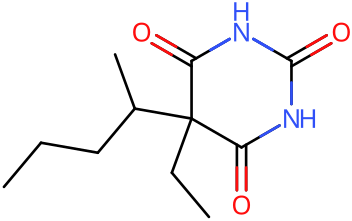
Pentobarbital Stats & Data
WEXRUCMBJFQVBZ-UHFFFAOYSA-NPharmacology
DrugBankDescription
A short-acting barbiturate that is effective as a sedative and hypnotic (but not as an anti-anxiety) agent and is usually given orally. It is prescribed more frequently for sleep induction than for sedation but, like similar agents, may lose its effectiveness by the second week of continued administration. (From AMA Drug Evaluations Annual, 1994, p236)
Mechanism of Action
Pentobarbital binds at a distinct binding site associated with a Cl- ionopore at the GABAA receptor, increasing the duration of time for which the Cl- ionopore is open. The post-synaptic inhibitory effect of GABA in the thalamus is, therefore, prolonged. All of these effects are associated with marked decreases in GABA-sensitive neuronal calcium conductance (gCa). The net result of barbiturate action is acute potentiation of inhibitory GABAergic tone. Barbiturates also act through potent (if less well characterized) and direct inhibition of excitatory AMPA-type glutamate receptors, resulting in a profound suppression of glutamatergic neurotransmission.
Pharmacodynamics
Pentobarbital, a barbiturate, is used for the treatment of short term insomnia. It belongs to a group of medicines called central nervous system (CNS) depressants that induce drowsiness and relieve tension or nervousness. Little analgesia is conferred by barbiturates; their use in the presence of pain may result in excitation.
Metabolism
by hepatic microsomal enzyme system
Absorption
Barbiturates are absorbed in varying degrees following oral, rectal, or parenteral administration.
Indication
For the short-term treatment of insomnia.
Elimination
Barbiturates are metabolized primarily by the hepatic microsomal enzyme system, and the metabolic products are excreted in the urine, and less commonly, in the feces. Approximately 25 to 50 percent of a dose of aprobarbital or phenobarbital is eliminated unchanged in the urine, whereas the amount of other barbiturates excreted unchanged in the urine is negligible.
Receptor Profile
Receptor Actions
Receptor Binding
History & Culture
1930–present
Pentobarbital was developed by chemists Ernest H. Volwiler and Donalee L. Tabern at Abbott Laboratories in 1930. That same year, physician John S. Lundy began clinical use of the compound and coined the brand name Nembutal, an amalgamation derived from the structural formula of its sodium salt—Na (sodium) combined with ethyl, methyl, butyl, and the common barbiturate suffix -al. The drug rapidly established itself in clinical practice as a sedative, short-term hypnotic, preanesthetic agent, and emergency anticonvulsant.
1930s–present
Pentobarbital became a widely abused pharmaceutical beginning in the late 1930s. Abbott's Nembutal capsules acquired the street name "yellow jackets" owing to the distinctive yellow color of the branded capsules. The formulation was available in 30, 50, and 100 mg capsules in yellow, white-orange, and yellow colors respectively, and the drug remained a commonly misused sedative throughout the mid-twentieth century.
1999–present
Abbott Pharmaceutical ceased production of their Nembutal-branded pentobarbital capsules in 1999, reflecting a broader transition in clinical practice as the benzodiazepine family of drugs supplanted barbiturates for most sedative and anxiolytic applications. Pentobarbital retained utility in veterinary medicine as an anesthetic and euthanasia agent. The injectable formulation continues to be manufactured, with Danish pharmaceutical company Lundbeck (now produced through Akorn Pharmaceuticals) remaining the sole supplier of injectable pentobarbital approved for sale in the United States.
Pentobarbital has become a primary agent in physician-assisted death protocols across several jurisdictions. In the Netherlands, it constitutes part of the standard protocol for voluntary euthanasia, administered as a 9-gram oral solution in sugar syrup and alcohol following an antiemetic to prevent vomiting. Swiss protocols utilize intravenous sodium pentobarbital administration, which induces unconsciousness within approximately 30 seconds and cardiac arrest within 3 minutes. In the United States, oral pentobarbital is employed for physician-assisted death in states including Oregon, Washington, Vermont, and California.
2010–present
Pentobarbital entered use in capital punishment following the 2011 cessation of sodium thiopental production by its sole U.S. manufacturer, which rendered importation of that traditional execution drug impractical. Pentobarbital was first employed in a U.S. execution in December 2010 in Oklahoma as part of a three-drug protocol. In March 2011, Ohio became the first jurisdiction to utilize pentobarbital as the sole lethal injection agent. This application generated significant international controversy. When Lundbeck discovered its product was being used for executions—a practice illegal under Danish law—public outcry in Danish media prompted the company to cease sales to U.S. states practicing capital punishment and to prohibit distributors from supplying any entities participating in human executions. Despite these supply complications, multiple U.S. jurisdictions adopted pentobarbital protocols. Texas implemented a single-drug pentobarbital protocol in July 2012 following shortages of pancuronium bromide. Missouri modified its protocol in October 2013 to permit pentobarbital obtained from compounding pharmacies. In July 2019, U.S. Attorney General William Barr authorized the federal government to resume capital punishment after a 16-year suspension, with the federal protocol specifying intravenous administration of two syringes each containing 2.5 grams of pentobarbital sodium.
Pentobarbital likely has moderate toxicity relative to dose. However, pentobarbital is potentially lethal when mixed with depressants like alcohol or opioids. Pentobarbital has a higher risk of death or serious adverse effects associated with concurrent depressant use than other drugs such as benzodiazepines. There have been studies linking the use of barbiturates, particularly phenobarbital, with the development of cancer . It is strongly recommended that one use harm reduction practices when using this drug.
Carcinogenicity
No indication of carcinogenicity to humans (not listed by IARC).
Overdose
Barbiturate overdose may occur when a barbiturate is taken in extremely heavy quantities or concurrently with other depressants. This is particularly dangerous with other GABAergic depressants such as benzodiazepines and alcohol since they work in a similar fashion, but bind to distinct allosteric sites on the GABAA receptor, thus their effects potentiate one another.
Toxicity (DrugBank)
Symptoms of an overdose typically include sluggishness, incoordination, difficulty in thinking, slowness of speech, faulty judgment, drowsiness or coma, shallow breathing, staggering, and in severe cases coma and death.
Tolerance & Pharmacokinetics
drugs.wikiNo tolerance chart. Our decay curves for these drugs were estimates, and a curve can make tolerance look longer-lasting than it is, which is the dangerous direction.
How fast tolerance to these drugs fades after a break has not been measured well enough to draw, so don't count on a dose you used to take still being safe: after time off, start with a much smaller amount and don't use alone. Mixing sedatives with each other, with alcohol or with opioids sharply raises the risk of a fatal overdose. If you've been using regularly, don't stop suddenly: withdrawal from benzodiazepines, alcohol or GHB/GBL can cause seizures or delirium, so get medical help to cut down gradually. With barbiturates, you get used to the effects much more than to a dangerous dose, so the gap between a dose that works and one that kills shrinks the more you use. Stopping suddenly after regular use can cause convulsions and delirium.
Sources: FRANK: benzodiazepines · Alcohol and Drug Foundation: GHB · FDA 2020: benzodiazepine boxed warning · FDA 2019: gabapentinoids and breathing · NHS: alcohol use disorder · Phenobarbital label: drug abuse and dependence
Experience Report Analysis
ErowidDemographics
Gender Distribution
Too few reports for a chart: gender is known from 4 reports, and a split is drawn only from 20 reports or more. Counts are shown instead. Why 20?
- Male 3 of 4
- Female 1 of 4
Age Distribution
Reports Over Time
Legal Status
| Country | Status | Notes |
|---|---|---|
| Australia | Schedule 8 | Controlled drug under Australian scheduling. Schedule 8 substances are available for therapeutic use but require strict prescribing and record-keeping requirements due to abuse potential. |
| Canada | Schedule IV CDSA | Controlled under the Controlled Drugs and Substances Act. Available for legitimate medical use with appropriate authorization. Historically marketed in combination products. |
| Germany | Anlage III BtMG | Listed in Anlage III of the Betäubungsmittelgesetz (Narcotics Act), indicating it is a marketable narcotic with recognized medical applications. Prescriptions require a special narcotic prescription form (Betäubungsmittelrezept). |
| Russia | Schedule II | Controlled substance under federal narcotics legislation. Subject to strict regulation with limited availability for medical purposes. |
| Switzerland | Verzeichnis B | Specifically named controlled substance under Verzeichnis B of Swiss narcotics legislation. Medicinal use is permitted with appropriate medical authorization. |
| United Kingdom | Class B | Controlled under the Misuse of Drugs Act 1971. Unauthorized possession, supply, and production carry criminal penalties, though less severe than Class A substances. |
| United States | Schedule II | Controlled under the Controlled Substances Act. Classified as having high potential for abuse but with currently accepted medical use. Approved for short-term treatment of insomnia and widely used in veterinary medicine. Available by prescription in injectable formulations. |