
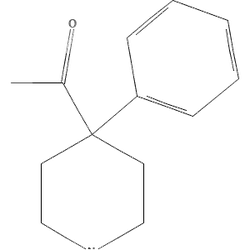
Pethidine Stats & Data
CCOC(=O)C1(CCN(C)CC1)c1ccccc1XADCESSVHJOZHK-UHFFFAOYSA-NPharmacology
DrugBankDescription
A narcotic analgesic that can be used for the relief of most types of moderate to severe pain, including postoperative pain and the pain of labor. Prolonged use may lead to dependence of the morphine type; withdrawal symptoms appear more rapidly than with morphine and are of shorter duration.
Mechanism of Action
Meperidine is primarily a kappa-opiate receptor agonist and also has local anesthetic effects. Meperidine has more affinity for the kappa-receptor than morphine. Opiate receptors are coupled with G-protein receptors and function as both positive and negative regulators of synaptic transmission via G-proteins that activate effector proteins. Binding of the opiate stimulates the exchange of GTP for GDP on the G-protein complex. As the effector system is adenylate cyclase and cAMP located at the inner surface of the plasma membrane, opioids decrease intracellular cAMP by inhibiting adenylate cyclase. Subsequently, the release of nociceptive neurotransmitters such as substance P, GABA, dopamine, acetylcholine and noradrenaline is inhibited. Opioids also inhibit the release of vasopressin, somatostatin, insulin and glucagon. Opioids close N-type voltage-operated calcium channels (OP2-receptor agonist) and open calcium-dependent inwardly rectifying potassium channels (OP3 and OP1 receptor agonist). This results in hyperpolarization and reduced neuronal excitability.
Pharmacodynamics
Meperidine is a synthetic opiate agonist belonging to the phenylpiperidine class. Meperidine may produce less smooth muscle spasm, constipation, and depression of the cough reflex than equivalent doses of morphine. The onset of action is lightly more rapid than with morphine, and the duration of action is slightly shorter. The chemical structure of meperidine is similar to local anesthetics. Meperidine is recommended for relief of moderate to severe acute pain and has the unique ability to interrupt postoperative shivering and shaking chills induced by amphotericin B. Meperidine has also been used for intravenous regional anesthesia, peripheral nerve blocks and intraarticular, epidural and spinal analgesia. Meperidine is considered a second-line agent for the treatment of acute pain.
Metabolism
Meperidine is metabolized in the liver by hydrolysis to meperidinic acid followed by partial conjugation with glucuronic acid. Meperidine also undergoes N-demethylation to normeperidine, which then undergoes hydrolysis and partial conjugation. Normeperidine is about half as potent as meperidine, but it has twice the CNS stimulation effects.
Absorption
The oral bioavailability of meperidine in patients with normal hepatic function is 50-60% due to extensive first-pass metabolism. Bioavailability increases to 80-90% in patients with hepatic impairment (e.g. liver cirrhosis). Meperidine is less than half as effective when administered orally compared to parenteral administration. One study reported that 80-85% of the drug administered intramuscularly was absorbed within 6 hours of intragluteal injection in health adults; however, inter-individual variation and patient-specific variable appear to cause considerable variations in absorption upon IM injection.
Indication
Used to control moderate to severe pain.
Half-life
Initial distribution phase (t1/2 α) = 2-11 minutes; terminal elimination phase (t1/2 β) = 3-5 hours. In patients with hepatic dysfunction (e.g. liver cirrhosis or active viral hepatitis) the t1/2 β is prolonged to 7-11 hours.
Protein Binding
60-80% bound to plasma proteins, primarily albumin and α1-acid glycoprotein. The presence of cirrhosis or active viral hepatitis does not appear to affect the extent of protein binding.
Elimination
Excreted in the urine. The proportion of drug that is excreted unchanged or as metabolites is dependent on pH. When urine pH is uncontrolled, 5-30% of the meperidine dose is excreted as normeperidine and approximately 5% is excreted unchanged. Meperidine and normeperidine are found in acidic urine, while the free and conjugated forms of meperidinic and normperidinic acids are found in alkaline urine.
Volume of Distribution
Meperidine crosses the placenta and is distributed into breast milk.
Receptor Profile
Receptor Actions
Receptor Binding
Measured Affinities
Guide to PHARMACOLOGYMeasured binding and functional data for pethidine, curated by the IUPHAR/BPS Guide to PHARMACOLOGY. Each row cites the paper it came from. Lower concentrations mean tighter binding — a value in the sub-nanomolar range indicates a very potent interaction.
| Target | Action | Measure | Value | Concentration | Species | Source |
|---|---|---|---|---|---|---|
| μ receptor OPRM1 | Agonist | pIC50 | 6.5 | 316.23 nM | Human | PMID 11585443 |
| κ receptor OPRK1 | Agonist | pIC50 | 5.63 | 2,344 nM | Human | PMID 11585443 |
| δ receptor OPRD1 | Agonist | pIC50 | 5 | 10,000 nM | Human | PMID 11585443 |
Reading this. pKi, pEC50 and pIC50 are negative log molar values, so a higher number means a tighter interaction; the concentration column converts them for you. Values from non-human species are laboratory measurements and do not translate directly to human effect. Receptor affinity is not a dose — it describes what a molecule binds, not how much of it is safe to take.
Receptor data from the IUPHAR/BPS Guide to PHARMACOLOGY (v2026.2), licensed CC BY-SA 4.0. Matched to this substance by InChIKey.
Pethidine has a high toxicity relative to dose. As with all opioids, long-term effects can vary but can include diminished libido, apathy and memory loss. It is also potentially lethal when mixed with depressants like alcohol or benzodiazepines and generally has a wider range of substances which it is dangerous to combine with in comparison to other opioids. One of pethdine's metabolites, norpethidine has little to no opioid action, but is known to cause seizures. Pethidine should not be taken during benzodiazepine withdrawals as this can potentially cause seizures.
Carcinogenicity
No indication of carcinogenicity to humans (not listed by IARC).
Effect Profile
Curated + 10 ReportsStrong euphoria and pain relief with moderate itching/nausea, mild sedation
Tolerance & Pharmacokinetics
drugs.wikiNo tolerance chart. Our decay curves for opioids were estimates, and a curve can make tolerance look longer-lasting than it is, which is the dangerous direction.
Opioid tolerance drops fast when you stop, and even a few days off can be enough, so a dose that used to be normal can now stop your breathing. Overdose deaths rise sharply after prison, detox or leaving treatment, and tolerance also falls during a hospital stay. After any break, start with a much smaller amount, try a test dose first, don't use alone, and keep naloxone within reach. Alcohol, benzodiazepines, gabapentinoids and other sedatives make an opioid overdose much more likely.
Sources: FRANK: heroin · National Harm Reduction Coalition · WHO: opioid overdose · Merrall et al. 2010 · Binswanger et al. 2007 · Strang et al. 2003 · FDA 2019: gabapentinoids and breathing
Experience Report Analysis
ErowidDemographics
Gender Distribution
Too few reports for a chart: gender is known from 19 reports, and a split is drawn only from 20 reports or more. Counts are shown instead. Why 20?
- Male 18 of 19
- Female 1 of 19
Age Distribution
Reports Over Time
Effect Analysis
ErowidEffects aggregated from 10 experience reports (10 single-substance Erowid)
Effect Sentiment Distribution
Confidence Distribution
Each bar is the share of reports mentioning the effect; its whisker, and the band on the rows below, is the 95% interval: where the share could plausibly be with other reports of the same kind.
Too few reports for bars: these effects come from 10 single-substance Erowid reports, and a bar is drawn only from 20 reports or more. With fewer, a percentage cannot tell a common effect from a rare one. Counts are shown instead. Why 20?
Positive Effects 4
Adverse Effects 1
Show 1 neutral or unclassified mention
Also reported in combinations. In the 9 Pethidine reports where another drug was taken too, 3 mention hospital, emergency services or an overdose, 0 a seizure and 0 psychosis (too few reports for percentages). In the 10 single-substance reports: 5, 2 and 0. These are not in the figures above: they cannot be put down to Pethidine alone, and a mention is not always something that happened to the writer.
Real-World Dose Distribution
ErowidFrom 17 of 29 recorded dose entries: those that state a weight (mg, g or µg), in routes with at least five of them. Values above Q3 + 3×IQR, far above what people typically take, are left out; they can include real heavy doses and overdoses, not only mistakes.
Oral (n=10)
Insufflated (n=7)
Common Combinations
Most co-occurring substances, as a share of all 19 reports filed under Pethidine
Too few reports for bars: these combinations come from 19 reports, and a bar is drawn only from 20 reports or more. With fewer, a percentage cannot tell a common effect from a rare one. Counts are shown instead. Why 20?
- Promethazine 4 of 19
Form / Preparation
Most common forms and preparations, as a share of the 14 reports that give one
Too few reports for bars: these forms come from 14 reports, and a bar is drawn only from 20 reports or more. With fewer, a percentage cannot tell a common effect from a rare one. Counts are shown instead. Why 20?
- Liquid 6 of 14
- Pill / Tablet 5 of 14
- Ground / Crushed 2 of 14
Body-Weight Dosing
Dose per kg of body weight, one dose per report (the first listed), from reports giving a weight of 30–250 kg. Doses above Q3 + 3×IQR, far above what people typically take, are left out of the median and range and listed under each route.
Redose Patterns
Redosing behavior across 14 reports
Too few reports for a chart: redosing is known from 14 reports, and a split is drawn only from 20 reports or more. Counts are shown instead. Why 20?
- Single dose 10 of 14
- Redosed 4 of 14
Opioid Equivalence (MME)
NIH HEAL 2024 & CDC 2022Pethidine (meperidine) 100 mg oral ≈ 10 mg Morphine oral
Legal Status
| Country | Status | Notes |
|---|---|---|
| Switzerland | Pethidine is a controlled substance specifically named under Verzeichnis A. | Medicinal use is permitted. |
| Turkey | Pethidine is a 'red prescription' only substance and illegal when sold or possessed without a prescription. | |
| United States | Schedule II | Caution : All legal information should be verified through other sources. see below U.S. FEDERAL LEGAL SUMMARY Meperidine - REGULATED: Yes - STATUS: Scheduled - SCHEDULE: Schedule II - CLASSIFICATION: Opiate Meperidine is Schedule II in the United States. This means it is illegal to sell without a DEA license and illegal to buy or possess without a license or prescription. |
References
Data Sources
Cited References
- Edwards et al. 1982 - Clinical Pharmacokinetics of Pethidine
- Erowid: Meperidine Vault
- Gillman 2005 - MAOIs, Opioid Analgesics and Serotonin Toxicity
- Latta et al. 2002 - Meperidine: A Critical Review
- Meperidine - StatPearls NCBI
- Siegel et al. 1982 - Heroin Overdose Death and Drug-Associated Environmental Cues
- Walker & Zacny 1999 - Subjective Effects of Cumulative Opioid μ Agonist Doses