
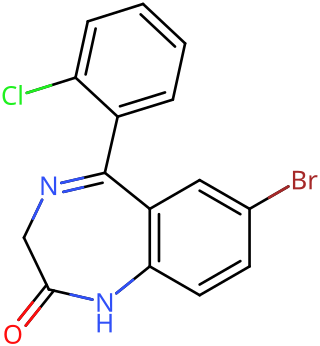
Phenazepam Stats & Data
O=C1CN=C(c2ccccc2Cl)c2cc(Br)ccc2N1CGMJQQJSWIRRRL-UHFFFAOYSA-NReceptor Profile
Receptor Actions
Effect Profile
Curated + 8 ReportsStrong anxiolysis with strong cognitive impairment, moderate euphoria, mild sedation
Tolerance & Pharmacokinetics
drugs.wikiNo tolerance chart. Our decay curves for these drugs were estimates, and a curve can make tolerance look longer-lasting than it is, which is the dangerous direction.
How fast tolerance to these drugs fades after a break has not been measured well enough to draw, so don't count on a dose you used to take still being safe: after time off, start with a much smaller amount and don't use alone. Mixing sedatives with each other, with alcohol or with opioids sharply raises the risk of a fatal overdose. If you've been using regularly, don't stop suddenly: withdrawal from benzodiazepines, alcohol or GHB/GBL can cause seizures or delirium, so get medical help to cut down gradually.
Sources: FRANK: benzodiazepines · Alcohol and Drug Foundation: GHB · FDA 2020: benzodiazepine boxed warning · FDA 2019: gabapentinoids and breathing · NHS: alcohol use disorder
Cross-Tolerances
Experience Report Analysis
ErowidDemographics
Gender Distribution
Too few reports for a chart: gender is known from 11 reports, and a split is drawn only from 20 reports or more. Counts are shown instead. Why 20?
- Male 10 of 11
- Female 1 of 11
Age Distribution
Reports Over Time
Effect Analysis
ErowidEffects aggregated from 8 experience reports (8 single-substance Erowid)
Effect Sentiment Distribution
Confidence Distribution
Each bar is the share of reports mentioning the effect; its whisker, and the band on the rows below, is the 95% interval: where the share could plausibly be with other reports of the same kind.
Too few reports for bars: these effects come from 8 single-substance Erowid reports, and a bar is drawn only from 20 reports or more. With fewer, a percentage cannot tell a common effect from a rare one. Counts are shown instead. Why 20?
Positive Effects 1
Adverse Effects 1
Show 1 neutral or unclassified mention
Also reported in combinations. In the 3 Phenazepam reports where another drug was taken too, 1 mentions hospital, emergency services or an overdose, 0 a seizure and 1 psychosis (too few reports for percentages). In the 8 single-substance reports: 3, 0 and 0. These are not in the figures above: they cannot be put down to Phenazepam alone, and a mention is not always something that happened to the writer.
Real-World Dose Distribution
ErowidFrom 13 of 15 recorded dose entries: those that state a weight (mg, g or µg), in routes with at least five of them. Values above Q3 + 3×IQR, far above what people typically take, are left out; they can include real heavy doses and overdoses, not only mistakes.
Oral (n=12)
Form / Preparation
Most common forms and preparations, as a share of the 9 reports that give one
Too few reports for bars: these forms come from 9 reports, and a bar is drawn only from 20 reports or more. With fewer, a percentage cannot tell a common effect from a rare one. Counts are shown instead. Why 20?
- Powder / Crystals 8 of 9
Redose Patterns
Redosing behavior across 10 reports
Too few reports for a chart: redosing is known from 10 reports, and a split is drawn only from 20 reports or more. Counts are shown instead. Why 20?
- Single dose 9 of 10
- Redosed 1 of 10
Benzodiazepine Equivalence
Phenazepam - ~1mg ~=10mg Diazepam.
Legal Status
| Country | Status | Notes |
|---|---|---|
| China | As of October 2015, phenazepam is a controlled substance in China. | |
| United Kingdom | Phenazepam is a class C drug in the UK. | The UK home office banned importation of phenazepam on Friday 22 July 2011 while it drafted legislation, released in January 2012 to become law at the end of March 2012. The bill was quashed following advice from the ACMD as it included two non-abusable steroids. There was a new discussion about its fate on April 23, 2012, where it was decided that the bill would be rewritten and phenazepam would still be banned. It was eventually banned on June 13, 2012 as a class C, schedule II drug. |
| United States | Under federal United States law, phenazepam is not currently classified as a controlled substance, as the Federal Analog Act only provides for automatic assumed classification of chemicals "substantially similar" to existing Schedule I or Schedule II drugs, whereas all controlled benzodiazepines under the Controlled Substances Act are classified as Schedule IV. | Although phenazepam is currently not controlled, sale for human use remains illegal in the United States. Suppliers attempt to circumvent this regulation by placing a "Not for human use" disclaimer on the product's label. Individual states in the United States often ban these analog drugs by name as they appear. Since 2012, Louisiana has classified phenazepam as a controlled dangerous substance. This ban affects several products, some of which were sold at retail stores under the guise of air freshener or similar, containing phenazepam yet claiming not to be for human use. This legislation was introduced after one such product, branded as "Zannie" and marketed as an air freshener rapidly gained publicity as the subject of numerous media reports, attracting the attention of officials. The ensuing investigation effort, led by Senator Fred Mills and Louisiana Poison Center Director Mark Ryan, positively identified the active ingredient of "Zannie" as phenazepam. According to Ryan, chemical analysis identified the active ingredient as "100 percent phenazepam". Paul Halverson, director and state health officer for the Arkansas Department of Health, approved an emergency rule to ban the sale and distribution of phenazepam shortly after the Louisiana ban. Alabama made Phenazepam a schedule I substance on March 18th, 2014. |
Harm Reduction
drugs.wiki• Phenazepam is a long‑acting benzodiazepine; TripSit’s benzo table lists an approximate 60 h half‑life, meaning effects and impairment can persist into the following days and accumulate with redosing. Plan doses with a multi‑day horizon and avoid daily use. • Relative potency is high: TripSit lists ~1 mg phenazepam ≈ 10 mg diazepam orally. Start at the low end (0.5–1 mg) and reassess after full onset; do not assume diazepam-like margins. • Because it is active at sub‑milligram to low‑milligram levels, eyeballing powder routinely leads to blackouts and multi‑day amnesia; use a 0.001 g scale and volumetric dosing. Numerous community harm‑reduction threads document severe consequences from mismeasurement. • Onset can be slow (up to 1–1.5 h or longer); redosing before the first dose peaks is a frequent cause of overdose and prolonged blackout. Wait several hours before considering any additional dose. • Avoid insufflation and injection: phenazepam is poorly water‑soluble and reports describe unreliable absorption and delayed effects by non‑oral routes, compounding overdose risk. • Polysubstance risk is high: combining benzodiazepines with alcohol, GHB/GBL, opioids, or tramadol markedly increases sedation and respiratory‑depression risk; if someone becomes unresponsive, place them in the recovery position and call emergency services. Do not attempt home reversal. • Counterfeit or mislabelled tablets are common in illicit markets (e.g., “Xanax/Valium” pressed with other benzos); use drug checking where available and be prepared for unexpected strength or different substances. • Benzodiazepine withdrawal can be severe and potentially life‑threatening; do not abruptly stop after extended or high‑dose use. Seek medical support for a gradual taper. (General benzo harm‑reduction guidance.) • Long half‑life plus amnesia increases risk of unsafe behaviors (driving, online purchases, interpersonal conflict) during multi‑day blackouts; secure access to the supply, log dose/time, and enlist a trusted sober person if needed. Community reports repeatedly describe multi‑day blackouts. • Cross‑tolerance with other benzodiazepines is expected; those with existing benzo tolerance may perceive little effect at low doses but still accrue impairment and dependence. • In some regions, benzodiazepines appear in opioid supplies (e.g., bromazolam/nordiazepam found in checked fentanyl samples), increasing overdose risk; test supplies and carry naloxone (note: naloxone does not reverse benzodiazepines).
References
Data Sources
Cited References
- Drummer et al. (2012) - Phenazepam: The drug that came in from the cold
- DrugWise: Phenazepam
- Drug-Do: Benzos - Phenazepam
- Erowid: Phenazepam Law
- IsomerDesign: ACMD Advice on Phenazepam
- PMC: New Uncontrolled Benzodiazepine, Phenazepam
- PsychonautWiki: Benzodiazepines
- Release: .org.uk - Phenazepam
- TALKTOFRANK - Phenazepam Effects
- TripSit Factsheet: Phenazepam
Additional references
- DrugWise – Phenazepam overview (potency, long-acting, avoid redosing, alcohol risk)
- TripSit Wiki – Benzodiazepines table (half‑life ~60 h; diazepam equivalence)
- TripSit – Drug combinations (benzos + GHB/GBL/opioids/tramadol warnings; recovery position)
- Drugs‑Forum Wiki – Phenazepam (onset/peak; solubility; dosing cautions)
- Bluelight – ‘Phenazepam: First time, no mg scale…’ (blackout/mismeasurement caution)
- Bluelight – Phenazepam discussion (long half‑life; eyeballing overdoses)
- DrugBank – Phenazepam (identifiers, synonyms)
- Toronto Drug Checking – Weekly reports (benzodiazepine‑related drugs in fentanyl supply)
- Saferparty (Zurich) – Frequent benzo mislabelling warnings (counterfeit tablets)