
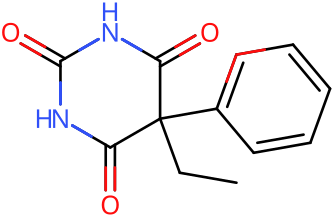
Phenobarbital Stats & Data
DDBREPKUVSBGFI-UHFFFAOYSA-NPharmacology
DrugBankDescription
A barbituric acid derivative that acts as a nonselective central nervous system depressant. It promotes binding to inhibitory gamma-aminobutyric acid subtype receptors, and modulates chloride currents through receptor channels. It also inhibits glutamate induced depolarizations.
Mechanism of Action
Phenobarbital acts on GABAA receptors, increasing synaptic inhibition. This has the effect of elevating seizure threshold and reducing the spread of seizure activity from a seizure focus. Phenobarbital may also inhibit calcium channels, resulting in a decrease in excitatory transmitter release. The sedative-hypnotic effects of phenobarbital are likely the result of its effect on the polysynaptic midbrain reticular formation, which controls CNS arousal.
Pharmacodynamics
Phenobarbital, the longest-acting barbiturate, is used for its anticonvulsant and sedative-hypnotic properties in the management of all seizure disorders except absence (petit mal).
Metabolism
Hepatic (mostly via CYP2C19).
Absorption
Absorbed in varying degrees following oral, rectal or parenteral administration. The salts are more rapidly absorbed than are the acids. The rate of absorption is increased if the sodium salt is ingested as a dilute solution or taken on an empty stomach.
Indication
For the treatment of all types of seizures except absence seizures.
Receptor Profile
Receptor Actions
Receptor Binding
Measured Affinities
Guide to PHARMACOLOGYMeasured binding and functional data for phenobarbital, curated by the IUPHAR/BPS Guide to PHARMACOLOGY. Each row cites the paper it came from. Lower concentrations mean tighter binding — a value in the sub-nanomolar range indicates a very potent interaction.
| Target | Action | Measure | Value | Concentration | Species | Source |
|---|---|---|---|---|---|---|
| Pregnane X receptor NR1I2 | Agonist | - | — | — | Human | PMID 9727070 |
Reading this. pKi, pEC50 and pIC50 are negative log molar values, so a higher number means a tighter interaction; the concentration column converts them for you. Values from non-human species are laboratory measurements and do not translate directly to human effect. Receptor affinity is not a dose — it describes what a molecule binds, not how much of it is safe to take.
Receptor data from the IUPHAR/BPS Guide to PHARMACOLOGY (v2026.2), licensed CC BY-SA 4.0. Matched to this substance by InChIKey.
History & Culture
1902–1912
The barbiturate class emerged in 1902 when German chemists Emil Fischer and Joseph von Mering synthesized barbital, the first compound of its kind, subsequently marketed as Veronal by Bayer. By 1904, Fischer had synthesized several related compounds including phenobarbital. The drug was introduced to market in 1912 by Bayer under the brand name Luminal, initially recognized for its sedative, hypnotic, and soporific properties.
While phenobarbital's sedative effects were well-established by its 1912 market introduction, its potential as an anticonvulsant remained unknown. The young physician Alfred Hauptmann made this discovery serendipitously when he administered the drug to his epilepsy patients as a tranquilizer and observed a marked reduction in their seizures. Hauptmann conducted a careful extended study of his patients, most of whom had previously relied on bromide—the only available treatment at the time, which offered limited efficacy and caused severe side effects. On phenobarbital, patients showed substantial improvement: the most severely affected experienced fewer and milder seizures, while some became entirely seizure-free. The drug was rapidly adopted as the first widely effective anticonvulsant, though World War I delayed its introduction to the United States.
1939–1943
Phenobarbital became implicated in one of history's darkest chapters when it was employed in Nazi Germany's involuntary euthanasia programs. In 1939, a German family petitioned Adolf Hitler to have their disabled five-month-old son killed; the infant was administered a lethal dose of Luminal after Hitler dispatched his personal physician to examine the child. This event precipitated a broader clandestine program—within days, fifteen psychiatrists were summoned to Hitler's Chancellery and directed to commence systematic involuntary euthanasia. By 1940, approximately fifty intellectually disabled children were killed by Luminal injection at a clinic in Ansbach, Germany. The drug continued to be used as an instrument of the Nazi children's euthanasia program until at least 1943.
1960s–present
Phenobarbital remained a commonly prescribed sedative and hypnotic for nearly five decades following its introduction. However, the emergence of benzodiazepines in the 1960s gradually displaced barbiturates for most sedative and anxiolytic applications due to their improved safety profile. Despite this shift, phenobarbital persists as the oldest continuously used anticonvulsant medication and is included on the World Health Organization's List of Essential Medicines.
Phenobarbital has been involved in several notable deaths throughout its history. In November 1970, an unidentified woman was discovered deceased in Bergen, Norway, in a case that remains unsolved. Known as the Isdal Woman, she died from a combination of burns, phenobarbital, and carbon monoxide poisoning; numerous theories have emerged about her death, with some investigators believing she may have been a spy. British veterinarian Donald Sinclair, who served as the inspiration for the character Siegfried Farnon in James Herriot's "All Creatures Great and Small" book series, ended his life at age 84 by self-administering an overdose of phenobarbital. American activist Abbie Hoffman died on April 12, 1989, after consuming phenobarbital combined with alcohol; residue from approximately 150 pills was detected in his body during autopsy. In March 1997, thirty-nine members of the Heaven's Gate religious group died in a mass suicide in Rancho Santa Fe, California. The members consumed lethal doses of phenobarbital mixed with vodka before lying down to die, believing they would be transported to an alien spacecraft.
Phenobarbital likely has moderate toxicity relative to dose. However, phenobarbital is potentially lethal when mixed with depressants like alcohol or opioids. Phenobarbital has a higher risk of death or serious adverse effects associated with concurrent depressant use than other drugs such as benzodiazepines. There have been studies linking the use of barbiturates, particularly phenobarbital, with the development of cancer . It is strongly recommended that one use harm reduction practices when using this drug.
Carcinogenicity
Group 2B: Possibly carcinogenic to humans
Liver injury risk
Low concern (rare serious cases reported)
Overdose
Barbiturate overdose may occur when a barbiturate is taken in extremely heavy quantities or concurrently with other depressants. This is particularly dangerous with other GABAergic depressants such as benzodiazepines and alcohol since they work in a similar fashion, but bind to distinct allosteric sites on the GABAA receptor, thus their effects potentiate one another.
Toxicity (DrugBank)
CNS and respiratory depression which may progress to Cheyne-Stokes respiration, areflexia, constriction of the pupils to a slight degree (though in severe poisoning they may wshow paralytic dilation), oliguria, tachycardia, hypotension, lowered body temperature, and coma. Typical shock syndrome (apnea, circulatory collapse, respiratory arrest, and death) may occur.
Tolerance & Pharmacokinetics
drugs.wikiNo tolerance chart. Our decay curves for these drugs were estimates, and a curve can make tolerance look longer-lasting than it is, which is the dangerous direction.
How fast tolerance to these drugs fades after a break has not been measured well enough to draw, so don't count on a dose you used to take still being safe: after time off, start with a much smaller amount and don't use alone. Mixing sedatives with each other, with alcohol or with opioids sharply raises the risk of a fatal overdose. If you've been using regularly, don't stop suddenly: withdrawal from benzodiazepines, alcohol or GHB/GBL can cause seizures or delirium, so get medical help to cut down gradually. With barbiturates, you get used to the effects much more than to a dangerous dose, so the gap between a dose that works and one that kills shrinks the more you use. Stopping suddenly after regular use can cause convulsions and delirium.
Sources: FRANK: benzodiazepines · Alcohol and Drug Foundation: GHB · FDA 2020: benzodiazepine boxed warning · FDA 2019: gabapentinoids and breathing · NHS: alcohol use disorder · Phenobarbital label: drug abuse and dependence
Cross-Tolerances
Experience Report Analysis
ErowidDemographics
Gender Distribution
Too few reports for a chart: gender is known from 4 reports, and a split is drawn only from 20 reports or more. Counts are shown instead. Why 20?
- Male 4 of 4
Age Distribution
Reports Over Time
Form / Preparation
Most common forms and preparations, as a share of the 2 reports that give one
Too few reports for bars: these forms come from 2 reports, and a bar is drawn only from 20 reports or more. With fewer, a percentage cannot tell a common effect from a rare one. Counts are shown instead. Why 20?
- Pill / Tablet 2 of 2
Legal Status
| Country | Status | Notes |
|---|---|---|
| Australia | Schedule 4 | Classified as a prescription-only medicine under the Poisons Standard. Legal for medical use with a valid prescription from a licensed healthcare provider. |
| Canada | Schedule IV CDSA | Controlled under the Controlled Drugs and Substances Act. Available for medical use by prescription, with restrictions on dispensing and record-keeping requirements. |
| Germany | Anlage III BtMG | Controlled under Schedule III of the Betäubungsmittelgesetz (Narcotics Act). Requires a narcotic prescription form for dispensing, with exceptions for preparations containing up to 10% phenobarbital or up to 300 mg per dosage unit. |
| Russia | Schedule III | Classified as a Schedule III controlled substance since 2013. However, phenobarbital remains available in over-the-counter combination medications such as Corvalol and Valocordin, which can be dispensed without a prescription. |
| Switzerland | Verzeichnis B | Specifically named as a controlled substance under Verzeichnis B of Swiss narcotics legislation. Medicinal use is permitted with appropriate authorization. |
| United Kingdom | Class B | Controlled as a Class B substance under the Misuse of Drugs Act 1971. Available for medical use by prescription, with penalties for unauthorized possession and supply. |
| United States | Schedule IV | Controlled under Schedule IV of the Controlled Substances Act. Recognized as having accepted medical use with lower abuse potential than Schedule II-III substances. Available by prescription for seizure disorders and sedation. |
Harm Reduction
drugs.wikiPhenobarbital is a long-acting barbiturate used primarily as an anticonvulsant; it enhances GABAA-mediated inhibition and also dampens excitatory transmission, producing dose-dependent CNS and respiratory depression. Its elimination half-life averages roughly 79 hours (range ~53–118 h), which means effects can accumulate across days; redosing on the same day or consecutive days markedly increases overdose risk. As a strong inducer of multiple CYP isoenzymes, phenobarbital reduces the efficacy of many medications, notably combined oral contraceptives (risk of unintended pregnancy) and warfarin (risk of subtherapeutic anticoagulation), and can lower levels of other antiepileptics; users should avoid assuming familiar medications behave normally while on phenobarbital. Barbiturates carry a narrow therapeutic index: toxic and even fatal blood concentrations overlap with or lie not far above therapeutic levels, making self-titration hazardous; overdose deaths typically result from respiratory depression compounded by hypotension and coma. Combining with other CNS depressants (opioids, alcohol, benzodiazepines, Z-drugs, GHB/GBL, sedating antihistamines, carisoprodol) substantially increases the risk of fatal respiratory depression; this risk persists for days because phenobarbital remains in the body long after the subjective effects fade. Phenobarbital is contraindicated in acute or latent porphyria and should be avoided in significant hepatic impairment; it can precipitate porphyric crises via enzyme induction. Chronic use can cause dependence; abrupt cessation after sustained daily use can provoke severe, potentially life-threatening withdrawal (including seizures)—any stop should be medically supervised and slowly tapered. Avoid driving or tasks requiring alertness for at least 24 hours after dosing (longer with higher or repeated doses), as coordination and reaction time are impaired even when one feels “sober.” If phenobarbital has been used with opioids, naloxone reverses only the opioid component—sedation from phenobarbital may persist and requires airway support and monitoring by professionals. Parenteral phenobarbital must be administered by clinicians; nonmedical IV use (especially of tablet formulations) risks immediate apnea/hypotension and catastrophic local injury; intra-arterial and subcutaneous injection are explicitly unsafe. Use in pregnancy is associated with congenital risks; avoid nonmedical exposure during pregnancy and lactation.
References
Cited References
Additional references
- DrugBank: Phenobarbital (DB01174) — PK and half-life
- StatPearls: Phenobarbital — contraindications, CYP induction, OCs/warfarin interactions, overdose ranges
- StatPearls: Barbiturates — enzyme induction profile; CNS depressant interactions; pregnancy risks; porphyria contraindication
- EUDA/EMCDDA Barbiturates drug profile — therapeutic/toxic/fatal blood concentrations; modes of use
- EUDA/EMCDDA Take-home naloxone — reverses opioid respiratory depression only (barbiturates unaffected)