
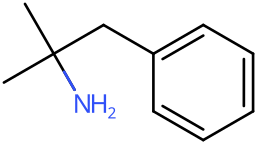
Phentermine Stats & Data
CC(C)(N)Cc1ccccc1DHHVAGZRUROJKS-UHFFFAOYSA-NPharmacology
DrugBankDescription
Phentermine is a sympathomimetic amine anorectic agent and it was introduced in 1959 as part of an anti-obesity combination drug. It is chemically related to amphetamine and it is commonly referred to as an atypical amphetamine. Phentermine has not been reported an addictive potential which allows this agent to be classified under the Schedule IV drugs (low abuse potential). Phentermine was FDA approved for short-term weight management in 1959 and it became widely used in 1960. This initial product, formed by the combination of phentermine with fenfluramine and dexfenfluramine was discontinued after finding several reports of abnormal valves in nearly 30% of the consumers. Later on, phentermine was approved alone and in combination with topiramate in 2012 as a new alternative that required lower doses of phentermine to obtain the desired effect.
Mechanism of Action
Phentermine is an indirect-acting sympathomimetic agent that acts by releasing noradrenaline from the presynaptic vesicles in the lateral hypothalamus. This increase in noradrenaline concentration in the synaptic cleft results in the stimulation of beta2-adrenergic receptors. Phentermine is classified as an indirect sympathomimetic due to the increase in the level of norepinephrine, dopamine and its indirect effect towards serotonin. Some reports have indicated that phentermine inhibits the neuropeptide Y which is a principal signaling pathway for the induction of hunger. This combined effect produces a continuous flight-or-fight response in the body which reduces the hunger signal as this state is on the immediate need for energy. Lastly, some reports have indicated that phentermine is a weak inhibitor of monoamine oxidase but this mechanism does not tend to produce a clinically significant response.
Pharmacodynamics
It is reported that the main mechanism of action of phentermine is the generation of appetite suppression, maybe due to the increase in leptin, but it is considered that other mechanisms should be involved. Some reports have indicated that the weight loss effect is mainly due to the increase in resting energy expenditure. In clinical studies where phentermine was used as a monotherapy and as combination therapy, this drug has shown an average weight loss of 3.6 kg when compared with the placebo in 2-24 weeks. Patients treated with phentermine also showed increased maintenance of the weight after treatment discontinuation. As well, even though it is a derivative of the amphetamines, it has not been registered to produce any of the effects of amphetamine such as central nervous system stimulation, elevation of blood pressure, tachyphylaxis or QTc prolongation.
Metabolism
Phentermine undergoes minimal p-hydroxylation, N-oxidation and N-hydroxylation followed by conjugation. The total proportion of the drug that goes under metabolism only represents about 6% of the administered dose where about 5% is represented by the N-oxidized and N-Hydroxylated metabolites.
Absorption
Phentermine shows a dose-dependent pharmacokinetic profile. After oral administration of a dose of 15 mg, the maximal concentration was achieved after 6 hours and its bioavailability was not affected by the consumption of high-fat meals. The reported plasma concentration at steady-state is of around 200 ng/ml as observed in clinical trials.
Indication
Phentermine is indicated, alone or in combination with topiramate, as a short-term adjunct, not pass a few weeks, in a regimen of weight reduction based on exercise, behavioral modifications and caloric restriction in the management of exogenous obesity for patients with an initial body mass index (BMI) greater than 30 kg/m2 or greater than 27 kg/m2 in presence of other risk factors such as controller hypertension, diabetes or hyperlipidemia. Exogenous obesity is considered when the overweight is caused by consuming more food than the person activity level warrants. This condition commonly causes an increase in fat storage. It is an epidemic condition in the United States where over two-thirds of adults are overweight or obese and one in three Americans is obese. In the world, the incidence of obesity has nearly doubled.
Half-life
The mean terminal half-life of phentermine is reported to be of approximately 20 hours. In conditions where there is acidic urine (pH <5), the elimination half-life is of 7-8 hours.
Protein Binding
The protein binding of phentermine is determined to be of 17.5%.
Elimination
Phentermine is excreted mainly in the urine from which about 70-80% of the administered dose can be found as the unchanged drug.
Volume of Distribution
The reported volume of distribution for phentermine is reported to be of 5 L/kg.
Clearance
The reported clearance when administered orally is 8.79 L/h as observed in pharmacokinetic population studies.
Phentermine hydrochloride is an amphetamine type antiobesity drug. Description: Indications: Used as an appetite suppressant (anorectic). Phentermine is an amphetamine that stimulates neurons to release or maintain high levels of a particular group of neurotransmitters known as catecholamines; these include dopamine and norepinephrine. High levels of these catecholamines tend to suppress hunger signals and appetite.
LD50
LD50: 15 to 20 mg/kg (monkey).
Carcinogenicity
No indication of carcinogenicity to humans (not listed by IARC).
Liver injury risk
No documented concern
Health effects (PubChem excerpts)
Using large amounts of these drugs can result in a condition known as amphetamine psychosis -- which can result in auditory, visual and tactile hallucinations, intense paranoia, irrational thoughts and beliefs, delusions, and mental confusion. Using large amounts of these drugs can result in a condition known as amphetamine psychosis -- which can result in auditory, visual and tactile hallucinations, intense paranoia, irrational thoughts and beliefs, delusions, and mental confusion.
Effect Profile
Curated + 16 ReportsModerate stimulation and euphoria with strong anxiety/jitters
Tolerance & Pharmacokinetics
drugs.wikiTolerance Decay
Experience Report Analysis
ErowidDemographics
Gender Distribution
Age Distribution
Reports Over Time
Effect Analysis
ErowidEffects aggregated from 16 experience reports (16 single-substance Erowid)
Effect Sentiment Distribution
Confidence Distribution
Each bar is the share of reports mentioning the effect; its whisker, and the band on the rows below, is the 95% interval: where the share could plausibly be with other reports of the same kind.
Too few reports for bars: these effects come from 16 single-substance Erowid reports, and a bar is drawn only from 20 reports or more. With fewer, a percentage cannot tell a common effect from a rare one. Counts are shown instead. Why 20?
Positive Effects 2
Adverse Effects 2
Dosage Distribution
Dose distribution from experience reports, one dose per report (the first listed). Doses above Q3 + 3×IQR, far above what people typically take, are left out of the median and range and listed under each route: most are real heavy doses or overdoses, not mistakes.
Real-World Dose Distribution
ErowidFrom 17 of 23 recorded dose entries: those that state a weight (mg, g or µg), in routes with at least five of them. Values above Q3 + 3×IQR, far above what people typically take, are left out; they can include real heavy doses and overdoses, not only mistakes.
Oral (n=17)
Form / Preparation
Most common forms and preparations, as a share of the 12 reports that give one
Too few reports for bars: these forms come from 12 reports, and a bar is drawn only from 20 reports or more. With fewer, a percentage cannot tell a common effect from a rare one. Counts are shown instead. Why 20?
- Pill / Tablet 10 of 12
Body-Weight Dosing
Dose per kg of body weight, one dose per report (the first listed), from reports giving a weight of 30–250 kg. Doses above Q3 + 3×IQR, far above what people typically take, are left out of the median and range and listed under each route.
Redose Patterns
Redosing behavior across 14 reports
Too few reports for a chart: redosing is known from 14 reports, and a split is drawn only from 20 reports or more. Counts are shown instead. Why 20?
- Single dose 11 of 14
- Redosed 3 of 14