
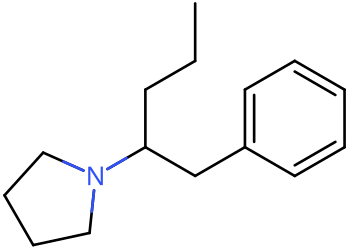
Prolintane Stats & Data
CCCC(Cc1ccccc1)N1CCCC1OJCPSBCUMRIPFL-UHFFFAOYSA-NReceptor Profile
Receptor Actions
Toxicity
PsychonautWikiThe toxicity and long-term health effects of recreational prolintane use do not seem to have been studied in any scientific context, and the exact toxic dosage is unknown. Anecdotal evidence from people who have tried prolintane within the community suggests that there do not seem to be any negative health effects attributed to simply trying this drug at low to moderate doses by itself and using it sparingly (but nothing can be completely guaranteed).
Effect Profile
CuratedModerate euphoria and focus with strong anxiety/jitters, mild stimulation
Tolerance & Pharmacokinetics
drugs.wikiTolerance Decay
Model reflects anecdotal stimulant patterns: tolerance builds rapidly across a day and decays over 3–7 days. Cross‑tolerance estimates are heuristic, informed by structural/subjective similarity to pyrrolidine NDRIs; data quality is low.
Cross-Tolerances
Legal Status
| Country | Status | Notes |
|---|---|---|
| Germany | Prolintane is a prescription only medicine, according to Anlage 1 AMVV ( Medicine Prescribing Regulation, Schedule 1 ). | |
| Switzerland | Prolintane is not controlled under Buchstabe A, B, C and D. | It could be considered legal. |
Harm Reduction
drugs.wikiEvidence synthesis: A double‑blind placebo‑controlled study in healthy volunteers using 10–20 mg oral prolintane found small cardiovascular changes relative to ephedrine but improved performance on a sign recording task at 2.5 h, consistent with NDRI‑type vigilance enhancement. Community reports consistently describe a narrow comfort window: low–moderate oral doses (≈10–50 mg) feel functional with mild euphoria, while higher/redosed amounts increase anxiety, vasoconstriction, tremor, and sweaty tunnel‑vision. Insufflation is commonly described as harsh on nasal mucosa with a sharper, shorter effect and more peripheral side‑effects; oral is favored for smoother onset. Users frequently remark on sexual arousal/pro‑sociality, compulsive redosing, and insomnia if taken late; repeating 40–60 mg oral doses the same day markedly worsens comedown discomfort. Structural and experiential similarity to pyrrolidine stimulants supports cross‑tolerance with α‑PVP/pyrovalerone‑like agents, though prolintane lacks the β‑keto group and tends to be milder/shorter. HR: identify substances via reagent/lab testing where available; dose accurately with a milligram scale; avoid late‑night redoses; monitor blood pressure/heart rate; maintain fluids and electrolytes; allow multi‑day breaks to reduce tolerance and compulsion; prefer oral route; avoid stimulant stacking and MAOIs; and treat unexpected chest pain, severe headache, or agitation as a medical issue. Legal status varies by jurisdiction; historically classified under ATC N06BX14 and not scheduled in Canada per 2012 Health Canada correspondence—always check current local law.
References
Cited References
- Barceloux (2012) - Medical Toxicology of Drug Abuse
- Bluelight: Prolintane User Reports
- Drugs-Forum: Prolintane Discussion
- Gillman (2005) - MAOIs and Serotonin Toxicity
- Kim et al. (2021) - Abuse Potential of Prolintane in Rodents
- Talaie et al. (2009) - Tramadol Seizure Risk
- Randomised trial – 10 mg & 20 mg prolintane vs placebo (1984)
- REM-sleep study – 15 mg & 30 mg doses
- MIMS monograph – adverse effects & interactions
- LOINC toxicology note – safety profile summary
- Rodent self-administration & DA release study
- Reddit: harm-reduction summary (clinical doses, 3-5 h half-life)
Additional references
- PubMed – Double‑blind placebo‑controlled comparison (10–20 mg prolintane)
- DrugBank – Prolintane entry (ATC code N06BX14; basic identifiers)
- PubChem – Prolintane compound record
- Isomer Design – Prolintane and α‑PVP (βk‑Prolintane) mapping
- Isomer Design – α‑PVP page noting βk‑Prolintane relationship
- Drugs‑Forum – ‘Prolintane/Katovit’ dosage thread with user timelines/effects
- Bluelight – ‘Prolintane or Flakka?’ discussion of dose window, comedown, compulsion
- Bluelight – ‘Prolintane? (2024+)’ user caution about high NE drive/anxiety at higher doses
- TripSit – Drug combinations chart (stimulants + MAOIs dangerous; stimulant stacking unsafe)
- IsomerDesign (Health Canada correspondence) – Prolintane not controlled (Canada, 2012)