
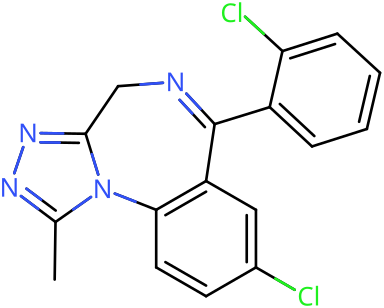
Triazolam Stats & Data
JOFWLTCLBGQGBO-UHFFFAOYSA-NPharmacology
DrugBankDescription
Withdrawn in the United Kingdom due to risk of psychiatric adverse drug reactions. This drug continues to be available in the U.S. Internationally, triazolam is a Schedule IV drug under the Convention on Psychotropic Substances.
Mechanism of Action
Benzodiazepines bind nonspecifically to bezodiazepine receptors BNZ1, which mediates sleep, and BNZ2, which affects affects muscle relaxation, anticonvulsant activity, motor coordination, and memory. As benzodiazepine receptors are thought to be coupled to gamma-aminobutyric acid-A (GABAA) receptors, this enhances the effects of GABA by increasing GABA affinity for the GABA receptor. Binding of GABA to the site opens the chloride channel, resulting in a hyperpolarized cell membrane that prevents further excitation of the cell.
Pharmacodynamics
A short-acting benzodiazepine used as a hypnotic agent in the treatment of insomnia. Some countries temporarily withdrew triazolam from the market because of concerns about adverse reactions, mostly psychological, associated with higher dose ranges. Its use at lower doses with appropriate care and labeling has been reaffirmed by the FDA and most other countries. Triazolam has a shorter half-life than chlordiazepoxide, flurazepam, and prazepam and does not generate active metabolites.
Metabolism
Hepatic. Small amounts of unmetabolized triazolam appear in the urine.
Absorption
Bioavailability is 44% (oral) and 53% (sublingual).
Indication
For the short-term treatment of insomnia.
Elimination
Triazolam and its metabolites, principally as conjugated glucuronides, which are presumably inactive, are excreted primarily in the urine. Only small amounts of unmetabolized triazolam appear in the urine. The two primary metabolites accounted for 79.9% of urinary excretion.
Receptor Profile
Receptor Actions
Receptor Binding
Measured Affinities
Guide to PHARMACOLOGYMeasured binding and functional data for triazolam, curated by the IUPHAR/BPS Guide to PHARMACOLOGY. Each row cites the paper it came from. Lower concentrations mean tighter binding — a value in the sub-nanomolar range indicates a very potent interaction.
| Target | Action | Measure | Value | Concentration | Species | Source |
|---|---|---|---|---|---|---|
| GABAA receptor α2 subunit GABRA2 | Positive | pKi | 9.23 | 0.589 nM | Human | PMID 10633039 |
| GABAA receptor α1 subunit GABRA1 | Positive | pKi | 9.1 | 0.794 nM | Human | PMID 10633039 |
| GABAA receptor α1 subunit GABRA1 | Positive | pKd | 9 | 1 nM | Human | PMID 18537233 |
| GABAA receptor α3 subunit GABRA3 | Positive | pKi | 8.84 | 1.45 nM | Human | PMID 10633039 |
| GABAA receptor α5 subunit GABRA5 | Positive | pKi | 8.81 | 1.55 nM | Human | PMID 10633039 |
| GABAA receptor α5 subunit GABRA5 | Positive | pKd | 8.4 | 3.98 nM | Human | PMID 18537233 |
Reading this. pKi, pEC50 and pIC50 are negative log molar values, so a higher number means a tighter interaction; the concentration column converts them for you. Values from non-human species are laboratory measurements and do not translate directly to human effect. Receptor affinity is not a dose — it describes what a molecule binds, not how much of it is safe to take.
Receptor data from the IUPHAR/BPS Guide to PHARMACOLOGY (v2026.2), licensed CC BY-SA 4.0. Matched to this substance by InChIKey.
History & Culture
Triazolam was patented in 1970 and subsequently entered the pharmaceutical market in the United States in 1982 under the brand name Halcion. The drug gained widespread clinical adoption, and by 2017 it ranked as the 289th most commonly prescribed medication in the United States with over one million prescriptions annually. Following its market introduction, triazolam became the subject of regulatory scrutiny in several countries due to concerns about adverse psychological reactions, particularly at higher dose ranges. Some nations temporarily withdrew the drug from their markets, though subsequent review by the FDA and regulatory bodies in most other countries reaffirmed its safety profile when used at lower doses with appropriate clinical guidance and labeling. Beyond its primary indication for insomnia, triazolam has found particular utility in specific clinical and practical contexts. It is frequently prescribed to airline passengers as a sleep aid for short- to medium-duration flights. Additionally, the drug's pronounced amnestic properties have made it a common choice in sedation dentistry, where its ability to induce anterograde amnesia helps patients undergo dental procedures with minimal subsequent recall of the experience.
Benzodiazepines bind nonspecifically to bezodiazepine receptors BNZ1, which mediates sleep, and BNZ2, which affects affects muscle relaxation, anticonvulsant activity, motor coordination, and memory. As benzodiazepine receptors are thought to be coupled to gamma-aminobutyric acid-A (GABA<sub>A</sub>) receptors, this enhances the effects of GABA by increasing GABA affinity for the GABA receptor.
LD50
LD50: >1000 mg/kg (Oral, Mouse)LD50: >5000 mg/kg (Oral, Rat)
Carcinogenicity
No indication of carcinogenicity to humans (not listed by IARC).
Liver injury risk
Ambiguous (limited data)
Health effects (PubChem excerpts)
Following acute overdose, clinical symptoms or manifestations may include sleepiness, which, following larger overdose can range from stage zero to stage one coma. Initially, excitement may be seen as a result of the disinhibition effects of these drugs, which then progresses to central nervous system depression, hypotension, respiratory depression, and coma (A629).
Effect Profile
Curated + 33 ReportsStrong anxiolysis, sedation, and euphoria with strong cognitive impairment
Tolerance & Pharmacokinetics
drugs.wikiNo tolerance chart. Our decay curves for these drugs were estimates, and a curve can make tolerance look longer-lasting than it is, which is the dangerous direction.
How fast tolerance to these drugs fades after a break has not been measured well enough to draw, so don't count on a dose you used to take still being safe: after time off, start with a much smaller amount and don't use alone. Mixing sedatives with each other, with alcohol or with opioids sharply raises the risk of a fatal overdose. If you've been using regularly, don't stop suddenly: withdrawal from benzodiazepines, alcohol or GHB/GBL can cause seizures or delirium, so get medical help to cut down gradually.
Sources: FRANK: benzodiazepines · Alcohol and Drug Foundation: GHB · FDA 2020: benzodiazepine boxed warning · FDA 2019: gabapentinoids and breathing · NHS: alcohol use disorder
Cross-Tolerances
Experience Report Analysis
ErowidDemographics
Gender Distribution
Age Distribution
Reports Over Time
Effect Analysis
ErowidEffects aggregated from 33 experience reports (33 single-substance Erowid)
Effect Sentiment Distribution
Confidence Distribution
Each bar is the share of reports mentioning the effect; its whisker, and the band on the rows below, is the 95% interval: where the share could plausibly be with other reports of the same kind.
Positive Effects 4
Adverse Effects 3
Show 1 neutral or unclassified mention
Dosage Distribution
Dose distribution from experience reports, one dose per report (the first listed). Doses above Q3 + 3×IQR, far above what people typically take, are left out of the median and range and listed under each route: most are real heavy doses or overdoses, not mistakes.
1 report gave a dose above the typical range (3.75 mg), so it is not in the figures above. Listing a dose here does not mean it is safe.
Show the report
Real-World Dose Distribution
ErowidFrom 21 of 30 recorded dose entries: those that state a weight (mg, g or µg), in routes with at least five of them. Values above Q3 + 3×IQR, far above what people typically take, are left out; they can include real heavy doses and overdoses, not only mistakes.
Oral (n=21)
Common Combinations
Most co-occurring substances, as a share of all 48 reports filed under Triazolam; whiskers are 95% intervals
Form / Preparation
Most common forms and preparations, as a share of the 41 reports that give one; whiskers are 95% intervals
Body-Weight Dosing
Dose per kg of body weight, one dose per report (the first listed), from reports giving a weight of 30–250 kg. Doses above Q3 + 3×IQR, far above what people typically take, are left out of the median and range and listed under each route.
Redose Patterns
Redosing behavior across 44 reports
Benzodiazepine Equivalence
Triazolam - 0.5mg ~=10mg Diazepam.
Legal Status
| Country | Status | Notes |
|---|---|---|
| United Kingdom | Withdrawn | Withdrawn from the market due to concerns about psychiatric adverse drug reactions associated with its use. Unlike in other countries where it remains available, triazolam is not prescribed in the UK despite being a medically used benzodiazepine elsewhere. |
| United States | Schedule IV | Controlled substance under the Controlled Substances Act (DEA Number 2887). Remains available for medical prescription use. Schedule IV classification indicates accepted medical use with relatively lower abuse potential compared to more restrictive schedules. |
References
Cited References
- Drugs.com: Triazolam Prescribing Information
- Erowid: Triazolam Vault
- FDA: Halcion (Triazolam) Label
- Mayo Clinic: Triazolam
- MedlinePlus: Triazolam
- NCBI LiverTox: Triazolam
- PMC: The effect of triazolam premedication on anxiety, sedation, and amnesia
- PsychonautWiki: Triazolam
- PubChem: Triazolam
- Roth et al. 1983: Pharmacology and hypnotic efficacy of triazolam