
Zolpidem Stats & Data
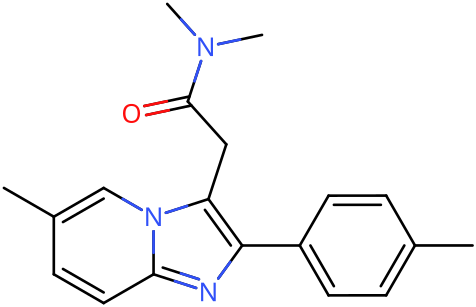
CN(C)C(=O)Cc1c(nc2ccc(C)cn12)c1ccc(C)cc1ZAFYATHCZYHLPB-UHFFFAOYSA-NPharmacology
DrugBankDescription
Zolpidem, also known as _Ambien_, is a hypnotic drug that was initially approved by the FDA in 1992 . Zolpidem improves sleep in patients with insomnia. It is aimed for use in patients with difficulties initiating sleep. This drug decreases the time to fall asleep (sleep latency), increases the duration of sleep, and decreases the number of awakenings during sleep in patients with temporary (transient) insomnia. It is available in both immediate acting and extended release forms , . Its tolerability profile is favorable when administered according to the manufacturer’s instructions, with a low risk of drug withdrawal, drug dependence, and drug tolerance . In addition, zolpidem improves sleep quality in patients suffering from chronic insomnia and can show mild muscle relaxant properties . Research also shows that zolpidem is rapid and effective in restoring brain function for patients in a vegetative state following brain injury. This drug has the propensity to completely or partially reverse the abnormal metabolism of damaged brain cells after injury , .
Mechanism of Action
Zolpidem, the active moiety of zolpidem tartrate, is a hypnotic substance with a chemical structure that is not related to the structure benzodiazepines, barbiturates, pyrrolopyrazines, pyrazolopyrimidines or other drugs exerting hypnotic effects. It interacts with a _GABA-BZ_ receptor complex and shares various pharmacological properties with the _benzodiazepine_ class of drugs . Subunit binding of the _GABAA_ receptor chloride channel macromolecular complex is thought to lead to the sedative, anticonvulsant, anxiolytic, and myorelaxant drug effects of zolpidem. The main regulatory site of the GABAA receptor complex can be found on its _alpha (α) subunit_ and is called the _benzodiazepine_ (BZ) or _omega (ω)_ receptor. At least three different subtypes of the (ω) receptor have been identified to this date . In contrast to benzodiazepine drugs, which are found to modulate all benzodiazepine receptor subtypes in a non-selective fashion, zolpidem binds the (BZ1) receptor specifically with a potent affinity for the alpha 1/alpha 5 subunits (in vitro) . More recent studies suggest that zolpidem binds primarily to the alpha 1, 2, and 3 subunits of the GABA receptor , , , and not the alpha 5 subunit.
Pharmacodynamics
**Effects on the central nervous system (CNS)** This drug has CNS depressant effects, which may include somnolence, decreased alertness, sedation, drowsiness, dizziness, and other changes in psychomotor function . Due to the above effects, the FDA has recommended an initial dose of zolpidem (immediate-acting) is a single dose of 5 mg for women and a single dose of 5 or 10 mg for men, immediately before bedtime with at least 7-8 hours remaining before the planned time of awakening . Refer to product labeling for detailed information , . **Effects on memory** Controlled studies in adults using objective measures of memory demonstrated no significant evidence of next-day memory impairment after the administration of zolpidem. On the contrary, in a clinical study involving the administration of zolpidem doses of 10 and 20 mg, a marked reduction in a next-morning recall of information relayed to subjects during peak drug effect (90 minutes after dosing) was observed. These subjects experienced a condition known as _anterograde amnesia_. Subjective evidence from adverse event data has suggested that anterograde amnesia may occur after zolpidem administration, mainly at doses above 10 mg . **Effects on psychomotor function** This drug may cause decreased psychomotor performance. Additive psychomotor effects may occur with other drugs that cause depression of psychomotor function, including alcohol .
Metabolism
Zolpidem is metabolized to three pharmacologically by various hepatic cytochrome P450 (CYP) isoenzymes, mainly CYP3A4, but also CYP1A2 and CYP2C9 , . Although zolpidem is heavily metabolized, all three metabolites are inactive . The major metabolic routes in humans are oxidation of the methyl group on the phenyl ring or the methyl group on the imidazopyridine moiety, to produce carboxylic acids (metabolites I and II), and hydroxylation of one of the imidazopyridine groups (to produce metabolite X). Another less common pathway is by the oxidation of the methyl groups on the substituted amide .
Absorption
Zolpidem is rapidly absorbed from the gastrointestinal tract. In a single-dose crossover study in 45 healthy subjects given 5 and 10 mg zolpidem tartrate tablets, the average peak zolpidem concentrations (Cmax) were 59 and 121 ng/mL, respectively, occurring at a mean time (Tmax) of 1.6 hours for both doses .
Indication
This drug is indicated for the short-term treatment of insomnia in adults characterized by difficulties with sleep initiation .
Half-life
The average zolpidem elimination half-life was 2.6 and 2.5 hours, for the 5 and 10 mg tablets, respectively .
Elimination
Zolpidem tartrate tablets are converted to inactive metabolites that are eliminated mainly by renal excretion .
Volume of Distribution
0.54 to 0.68 L/kg (in humans) . In patients with long term renal insufficiency who were not yet on hemodialysis, the volume of distribution was found to increase significantly, AUC increased by 60%, and half-life nearly doubled .
Clearance
In a clinical trial, after a 20mg dose, total clearance of zolpidem 0.24 to 0.27 ml/min/kg .
Receptor Profile
Receptor Actions
Receptor Binding
History & Culture
1988–1992
Zolpidem entered clinical use in Europe in 1988 through the pharmaceutical company Synthelabo. Following its European introduction, Synthelabo collaborated with Searle to pursue regulatory approval in the United States. The FDA granted approval in 1992, and the drug was marketed under the brand name Ambien. Generic formulations became available in 2007, significantly expanding accessibility. By 2023, zolpidem had become the 54th most commonly prescribed medication in the United States, with over 11 million prescriptions dispensed annually.
Beyond its established use as a hypnotic, research has identified potential therapeutic applications for zolpidem in treating disorders of consciousness. Studies have demonstrated that the drug can rapidly and effectively restore brain function in some patients who have entered vegetative states following brain injury, potentially reversing abnormal metabolism in damaged neural tissue. The United States Air Force has approved zolpidem as one of its authorized "no-go pills" since at least 2012. These medications are provided to aviators and special operations personnel to assist with sleep during mission preparation, though a mandatory six-hour restriction on subsequent flight operations follows use of the drug.
Zolpidem has received substantial media coverage concerning complex sleep behaviors, wherein users engage in activities such as sleepwalking or driving automobiles while not fully conscious. High-profile incidents have included a motor vehicle accident involving U.S. Congressman Patrick Kennedy and a fatal fall from the Sydney Harbour Bridge in Australia attributed to an individual reportedly using the medication. In May 2018, television actress Roseanne Barr attributed a racist tweet comparing former Obama advisor Valerie Jarrett to an ape to the effects of zolpidem. Manufacturer Sanofi responded publicly, stating that "racism is not a known side effect" of Ambien. Z-drugs including zolpidem have been documented in connection with drug-facilitated sexual assault. This issue received significant attention during the prosecution of former NFL safety Darren Sharper, who was accused of using his prescription tablets to incapacitate victims. Separately, use of zolpidem by Australian swimmers during the 2012 London Olympics generated controversy regarding medication use in athletic competition.
Zolpidem has a low toxicity relative to dose. However, it is potentially lethal when mixed with depressants like alcohol or opioids. Zolpidem has been reported to cause psychosis, delusions and delirium at a significantly higher rate than other hallucinogens like LSD, ketamine, or DMT. There are a large number of experience reports online which describe states of delirium, amnesia, bizarre behavior, sleep walking, driving while impaired and other serious consequences after abusing the drug. In many cases this has resulted in hospitalization, arrests, car crashes, lengthy court cases and even death.
LD50
LD50: 695 mg/kg (Oral, Rat) (A308)
Carcinogenicity
No indication of carcinogenicity to humans (not listed by IARC).
Empirical Duration
Erowid ReportsMedian times after the dose that Erowid reports state. A curve is drawn only when reports state all four points (onset, peak begins, comedown begins, back to baseline) and the medians fall in that order. No point is estimated from another.
No curve: the stated times run backwards. Reports put the start of the peak (T+12min, 5 reports) before the onset (T+15min, 18 reports). Each time is the median of a different set of reports, so they are shown as stated, not rearranged.
Tolerance & Pharmacokinetics
drugs.wikiNo tolerance chart. Our decay curves for these drugs were estimates, and a curve can make tolerance look longer-lasting than it is, which is the dangerous direction.
How fast tolerance to these drugs fades after a break has not been measured well enough to draw, so don't count on a dose you used to take still being safe: after time off, start with a much smaller amount and don't use alone. Mixing sedatives with each other, with alcohol or with opioids sharply raises the risk of a fatal overdose. If you've been using regularly, don't stop suddenly: withdrawal from benzodiazepines, alcohol or GHB/GBL can cause seizures or delirium, so get medical help to cut down gradually.
Sources: FRANK: benzodiazepines · Alcohol and Drug Foundation: GHB · FDA 2020: benzodiazepine boxed warning · FDA 2019: gabapentinoids and breathing · NHS: alcohol use disorder
Cross-Tolerances
Demographics
Gender Distribution
Age Distribution
Reports Over Time
Effect Analysis
Erowid + BluelightEffects aggregated from 279 experience reports (229 single-substance Erowid + 71 Bluelight)
Effect Sentiment Distribution
Confidence Distribution
Each bar is the share of reports mentioning the effect; its whisker, and the band on the rows below, is the 95% interval: where the share could plausibly be with other reports of the same kind.
Positive Effects 41
Adverse Effects 47
Show 25 more adverse effects
Show 33 neutral or unclassified mentions
Also reported in combinations. In the 125 Zolpidem reports where another drug was taken too, 18 (14.4%) mention hospital, emergency services or an overdose, 1 (0.8%) a seizure and 2 (1.6%) psychosis. In the 229 single-substance reports: 6.1%, 1.7% and 2.6%. These are not in the figures above: they cannot be put down to Zolpidem alone, and a mention is not always something that happened to the writer.
Dose-Response Correlation
How effect frequency changes across dose levels. Whiskers, and the numbers' hover text, give each figure's 95% interval.
View data table
| Effect | Strong (n=77) | Heavy (n=67) |
|---|---|---|
| Memory Suppression | 16.9% (95% interval 10 to 27 percent) | 43.3% (95% interval 32 to 55 percent) |
| Stimulation | 40.3% (95% interval 30 to 51 percent) | 22.4% (95% interval 14 to 34 percent) |
| Visual Distortions | 35.1% (95% interval 25 to 46 percent) | 29.9% (95% interval 20 to 42 percent) |
| Sedation | 28.6% (95% interval 20 to 40 percent) | 28.4% (95% interval 19 to 40 percent) |
| Anxiety | 26.0% (95% interval 18 to 37 percent) | 23.9% (95% interval 15 to 35 percent) |
| Confusion | 18.2% (95% interval 11 to 28 percent) | 23.9% (95% interval 15 to 35 percent) |
| Empathy | 22.1% (95% interval 14 to 32 percent) | 13.4% (95% interval 7 to 24 percent) |
| Euphoria | 20.8% (95% interval 13 to 31 percent) | 20.9% (95% interval 13 to 32 percent) |
| Open-Eye Visuals | 15.6% (95% interval 9 to 25 percent) | 20.9% (95% interval 13 to 32 percent) |
| Color Enhancement | 20.8% (95% interval 13 to 31 percent) | 13.4% (95% interval 7 to 24 percent) |
| Auditory Effects | 16.9% (95% interval 10 to 27 percent) | 6.0% (95% interval 2 to 14 percent) |
| Motor Impairment | 15.6% (95% interval 9 to 25 percent) | 16.4% (95% interval 9 to 27 percent) |
| Music Enhancement | 14.3% (95% interval 8 to 24 percent) | 16.4% (95% interval 9 to 27 percent) |
| Nausea | 9.1% (95% interval 4 to 18 percent) | 14.9% (95% interval 8 to 25 percent) |
| Dissociation | 9.1% (95% interval 4 to 18 percent) | 4.5% (95% interval 2 to 12 percent) |
Subjective Effect Ontology
Experience ReportsStructured effect tags extracted from 404 Erowid & Bluelight experience reports using a controlled vocabulary of 220+ canonical effects across 15 domains.
Cognitive
Motor
Visual
Dose–Effect Mapping
Experience ReportsHow reported effects shift across dose tiers, based on 229 single-substance experience reports. The shaded band on each bar is its 95% interval. An arrow (↑ ↓) marks a change between the lowest and highest tier that count an effect only when the gap is bigger than chance would explain; ~ means no clear change. How changes are called
Limited tier coverage — most reports fall within the Strong / Heavy range. Effects at other dose levels may not be represented.
| Effect | Strong (n=77) | Heavy (n=67) | Change with dose |
|---|---|---|---|
| memory suppression | (+26 points from Strong to Heavy, 95% interval +12 to +40) | ||
| stimulation | (−18 points from Strong to Heavy, 95% interval −32 to −3) | ||
| visual distortions | (no clear change: −5 points from Strong to Heavy, 95% interval −20 to +10) | ||
| sedation | (no clear change: −0.2 points from Strong to Heavy, 95% interval −15 to +14) | ||
| anxiety | (no clear change: −2 points from Strong to Heavy, 95% interval −16 to +12) | ||
| confusion | (no clear change: +6 points from Strong to Heavy, 95% interval −8 to +19) | ||
| empathy | (no clear change: −9 points from Strong to Heavy, 95% interval −21 to +4) | ||
| euphoria | (no clear change: +0.1 points from Strong to Heavy, 95% interval −13 to +14) | ||
| open-eye visuals | (no clear change: +5 points from Strong to Heavy, 95% interval −7 to +18) | ||
| color enhancement | (no clear change: −7 points from Strong to Heavy, 95% interval −19 to +5) | ||
| auditory effects | (−11 points from Strong to Heavy, 95% interval −21 to −0.1) | ||
| motor impairment | (no clear change: +1 points from Strong to Heavy, 95% interval −11 to +13) | ||
| music enhancement | (no clear change: +2 points from Strong to Heavy, 95% interval −10 to +14) | ||
| nausea | (no clear change: +6 points from Strong to Heavy, 95% interval −5 to +17) | ||
| dissociation | (no clear change: −5 points from Strong to Heavy, 95% interval −14 to +4) | ||
| hospital | (no clear change: +4 points from Strong to Heavy, 95% interval −5 to +14) | ||
| closed-eye visuals | — | counted in the Strong tier only | |
| psychosis | — | counted in the Strong tier only | |
| increased heart rate | — | counted in the Strong tier only | |
| headache | (no clear change: +1 points from Strong to Heavy, 95% interval −7 to +9) |
Showing top 20 of 28 effects
Risk Escalation
Sentiment AnalysisAverage frequency of positive vs adverse effects across dose tiers. A tier's average is the mean share of the effects counted in that tier, not a share of reports, and its range is a deliberately wide 95% interval. A tier with more reports also counts rarer effects, which pulls its average down, so compare single effects in the breakdown rather than these averages. There, the shaded band on each bar is its 95% interval, and Change is marked up or down only when the gap between two tiers is bigger than chance would explain. How changes are called
View effect breakdown
Adverse Effects
| Effect | Strong (n=77) | Heavy (n=67) | Change |
|---|---|---|---|
| Memory Suppression | +26 pts (+26 points from Strong to Heavy, 95% interval +12 to +40) | ||
| Anxiety | no clear change (no clear change: −2 points from Strong to Heavy, 95% interval −16 to +12) | ||
| Confusion | no clear change (no clear change: +6 points from Strong to Heavy, 95% interval −8 to +19) | ||
| Motor Impairment | no clear change (no clear change: +1 points from Strong to Heavy, 95% interval −11 to +13) | ||
| Nausea | no clear change (no clear change: +6 points from Strong to Heavy, 95% interval −5 to +17) | ||
| Psychosis | — | — | |
| Increased Heart Rate | — | — | |
| Headache | no clear change (no clear change: +1 points from Strong to Heavy, 95% interval −7 to +9) | ||
| Seizure | — | — | |
| Muscle Tension | — | — |
Positive Effects
| Effect | Strong (n=77) | Heavy (n=67) | Change |
|---|---|---|---|
| Stimulation | −18 pts (−18 points from Strong to Heavy, 95% interval −32 to −3) | ||
| Empathy | no clear change (no clear change: −9 points from Strong to Heavy, 95% interval −21 to +4) | ||
| Euphoria | no clear change (no clear change: +0.1 points from Strong to Heavy, 95% interval −13 to +14) | ||
| Color Enhancement | no clear change (no clear change: −7 points from Strong to Heavy, 95% interval −19 to +5) | ||
| Music Enhancement | no clear change (no clear change: +2 points from Strong to Heavy, 95% interval −10 to +14) | ||
| Creativity Enhancement | no clear change (no clear change: −1 points from Strong to Heavy, 95% interval −8 to +7) | ||
| Focus Enhancement | — | — | |
| Introspection | no clear change (no clear change: −1 points from Strong to Heavy, 95% interval −8 to +7) | ||
| Body High | — | — | |
| Tactile Enhancement | — | — |
Dosage Distribution
Dose distribution from experience reports, one dose per report (the first listed). Doses above Q3 + 3×IQR, far above what people typically take, are left out of the median and range and listed under each route: most are real heavy doses or overdoses, not mistakes.
Oral
5 reports gave a dose above the typical range (60–300 mg), so they are not in the figures above. Listing a dose here does not mean it is safe.
Insufflated
Real-World Dose Distribution
ErowidFrom 483 of 527 recorded dose entries: those that state a weight (mg, g or µg), in routes with at least five of them. Values above Q3 + 3×IQR, far above what people typically take, are left out; they can include real heavy doses and overdoses, not only mistakes.
Oral (n=421)
Insufflated (n=41)
Intravenous (n=6)
Common Combinations
Most co-occurring substances, as a share of all 354 reports filed under Zolpidem; whiskers are 95% intervals
Form / Preparation
Most common forms and preparations, as a share of the 293 reports that give one; whiskers are 95% intervals
Body-Weight Dosing
Dose per kg of body weight, one dose per report (the first listed), from reports giving a weight of 30–250 kg. Doses above Q3 + 3×IQR, far above what people typically take, are left out of the median and range and listed under each route.
Oral
7 reports gave a dose above the typical range (0.817–1.225 mg/kg), so they are not in the figures above. 2 of them mention hospital, emergency services or an overdose. Listing a dose here does not mean it is safe.
Show the reports
- 1.225 mg/kg
- 1.149 mg/kg · another drug taken too
- 1.101 mg/kg · mentions hospital, emergency services or an overdose
- 0.882 mg/kg
- 0.847 mg/kg · mentions hospital, emergency services or an overdose
- 0.817 mg/kg
- 0.817 mg/kg
Insufflated
Redose Patterns
Redosing behavior across 316 reports
Harm Reduction
drugs.wiki• Complex sleep behaviors (sleep‑walking, sleep‑driving, cooking/eating, sexsomnia) have been repeatedly reported and can cause injury; risk increases with higher blood levels, redosing, extended‑release products, and concurrent CNS depressants. Discontinue and seek medical advice if any occur. Evidence includes emergency department data and labeling summaries.
• Next‑day impairment (memory, reaction time, driving) can persist, especially with extended‑release forms and higher doses. Patients should avoid driving or hazardous tasks the following morning if not fully alert.
• Take immediately before bed with the intention and ability to sleep 7–8 hours (4+ hours for low‑dose sublingual “middle‑of‑the‑night” products). Redosing during the night greatly increases amnesia and complex behaviors.
• Women generally have higher exposure from the same dose due to lower clearance; many regulators and labels recommend lower initial doses for women. Elderly patients and those with hepatic impairment also have increased exposure and fall risk; they typically require lower doses and careful monitoring.
• Food delays absorption and may prolong residual effects; for fastest onset and least next‑day impairment take on an empty stomach and do not combine with alcohol.
• Avoid combining with other CNS depressants (alcohol, opioids, benzos, GHB, barbiturates, gabapentinoids, sedating antihistamines/antipsychotics); these combinations increase amnesia, accidental injury, respiratory depression, and overdose risk.
• Dependence and withdrawal can occur (anxiety, tremor, rebound insomnia; seizures have been reported after high‑dose, prolonged use). Do not abruptly stop after chronic/heavy use; seek medical guidance for a taper.
• Hepatic impairment can prolong zolpidem half‑life to ~10 hours on average (wide range), increasing next‑day impairment and accumulation risk; dose reductions are warranted and extended‑release should be avoided in significant impairment.
• Serious allergic reactions (angioedema/anaphylaxis) are reported; discontinue and seek urgent care if swelling or breathing problems occur.
• Use extreme caution in sleep apnea, chronic respiratory disease, or with opioid therapy due to additive respiratory depression and hypoxemia risk.
• Extended‑release tablets must not be crushed or split; crushing/insufflating tablets or using non‑oral routes adds risk from excipients and rapid CNS depression without improving safety or outcomes.
References
Data Sources
Cited References
- Erowid: Zolpidem Vault
- NIST: Zolpidem Chemical Data
- PsychonautWiki: Zolpidem
- Salva & Costa 1995: Clinical pharmacokinetics of zolpidem
- TripSit: Combining Depressants Risks
- DrugBank Article: Zolpidem pharmacology
- DrugBank Article: Zolpidem GABA(A) receptor activity
- DrugBank Article: Zolpidem structure and effects
- DrugBank Article: Zolpidem onset and duration
Additional references
- DrugBank: Zolpidem (DB00425) overview, PK, interactions, food effects, next‑day driving warning, sex‑specific dosing
- TripSit wiki: Zolpidem dosage, duration, effects, HR notes
- NCBI (SAMHSA CBHSQ Report): ED visits and adverse reactions; complex sleep behaviors; additive CNS depression with alcohol/benzos/opioids
- NCBI (SAMHSA CBHSQ Report): Overmedication with zolpidem and safety guidance
- Drugs‑Forum wiki: Zolpidem—side effects, interactions (ketoconazole↑, rifampin↓, SSRI effects), next‑day impairment, withdrawal seizures
- Drugs‑Forum (Pharmacology: Zolpidem) PK details incl. Tmax, protein binding; elderly and hepatic impairment half‑life ~9.9 h; dosing cautions
- Drugs‑Forum: Intermezzo (sublingual zolpidem) labeling summary—indication, 1.75/3.5 mg dosing, ≥4 h remaining, respiratory depression warning
- Bluelight Benzo Guide: Z‑drug overview and receptor selectivity note (alpha1 preference)