
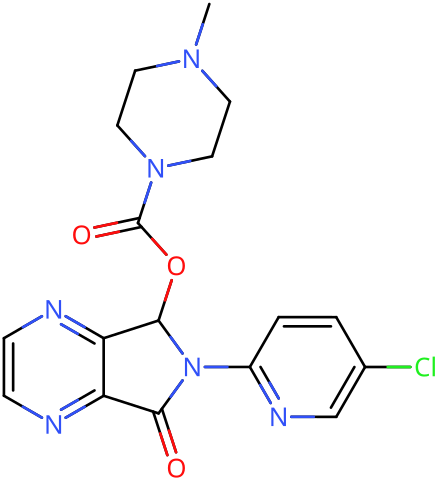
Zopiclone Stats & Data
GBBSUAFBMRNDJC-UHFFFAOYSA-NPharmacology
DrugBankDescription
Zopiclone is a novel hypnotic agent used in the treatment of insomnia. Its mechanism of action is based on modulating benzodiazepine receptors. In addition to zopiclone's benzodiazepine pharmacological properties it also has some barbiturate-like properties.
Mechanism of Action
Zopiclone exerts its action by binding on the benzodiazepine receptor complex and modulation of the GABABZ receptor chloride channel macromolecular complex. Both zopiclone and benzodiazepines act indiscriminately at the benzodiazepine binding site on α1, α2, α3 and α5 GABAA containing receptors as full agonists causing an enhancement of the inhibitory actions of GABA to produce the therapeutic (hypnotic and anxiolytic) and adverse effects of zopiclone.
Pharmacodynamics
Zopiclone is a nonbenzodiazepine hypnotic from the pyrazolopyrimidine class and is indicated for the short-term treatment of insomnia. While Zopiclone is a hypnotic agent with a chemical structure unrelated to benzodiazepines, barbiturates, or other drugs with known hypnotic properties, it interacts with the gamma-aminobutyric acid-benzodiazepine (GABABZ) receptor complex. Subunit modulation of the GABABZ receptor chloride channel macromolecular complex is hypothesized to be responsible for some of the pharmacological properties of benzodiazepines, which include sedative, anxiolytic, muscle relaxant, and anticonvulsive effects in animal models. Zopiclone binds selectively to the brain alpha subunit of the GABA A omega-1 receptor.
Metabolism
Extensively metabolized in the liver via decarboxylation (major pathway), demethylation, and side chain oxidation. Metabolites include an N-oxide derivative (weakly active; approximately 12% of a dose) and an N-desmethyl metabolite (inactive; approximately 16%). Approximately 50% of a dose is converted to other inactive metabolites via decarboxylation. Hepatic microsomal enzymes are apparently not involved in zopiclone clearance.
Absorption
Rapidly absorbed following oral administration.
Indication
For the short-term treatment of insomnia.
Half-life
Elimination half life is approximately 5 hours (range 3.8 to 6.5 hours) and is prolonged to 11.9 hours in patients with hepatic insufficiency.
Receptor Profile
Receptor Actions
Receptor Binding
History & Culture
Zopiclone was developed by the French pharmaceutical company Rhône-Poulenc S.A. and first introduced to the market in 1986. Rhône-Poulenc has since become part of Sanofi, which remains the primary global manufacturer. Upon its release, zopiclone was marketed as offering improvements over benzodiazepines for treating insomnia, though subsequent meta-analyses have found it comparable to benzodiazepines across all assessed parameters. The substance remained unscheduled in the United States until April 4, 2005, when the Drug Enforcement Administration placed it under Schedule IV of the Controlled Substances Act, citing evidence of addictive properties similar to those of benzodiazepines. Zopiclone as marketed globally is a racemic mixture containing two stereoisomers, of which only one possesses pharmacological activity. In 2005, the same year as federal scheduling, the Massachusetts-based pharmaceutical company Sepracor began marketing the active stereoisomer separately as eszopiclone under the brand name Lunesta in the United States. This development effectively placed what functions as a generic medication in most countries under new patent protection within the American market. In France, zopiclone ranks among the ten most commonly obtained medications through fraudulent prescriptions, indicating significant diversion from legitimate pharmaceutical channels.
Subjective Effects
Physical
The physical effects of zopiclone can be broken down into several components which progressively intensify proportional to dosage.
- Sedation: In terms of energy level alterations, zopiclone is extremely sedating and often results in an overwhelmingly lethargic state. At higher levels, this causes users to suddenly feel as if they are extremely sleep deprived and have not slept for days, forcing them to sit down and generally feel as if they are constantly on the verge of passing out instead of engaging in physical activities. This sense of sleep deprivation increases proportional to dosage and eventually becomes powerful enough to force a person into complete unconsciousness.
- Respiratory depression
- Muscle relaxation
- Dizziness
- Motor control loss
Cognitive
The general head space of zopiclone is described by many as one of intense sedation and decreased inhibition. It contains a large number of typical depressant cognitive effects.
- Amnesia
- Anxiety suppression
- Thought deceleration
- Disinhibition
- Information processing suppression
- Euphoria
- Compulsive redosing
Forked from Subjective Effect Documentation by Josie Kins, September 2015. Via dose.wiki (CC0).
Zopiclone is generally thought to have a low toxicity relative to dose. However, it is potentially lethal when mixed with depressants like benzodiazepines, alcohol or opioids. When combined with one or several of these substances the already existing chance of a having a "black-out" is significantly increased, leaving the user with very little to no memory of the events that occurred whilst under the influence of zopiclone alone or combined with most other CNS depressants. Some users have reported taking zopiclone in combination with alcohol in an attempt to treat hangovers with varying degrees of success. It is strongly recommended that one use harm reduction practices when using this substance.
Carcinogenicity
No indication of carcinogenicity to humans (not listed by IARC).
Addiction & dependence
Zopiclone is extremely physically and psychologically addictive. This compound may have an even greater addictive potential than benzodiazepines. Tolerance will develop to the sedative-hypnotic effects within a couple of weeks of daily use.
Toxicity (DrugBank)
Rare individual instances of fatal outcomes following overdose with racemic zopiclone have been reported in European postmarketing reports, most often associated with overdose with other CNS-depressant agent. Signs and symptoms of overdose effects of CNS depressants can be expected to present as exaggerations of the pharmacological effects noted in preclinical testing.
Effect Profile
Curated + 23 ReportsStrong anxiolysis, sedation, and euphoria with strong cognitive impairment
Tolerance & Pharmacokinetics
drugs.wikiNo tolerance chart. Our decay curves for these drugs were estimates, and a curve can make tolerance look longer-lasting than it is, which is the dangerous direction.
How fast tolerance to these drugs fades after a break has not been measured well enough to draw, so don't count on a dose you used to take still being safe: after time off, start with a much smaller amount and don't use alone. Mixing sedatives with each other, with alcohol or with opioids sharply raises the risk of a fatal overdose. If you've been using regularly, don't stop suddenly: withdrawal from benzodiazepines, alcohol or GHB/GBL can cause seizures or delirium, so get medical help to cut down gradually.
Sources: FRANK: benzodiazepines · Alcohol and Drug Foundation: GHB · FDA 2020: benzodiazepine boxed warning · FDA 2019: gabapentinoids and breathing · NHS: alcohol use disorder
Cross-Tolerances
Experience Report Analysis
ErowidDemographics
Gender Distribution
Age Distribution
Reports Over Time
Effect Analysis
ErowidEffects aggregated from 23 experience reports (23 single-substance Erowid)
Effect Sentiment Distribution
Confidence Distribution
Each bar is the share of reports mentioning the effect; its whisker, and the band on the rows below, is the 95% interval: where the share could plausibly be with other reports of the same kind.
Positive Effects 4
Adverse Effects 5
Show 1 neutral or unclassified mention
Also reported in combinations. In the 21 Zopiclone reports where another drug was taken too, 2 (9.5%) mention hospital, emergency services or an overdose, 0 (0.0%) a seizure and 3 (14.3%) psychosis. In the 23 single-substance reports: 4.3%, 0.0% and 0.0%. These are not in the figures above: they cannot be put down to Zopiclone alone, and a mention is not always something that happened to the writer.
Dosage Distribution
Dose distribution from experience reports, one dose per report (the first listed). Doses above Q3 + 3×IQR, far above what people typically take, are left out of the median and range and listed under each route: most are real heavy doses or overdoses, not mistakes.
1 report gave a dose above the typical range (67.5 mg), so it is not in the figures above. Listing a dose here does not mean it is safe.
Show the report
Real-World Dose Distribution
ErowidFrom 51 of 62 recorded dose entries: those that state a weight (mg, g or µg), in routes with at least five of them. Values above Q3 + 3×IQR, far above what people typically take, are left out; they can include real heavy doses and overdoses, not only mistakes.
Oral (n=47)
Common Combinations
Most co-occurring substances, as a share of all 44 reports filed under Zopiclone; whiskers are 95% intervals
Form / Preparation
Most common forms and preparations, as a share of the 30 reports that give one; whiskers are 95% intervals
Body-Weight Dosing
Dose per kg of body weight, one dose per report (the first listed), from reports giving a weight of 30–250 kg. Doses above Q3 + 3×IQR, far above what people typically take, are left out of the median and range and listed under each route.
1 report gave a dose above the typical range (0.844 mg/kg), so it is not in the figures above. Listing a dose here does not mean it is safe.
Show the report
Redose Patterns
Redosing behavior across 35 reports
Legal Status
| Country | Status | Notes |
|---|---|---|
| Canada | Approved prescription medication | Approved for medical use and marketed since the mid-1990s. Multiple brand name products (Imovane, Act Zopiclone, M-zopiclone) and generic formulations (Apo-zopiclone, Ag-zopiclone) are available by prescription. |
| United Kingdom | Prescription only medicine | Available as a prescription medication, commonly dispensed in 3.75mg and 7.5mg tablet formulations for the treatment of insomnia. |
| United States | Scheduled controlled substance | Became a federally scheduled controlled substance in 2005. Prior to scheduling, it was available but not specifically controlled under the Controlled Substances Act. |
Harm Reduction
drugs.wikiZopiclone acts at the benzodiazepine site of the GABAA receptor and should be reserved for short‑term insomnia; longer courses increase tolerance, dependence, and withdrawal risks. Complex sleep‑related behaviors (e.g., sleep‑eating, sleep‑driving) and anterograde amnesia can occur, especially with higher doses, redosing, or use while not immediately going to bed. Residual psychomotor impairment can persist 9–11+ hours; avoid driving or hazardous tasks the next morning and allow a full 8+ hours time in bed. Bitter/metallic taste (dysgeusia) and dry mouth are common and may persist into the next day. Co‑use with other depressants (alcohol, opioids, gabapentinoids, sedating antipsychotics/antihistamines) markedly increases risk of respiratory depression, blackouts, falls, and crashes; avoid such combinations. Hepatic impairment prolongs half‑life and increases next‑day effects; lower doses and extra caution are indicated. Redosing during the same night increases amnesia and disinhibition; due to memory gaps, some users unintentionally redose—pre‑plan a single dose and secure the remainder. If dependence has developed, avoid abrupt cessation; a supervised, gradual taper is safer due to seizure risk. Do not confuse racemic zopiclone dosing (commonly 7.5 mg) with eszopiclone (Lunesta; 1–3 mg)—they are related but not dose‑equivalent.
References
Data Sources
Cited References
Additional references
- DrugBank: Zopiclone
- Zopiclone metabolism via CYP3A4/CYP2C8 (DMD 1999)
- EMCDDA/ EUDA: Benzodiazepines drug profile – risks incl. driving/falls and alcohol synergy
- EMCDDA/ EUDA: Non‑medical use of medicines – Z‑drugs with opioids/stimulants in polydrug use
- NCBI Bookshelf: Halcion safety review table citing zopiclone dysgeusia and adverse‑effect profile
- PMCID: Poster Session—Standardized highway driving test; zopiclone 7.5 mg active control shows residual morning impairment
- Drugs‑Forum Wiki: Zopiclone – next‑day impairment, complex behaviors, withdrawal seizures (overview)
- EMCDDA/EUDA: Designer/illicit benzodiazepines – overdose risk, especially with alcohol/sedatives
- DrugWise: Benzodiazepines – harm reduction, driving risk, avoid mixing with alcohol and gabapentinoids (MHRA alert)
- NCBI MeSH: Zopiclone – brand/entry terms