
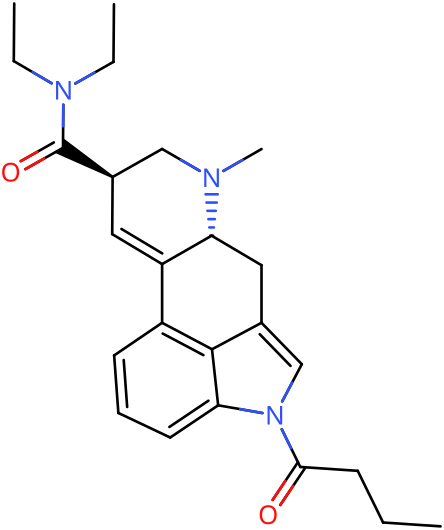
1B-LSD Stats & Data
CCCC(=O)n1cc2CC3N(C)CC(C(=O)N(CC)CC)C=C3c3cccc1c23SVRFNPSJPIDUBC-DYESRHJHSA-NReceptor Profile
Receptor Actions
History & Culture
1B-LSD emerged on the online research chemical market in August 2016, following a pattern common among novel lysergamide derivatives designed to occupy legal grey areas in jurisdictions where LSD itself is controlled. The identity of the original synthesizer remains unknown, and notably, no academic literature documenting the compound exists prior to its commercial appearance—suggesting it was developed specifically for the grey market rather than originating from traditional pharmaceutical or academic research. The strategic use of 1-alkylated lysergamide derivatives to circumvent controlled substance laws was anticipated well before 1B-LSD's emergence. A 1988 report from the United States Drug Enforcement Administration foresaw that modifications to the lysergamide core structure could be employed to create functional LSD analogues that technically fall outside existing scheduling frameworks, presaging the wave of designer lysergamides that would appear decades later.
Toxicity
PsychonautWikiThe toxicity and long-term health effects of recreational 1B-LSD use have not been studied. This is because 1B-LSD is a research chemical with almost no history of human use. Anecdotal reports suggest that there are no negative health effects attributed to simply trying 1B-LSD by itself, at low to moderate doses, and using it very sparingly (although nothing can be completely guaranteed). Independent research should always be conducted to ensure that a combination of two or more substances is safe before consumption. Based on its similarity to LSD, 1B-LSD is assumed to be physiologically well-tolerated with a extremely low toxicity relative to dose.
Overdose
1B-LSD has no known toxic dose. However, higher doses increase the risk of adverse psychological reactions. These reactions include anxiety, delusions, panic attacks and, more rarely, seizures.
Addiction & dependence
Although no formal studies have been conducted, it is assumed that like LSD itself, 1B-LSD is non-addictive with a low abuse potential. There are no literature reports of successful attempts to train animals to self-administer LSD — an animal model predictive of abuse liability — indicating that it does not have the necessary pharmacology to either initiate or maintain dependence. Likewise, there is virtually no withdrawal syndrome when chronic use of LSD is stopped.
Effect Profile
CuratedStrong visuals, headspace, and auditory effects with moderate body load
Duration Timeline
BluelightTolerance & Pharmacokinetics
drugs.wikiTolerance Decay
Rapid tolerance after a single session; meaningful reduction after ~5–7 days; near‑baseline by ~14 days is typical for LSD‑like psychedelics. Data are based on human experience and general psychedelic pharmacology rather than controlled trials.
Cross-Tolerances
Experience Report Analysis
ErowidDemographics
Gender Distribution
Too few reports for a chart: gender is known from 2 reports, and a split is drawn only from 20 reports or more. Counts are shown instead. Why 20?
- Female 1 of 2
- Not Specified 1 of 2
Age Distribution
Reports Over Time
Legal Status
| Country | Status | Notes |
|---|---|---|
| Austria | Grey area (NPSG may apply) | While not technically illegal by name, 1B-LSD may fall under the Neue-Psychoaktive-Substanzen-Gesetz (NPSG) as a structural analogue of LSD, rendering it illegal to supply for human consumption. |
| Germany | Controlled (NpSG) | Controlled under the Neue-psychoaktive-Stoffe-Gesetz (New Psychoactive Substances Act) as of July 18, 2019. Production and import with intent to distribute, administration to others, and trading are punishable offenses. Possession is technically illegal but not subject to penalty. |
| Japan | Illegal | Controlled under the Pharmaceutical Affairs Law. Both possession and sale are prohibited. |
| Latvia | Illegal | Although not officially scheduled by name, 1B-LSD is controlled as a structural analogue of LSD pursuant to an amendment enacted on June 1, 2015. |
| Lithuania | Illegal | Specifically named on the national list of controlled substances since June 5, 2019. |
| Singapore | Illegal | Prohibited under Singapore's controlled substances legislation. |
| Sweden | Illegal | Prohibited as of January 26, 2016, following its emergence as a designer drug. Sweden's public health agency further recommended classifying it as a hazardous substance on June 24, 2019. |
| Switzerland | Controlled (with exceptions) | Considered a controlled substance as a defined derivative of lysergic acid under Verzeichnis E, point 263. Remains legal when used exclusively for scientific or industrial purposes. |
| United Kingdom | Illegal (Psychoactive Substances Act) | Prohibited under the Psychoactive Substances Act 2016, which came into effect on May 26, 2016. Production, supply, and importation are criminal offenses. |
| United States | Unscheduled (Federal Analogue Act applies) | Not explicitly listed as a controlled substance. However, as a prodrug that metabolizes to LSD, possession and sale may be prosecutable under the Federal Analogue Act when intended for human consumption. |
Harm Reduction
drugs.wiki• Sublingual units corrected from “g” to “µg” to prevent misinterpretation; lysergamides are dosed in micrograms. TripSit and multiple HR sources list LSD-class dosing in µg, not mg or g.
• Blotter potency is highly variable and often over‑stated; Swiss drug‑checking found mean LSD content near ~76–81 µg per tab (2023–2024). Start with a partial tab if untested. Wait up to 3 hours before considering any redose because delayed-onset adulterants sometimes appear on blotter. Use professional drug checking when available; many services accept blotter pieces.
• Reagent testing: Ehrlich (p‑DMAB) turns violet with indole lysergamides (LSD, 1B‑LSD). NBOMe/NBOH phenethylamines do not give this reaction, so a negative Ehrlich is a red flag for non‑lysergamide blotters.
• Avoid lithium entirely with psychedelics; numerous case reports and user accounts describe seizures and severe adverse reactions when combined.
• Avoid tramadol and be cautious with other seizure‑threshold–lowering medicines (e.g., bupropion); combine only under medical oversight.
• Combining with potent stimulants (e.g., amphetamines, cocaine) increases tachycardia, blood pressure, anxiety, and risk of panic or manic states.
• Cannabis frequently potentiates visual and cognitive effects; it also increases the chance of anxiety and confusion during come‑up and peak.
• Set and setting matter: use in a safe, familiar environment with a trusted sober sitter if inexperienced. Postpone if feeling unwell or unstable.
• Storage: like LSD, 1B‑LSD on blotter is degraded by heat, light, oxygen, and moisture. Best practice is foil wrap, airtight container with desiccant, stored cold and dark (freezer).
• Tolerance rises rapidly after a single dose and can make redoses during the same or next day unpredictably weak while increasing side‑effects. Allow at least ~2 weeks to return to baseline.
• As an N‑acyl lysergamide, 1B‑LSD is widely considered a prodrug of LSD. Treat unknown or novel analogs with the same caution as LSD, assuming full psychedelic potency and duration.
References
Cited References
- Brandt SD et al. Return of the lysergamides Part V: 1B-LSD analytical and behavioural characterisation
- Erowid: 1B-LSD Experience Vault
- Halberstadt AL & Geyer MA. Head-twitch response methodology. Psychopharmacology 2013
- PubChem: CID 145875086
- TripSit: Drug Combinations Chart
- Wagmann L et al. In-vitro metabolic fate of nine LSD-based NPS
- Brandt SD et al. Return of the lysergamides Part V: 1B-LSD analytical & behavioural characterisation.
- Wagmann L et al. In-vitro metabolic fate of nine LSD-based NPS.
- Bluelight: The small & handy 1B-LSD thread (user experience reports).
- Halberstadt AL & Geyer MA. Head-twitch response methodology.
- PubChem: 145845769
Additional references
- Isomer Design: 1B‑LSD (synonyms and identifiers)
- Bluelight: The Small & Handy 1‑Bu‑LSD (1B‑LSD) Thread (user reports)
- TripSit Wiki: LSD (duration, general HR)
- TripSit Wiki: Drug combinations (general interaction cautions)
- Saferparty Zürich: LSD‑Filze 2024 info (average µg per tab; set/setting; wait 3 h)
- Saferparty Zürich: Warnstufen (how warnings are categorized)
- Drugchecking.community: Program accepts blotter and liquid; about page
- Drugs‑Forum LSD: Storage & Ehrlich reagent info
- Erowid experience vaults: LSD + lithium incidents (seizure risk)
- Effect Index: 1B‑LSD trip report (ROA context)
- Effect Index: Environmental patterning (psychedelic visual effect)
- Effect Index: Symmetrical texture repetition
- Effect Index: Chromatic aberration
- Effect Index: Muscle twitching
- Effect Index: Emotion intensification