
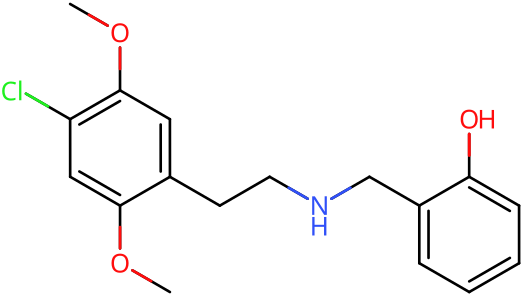
25C-NBOH Stats & Data
COc1cc(CCNCc2ccccc2O)c(OC)cc1ClVHWXICYYQMMZCW-UHFFFAOYSA-NReceptor Profile
Receptor Actions
History & Culture
25C-NBOH was first synthesized and documented in 2011 by Martin Hansen at the University of Copenhagen. The compound is a derivative of the phenethylamine psychedelic 2C-C, distinguished by the addition of an N-benzyl group bearing a hydroxyl substituent on the benzyl ring. The substance has no documented history of human use prior to 2011, when it emerged on the online designer drug market shortly after its initial synthesis. It belongs to the NBOH (N-benzyl-2-hydroxybenzyl) series of phenethylamines, which are structurally related to the more widely known 25x-NBOMe compounds. Due to its recent development and limited formal research, documentation regarding its properties and effects in humans remains sparse.
Toxicity
PsychonautWiki25C-NBOH is a relatively new substance, and little is known about its toxicity or interaction with other substances. It is assumed to pose similar acute health risks as 25C-NBOMe and other members of 25x-NBOMe series. The LD50 has not yet been determined although it is likely to be potentially fatal at heavy dosages. 25C-NBOH's extreme potency means it should not be insufflated (snorted) as this method of administration has been associated with many deaths and hospitalizations with closely related members of the 25x-NBOMe series.
Effect Profile
Curated + 3 ReportsStrong visuals, auditory effects, and headspace with strong body load
Tolerance & Pharmacokinetics
drugs.wikiTolerance Decay
Experience Report Analysis
ErowidDemographics
Gender Distribution
Too few reports for a chart: gender is known from 4 reports, and a split is drawn only from 20 reports or more. Counts are shown instead. Why 20?
- Male 4 of 4
Age Distribution
Reports Over Time
Effect Analysis
ErowidEffects aggregated from 3 experience reports (3 single-substance Erowid)
Effect Sentiment Distribution
Confidence Distribution
Each bar is the share of reports mentioning the effect; its whisker, and the band on the rows below, is the 95% interval: where the share could plausibly be with other reports of the same kind.
Too few reports for bars: these effects come from 3 single-substance Erowid reports, and a bar is drawn only from 20 reports or more. With fewer, a percentage cannot tell a common effect from a rare one. Counts are shown instead. Why 20?
Positive Effects 1
Adverse Effects 0
Form / Preparation
Most common forms and preparations, as a share of the 4 reports that give one
Too few reports for bars: these forms come from 4 reports, and a bar is drawn only from 20 reports or more. With fewer, a percentage cannot tell a common effect from a rare one. Counts are shown instead. Why 20?
- Blotter / Tab 4 of 4
Legal Status
| Country | Status | Notes |
|---|---|---|
| Brazil | Controlled (Portaria SVS/MS nº 344) | Added to Portaria SVS/MS nº 344 on December 10, 2018, which is Brazil's regulatory framework for controlled substances. Possession, distribution, and use are prohibited under federal law. |
| Germany | NpSG (Controlled) | Controlled under the Neue-psychoaktive-Stoffe-Gesetz (New Psychoactive Substances Act) since November 26, 2016. Production and importation with intent to market, administration to others, and commercial trading are criminally punishable. Possession is technically illegal but carries no criminal penalty. |
| Sweden | Schedule I (Narcotic) | Classified under Schedule I of the Narcotic Drugs Punishments Act since August 18, 2015, following action by the Riksdag. This scheduling applies to substances, plant materials, and fungi that normally have no accepted medical use. Published by the Medical Products Agency in regulation HSLF-FS 2015:12. |
| Switzerland | Controlled (Verzeichnis E) | Specifically named as a controlled substance under Verzeichnis E (Schedule E) of Swiss narcotics legislation. Unauthorized possession, production, and distribution are prohibited. |
| United Kingdom | Class A | Controlled as a Class A substance under the Misuse of Drugs Act 1971 through the N-benzylphenethylamine catch-all clause. Class A drugs carry the most severe penalties, including up to 7 years imprisonment for possession and life imprisonment for supply offenses. |
References
Cited References
- Bluelight: The Big & Dandy 25C-NBOH Thread
- ChemSpider: 25C-NBOH Chemical Structure
- Erowid: 25C-NBOH Experience Vault
- Hansen, M. (2010). Design and Synthesis of Selective Serotonin Receptor Agonists for PET Imaging
- Hansen et al. (2014). Synthesis and Structure-Activity Relationships of N-Benzyl Phenethylamines as 5-HT2A/2C Agonists
- Silva et al. (2011). Theoretical Studies on the Interaction of Partial Agonists with the 5-HT2A Receptor
- Talaie et al. (2009). Dose-independent occurrence of seizure with tramadol
- Isomer Design: 25C-NBOH