
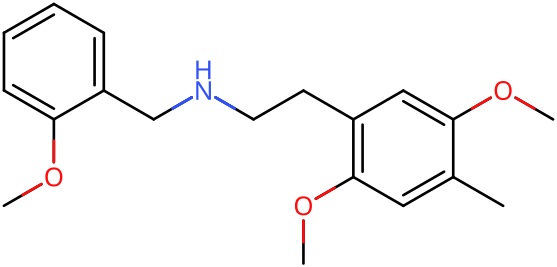
25D-NBOMe Stats & Data
COc1ccccc1CNCCc1cc(OC)c(C)cc1OCUTVHBNXCFSATDB-UHFFFAOYSA-NReceptor Profile
Receptor Actions
History & Culture
25D-NBOMe is a derivative of the phenethylamine psychedelic 2C-D, created through the addition of an N-benzyl methoxy group to the parent compound. The substance emerged on the designer drug market around 2010, appearing for sale online before formal scientific characterization had been completed. It was first described in the scientific literature by 2012, with subsequent research by Martin Hansen and colleagues in 2014 examining the structure-activity relationships of N-benzyl phenethylamines and establishing 25D-NBOMe's activity profile as a potent 5-HT2A receptor agonist. The substance acquired the street name "divination" and became part of the broader NBOMe series that proliferated through online research chemical vendors in the early 2010s. Like other members of this chemical class, 25D-NBOMe had no documented history of human use prior to its appearance as a designer drug, and its emergence as a recreational substance preceded systematic research into its effects and safety profile. This pattern of market availability outpacing scientific understanding has been characteristic of the NBOMe compound series more broadly.
Subjective Effects
Physical
The physical effects of 25D-NBOMe can be broken down into several components which progressively intensify proportional to dosage.
- Sedation: In terms of its effects on the subject's physical energy levels, 25D-NBOMe is considered to be sedating. The sedation can be considered slightly less intense than other psychedelics such as psilocin and 4-AcO-DMT.
- Sublingual numbing: Assuming the substance has been taken sublingually, the very first physical effect which a person will notice immediately after sublingual absorption is a strong, unpleasant, metallic chemical taste. This is accompanied by a very obvious feeling of general numbness of the tongue and mouth which can stay for up to an hour after the blotter paper has been consumed. This is the key difference when it comes to determining whether your blotter paper contains LSD or one of the NBOMe series.
- Perception of increased weight
- Tactile hallucinations
- Nausea: As the tripper begins to come up, nausea is not uncommon and can sometimes result in initial vomiting. It passes once this has happened or the trip begins to fully set in. In comparison to other psychedelics such as psilocin, LSD, 2C-E and 2C-I, this could actually be very considered very mild in its intensity.
- Vasoconstriction
- Increased heart rate
- Pupil dilation
- Wakefulness
Cognitive
The cognitive effects of 25D-NBOMe are remarkably light and underwhelming in comparison to more traditional psychedelics. It is not uncommon for people to report feeling that their thought stream has maintained general normality in its specific style throughout moderate to high doses. At heavy doses, however, mild cognitive alterations become present; this dose seems to be lower in proportion to physical effects when compared to 25I-NBOMe.
- Analysis enhancement
- Thought deceleration
- Time distortion
- Novelty enhancement
- Conceptual thinking
- Emotion enhancement
- Personal bias suppression
- Memory suppression
- Ego death
Sensory
- Drifting: (Melting, flowing, breathing and morphing) - In comparison to other psychedelics, this effect can be described as bland, slow and smooth in motion, inconsistent in appearance and unrealistic/cartoon-like in style.
- Tracers
- After images
- Symmetrical texture repetition
- Colour shifting
- Diffraction
25D-NBOMe presents a mild array of possible visual enhancements.
- Visual acuity enhancement
- Colour enhancement
- Pattern recognition enhancement
25D-NBOMe is capable of producing a full range of hallucinatory states within the level 1 - 3 range extremely consistently within doses higher than of 2mg.
- Transformations
- Internal hallucinations: (Settings, sceneries, and landscapes; alterations in perspective and scenarios and plots)
- External hallucinations: (Autonomous entities; settings, sceneries, and landscapes; alterations in perspective and scenarios and plots)
Forked from Subjective Effect Documentation by Josie Kins, June 2016. Via dose.wiki (CC0).
Toxicity
PsychonautWiki25D-NBOMe is a very new substance, and very little is known about its pharmacological risks or its interaction with other substances. The LD50 has not yet been determined. Due to 25D-NBOMe's extreme potency, it should not be insufflated (snorted) as this method of administration appears to have led to several deaths from other NBOMe compounds in the past year. It is strongly recommended that one use harm reduction practices when using this substance.
Effect Profile
Curated + 7 ReportsStrong visuals, auditory effects, and headspace with strong body load
Tolerance & Pharmacokinetics
drugs.wikiTolerance Decay
Experience Report Analysis
ErowidDemographics
Gender Distribution
Too few reports for a chart: gender is known from 12 reports, and a split is drawn only from 20 reports or more. Counts are shown instead. Why 20?
- Male 11 of 12
- Not Specified 1 of 12
Age Distribution
Reports Over Time
Effect Analysis
ErowidEffects aggregated from 7 experience reports (7 single-substance Erowid)
Effect Sentiment Distribution
Confidence Distribution
Each bar is the share of reports mentioning the effect; its whisker, and the band on the rows below, is the 95% interval: where the share could plausibly be with other reports of the same kind.
Too few reports for bars: these effects come from 7 single-substance Erowid reports, and a bar is drawn only from 20 reports or more. With fewer, a percentage cannot tell a common effect from a rare one. Counts are shown instead. Why 20?
Positive Effects 4
Adverse Effects 1
Real-World Dose Distribution
ErowidFrom 6 of 11 recorded dose entries: those that state a weight (mg, g or µg), in routes with at least five of them. Values above Q3 + 3×IQR, far above what people typically take, are left out; they can include real heavy doses and overdoses, not only mistakes.
Sublingual (n=6)
Common Combinations
Most co-occurring substances, as a share of all 12 reports filed under 25D-NBOMe
Too few reports for bars: these combinations come from 12 reports, and a bar is drawn only from 20 reports or more. With fewer, a percentage cannot tell a common effect from a rare one. Counts are shown instead. Why 20?
- THC 4 of 12
Form / Preparation
Most common forms and preparations, as a share of the 9 reports that give one
Too few reports for bars: these forms come from 9 reports, and a bar is drawn only from 20 reports or more. With fewer, a percentage cannot tell a common effect from a rare one. Counts are shown instead. Why 20?
- Blotter / Tab 9 of 9
Redose Patterns
Redosing behavior across 10 reports
Too few reports for a chart: redosing is known from 10 reports, and a split is drawn only from 20 reports or more. Counts are shown instead. Why 20?
- Single dose 10 of 10
- Redosed 0 of 10
Legal Status
| Country | Status | Notes |
|---|---|---|
| Austria | Illegal (NPSG) | Controlled under the Neue-Psychoaktive-Substanzen-Gesetz (New Psychoactive Substances Act). Possession, production, and sale are prohibited. |
| Brazil | Illegal | Listed as a controlled substance under Portaria SVS/MS nº 344. Possession, production, and sale are prohibited. |
| Canada | Schedule III (CDSA) | Considered a Schedule III substance under the Controlled Drugs and Substances Act as a derivative of 2,5-dimethoxyphenethylamine. |
| China | Controlled | Designated as a controlled substance as of October 2015. |
| Finland | Scheduled | Listed in the government decree on prohibited psychoactive substances in consumer markets. |
| Germany | Controlled (NpSG) | Regulated under the Neue-psychoaktive-Stoffe-Gesetz (New Psychoactive Substances Act) since November 26, 2016. Production, import for distribution, administration to others, and trading are criminal offenses. Possession is prohibited but not subject to criminal penalty. |
| Japan | Controlled | Designated as a controlled substance effective March 25, 2015. |
| Latvia | Schedule I | Classified as a Schedule I controlled substance under national drug legislation. |
| Sweden | Schedule I | Added to Schedule I (substances without recognized medical use) as of August 1, 2013, as published by the Medical Products Agency in regulation LVFS 2013:15. |
| Switzerland | Controlled (Verzeichnis E) | Specifically named as a controlled substance under Verzeichnis E of the Swiss narcotics scheduling system. |
| Turkey | Illegal | Classified as a controlled drug. Possession, production, supply, and importation are prohibited. |
| United Kingdom | Class A | Controlled as a Class A substance under the Misuse of Drugs Act 1971 via the N-benzylphenethylamine catch-all clause. Initially placed under a Temporary Class Drug Order on June 10, 2013 before permanent scheduling. |
| United States | Unscheduled | Not specifically scheduled at the federal or state level. However, prosecution under the Federal Analogue Act may be possible when sold for human consumption due to structural and functional similarity to the controlled substance 2C-D. |
References
Cited References
- Alcohol and Drug Foundation: NBOMes
- Erowid: 25D-NBOMe Experience Vault
- Erowid: NBOMe Series Vault
- Frontiers in Neuroscience: NBOMes - Highly Potent and Toxic Alternatives of LSD
- Gil-Martins et al. (2025): Toxicodynamic insights of 2C and NBOMe drugs
- Hansen et al. (2014): Synthesis and Structure-Activity Relationships of N-Benzyl Phenethylamines
- Isomer Design: 25D-NBOMe
- Lee et al. (2023): Designer Drug 25D-NBOMe Has Reinforcing and Rewarding Effects
- Marchi et al. (2019): Clinical and Toxicological Profile of NBOMes: A Systematic Review
- Yoon et al. (2019): Cardiac Effects of 25D-NBOMe and 25C-NBOMe