
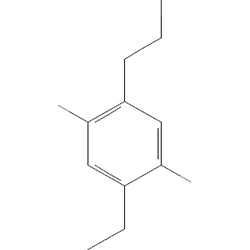
25E-NBOH Stats & Data
CCc1cc(OC)c(CCNCc2ccccc2O)cc1OCSYBINTRPEZWFLZ-UHFFFAOYSA-NReceptor Profile
Receptor Actions
History & Culture
25E-NBOH was first synthesized in 2010 by Martin Hansen at the University of Copenhagen, where it was developed as a brain imaging agent for research purposes. The compound was part of a broader effort to create selective serotonin receptor ligands suitable for neuroimaging applications. The substance subsequently appeared on the recreational drug market, with the first confirmed identification occurring in Brazil in 2018 when it was detected on seized blotter paper. It has since been identified in several European countries, including Slovenia and France. The broader NBOH series, encompassing related compounds such as 25B-NBOH, 25C-NBOH, and 25I-NBOH, gained recognition from European drug monitoring authorities around 2016. Within recreational contexts, 25E-NBOH has been marketed as a cost-effective alternative to LSD and has reportedly been misrepresented and sold as LSD in some instances, following a pattern common to many novel psychoactive substances distributed on blotter paper.
Toxicity
PsychonautWiki25E-NBOH like other classical psychedelics is not believed to have any long term safety concerns. Anecdotal reports suggest that 25E-NBOH is non-habit forming. It is recommended that a break is taken between use of this or other psychedelics to allow for tolerance to reset and the body to recover. It is strongly recommended that one use harm reduction practices when using this substance.
Effect Profile
Curated + 7 ReportsStrong visuals, auditory effects, and headspace with strong body load
Mild stimulation and focus with mild anxiety/jitters, low euphoria
Tolerance & Pharmacokinetics
drugs.wikiTolerance Decay
Experience Report Analysis
ErowidDemographics
Gender Distribution
Too few reports for a chart: gender is known from 10 reports, and a split is drawn only from 20 reports or more. Counts are shown instead. Why 20?
- Male 8 of 10
- Not Specified 2 of 10
Age Distribution
Reports Over Time
Effect Analysis
ErowidEffects aggregated from 7 experience reports (7 single-substance Erowid)
Effect Sentiment Distribution
Confidence Distribution
Each bar is the share of reports mentioning the effect; its whisker, and the band on the rows below, is the 95% interval: where the share could plausibly be with other reports of the same kind.
Too few reports for bars: these effects come from 7 single-substance Erowid reports, and a bar is drawn only from 20 reports or more. With fewer, a percentage cannot tell a common effect from a rare one. Counts are shown instead. Why 20?
Positive Effects 6
Adverse Effects 1
Show 1 neutral or unclassified mention
Real-World Dose Distribution
ErowidFrom 5 of 14 recorded dose entries: those that state a weight (mg, g or µg), in routes with at least five of them. Values above Q3 + 3×IQR, far above what people typically take, are left out; they can include real heavy doses and overdoses, not only mistakes.
Sublingual (n=5)
Form / Preparation
Most common forms and preparations, as a share of the 7 reports that give one
Too few reports for bars: these forms come from 7 reports, and a bar is drawn only from 20 reports or more. With fewer, a percentage cannot tell a common effect from a rare one. Counts are shown instead. Why 20?
- Blotter / Tab 6 of 7
Legal Status
| Country | Status | Notes |
|---|---|---|
| United Kingdom | Class A | Controlled under the Misuse of Drugs Act 1971 through the N-benzylphenethylamine catch-all clause, which covers structurally related compounds regardless of specific scheduling. Class A classification carries the most severe penalties under UK drug law, including up to seven years imprisonment for possession and life imprisonment for supply offenses. |
| United States | Unscheduled (Analogue Act applies) | Not explicitly listed under the Controlled Substances Act of 1970. However, due to structural similarity to NBOMe-class compounds, it may be prosecuted under the Federal Analogue Act of 1986 when sold or possessed for human consumption, effectively treating it as a Schedule I substance. Manufacturing, purchasing, possessing, or distributing without DEA authorization could result in federal prosecution. |
References
Data Sources
Cited References
- Bluelight: Big & Dandy 25x-NBOH discussion thread
- Erowid: 25E-NBOH Experience Vault
- Ettrup et al. 2011: Radiosynthesis and in vivo evaluation of N-benzyl phenethylamines as 5-HT2A agonist PET tracers
- Hansen 2010: Design and Synthesis of Selective Serotonin Receptor Agonists for PET Imaging
- Hansen et al. 2014: Synthesis and Structure-Activity Relationships of N-Benzyl Phenethylamines as 5-HT2A/2C Agonists
- Machado et al. 2020: Identification of new NBOH drugs in seized blotter papers
- NMS Labs: 25E-NBOH Seized Material Profile
- Pelletier et al. 2024: Severe 25E-NBOH intoxication associated with MDPHP intake (French case report)
- Severe 25E-NBOH intoxication case report (France, 2024)
- Locomotor and discriminative stimulus effects of NBOH analogues in mice
- Reddit: /r/researchchemicals post – 500 µg blotter equated to ~300 µg LSD