
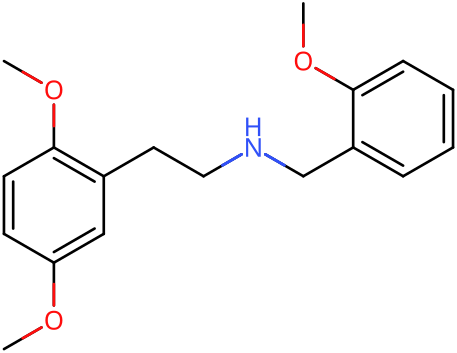
25H-NBOMe Stats & Data
COc1ccc(OC)c(CCNCc2ccccc2OC)c1RMLXCDMTGWSEOU-UHFFFAOYSA-NReceptor Profile
Receptor Actions
Effect Profile
CuratedStrong visuals with strong body load, moderate headspace
Mild stimulation and focus with strong anxiety/jitters, low euphoria
Tolerance & Pharmacokinetics
drugs.wikiTolerance Decay
Cross‑tolerance among serotonergic psychedelics is expected due to 5‑HT2A receptor desensitization. Many users report markedly blunted effects if re‑dosing within 1–2 weeks after NBOMe exposure; some describe longer cross‑tolerance windows with higher doses. Data remain anecdotal and variable.
Cross-Tolerances
Experience Report Analysis
ErowidDemographics
Gender Distribution
Too few reports for a chart: gender is known from 1 report, and a split is drawn only from 20 reports or more. Counts are shown instead. Why 20?
- Male 1 of 1
Reports Over Time
Legal Status
| Country | Status | Notes |
|---|---|---|
| Sweden | The Riksdag added 25H-NBOMe to Narcotic Drugs Punishments Act under swedish schedule I ("substances, plant materials and fungi which normally do not have medical use") as of August 1, 2013, published by Medical Products Agency (MPA) in regulation LVFS 2013:15 listed as 25H-NBOMe, and 2-(2,5-dimetoxifenyl)-N-(2-metoxibensyl)etanamin. | |
| United Kingdom | This substance is a Class A drug in the United Kingdom as a result of the N-benzylphenethylamine catch-all clause in the Misuse of Drugs Act 1971. |
Harm Reduction
drugs.wiki25H-NBOMe is the N-(2‑methoxybenzyl) derivative of the unsubstituted phenethylamine 2C‑H. Compared with the more common halogenated NBOMes (25I/25C/25B), community and in‑vitro discussions indicate it is much weaker at 5‑HT2A and more adrenergic in feel, which encourages multi‑milligram dosing and raises peripheral toxicity risk (tachycardia, hypertension, cold/numb extremities). NBOMes have been repeatedly mis‑sold as LSD on blotter; field checks can help: LSD fluoresces under UV and yields a positive on certain LSD field reagent kits, while NBOMes typically do not. However, taste/numbness and quick field tests are not definitive—use laboratory drug checking where available. Avoid relying on swallowing blotter as a safety test: some NBOMe salts show uncertain oral activity; discard unknown blotters if you wish to avoid NBOMes. Volumetric dosing is strongly recommended for any sub‑milligram or low‑milligram material; label solutions clearly, use appropriate solvent, and calculate carefully. Insufflation of NBOMes is associated with a disproportionate number of medical emergencies; mucosal damage and rapid spikes in BP/HR are common—prefer buccal/sublingual if one uses at all. Set, setting, and body temperature management matter: minimize exertion, take cooling breaks, and sip electrolytes to mitigate hyperthermia risk from the stimulant component. People with cardiovascular disease, uncontrolled hypertension, Raynaud‑type circulation issues, or migraine with vasospasm should avoid NBOMes due to vasoconstriction risk. Because cross‑tolerance within 5‑HT2A agonists is common, allow at least 1–2 weeks between sessions to reduce unpredictable dosing and muted effects. There are anecdotal reports of HPPD after NBOMe use; persistent visual effects are possible even after single exposures. Parenteral routes (IV/IM) are strongly discouraged due to potency, solubility variability, and severe vasoconstriction risk. If severe chest pain, blue/cold digits, intractable vomiting, severe agitation, seizures, or loss of consciousness occur, seek emergency care immediately and avoid taking additional substances while waiting.
References
Data Sources
Cited References
- Braden MR et al. (2006) N-benzyl phenethylamines as potent 5-HT2A receptor agonists
- Johnson RD et al. (2014) LC-MS-MS evaluation of NBOMe compounds
- Poklis JL et al. (2014) NBOMe intoxication case report with 25B-NBOMe quantification
- Pottie E et al. (2021) Serotonin 2A receptor activation by 25H-NBOMe positional isomers
- PsychonautWiki: 25x-NBOMe series
- PsychonautWiki Talk: 25H-NBOMe
- Suzuki J et al. (2015) Toxicities associated with NBOMe ingestion: systematic review
- The Small & Handy 25H-NBOMe Thread - Bluelight user reports
- TripSit: Factsheet - 25H-NBOMe
- Zawilska JB & Kacela M (2020) NBOMes - Highly potent and toxic alternatives of LSD
Additional references
- TripSit Wiki – NBOMes overview: dosing, duration, harm‑reduction caveats (oral bioavailability uncertainty, heart risk)
- Erowid Spotlight on NBOMes: potency, vasoconstriction concerns, overdose risk, and handling cautions
- Erowid – 25I‑NBOMe caution: do not snort; mis‑sold as LSD on blotter
- Erowid – Liquid Measurement Technique (volumetric dosing)
- Erowid – LSD field tests differentiate LSD from 25I‑NBOMe; UV fluorescence vs no reaction
- Erowid – LSD glows under UV; 25I‑NBOMe did not in side‑by‑side test
- Bluelight – Important NBOMe warning: unknown blotters sold as LSD; bitter/numbing heuristic; updated oral caution
- Bluelight – The Small & Handy 25H‑NBOMe thread (reports of pronounced adrenergic profile; low potency vs 25I)
- Erowid – 2C‑C‑NBOMe effects/risks page: vasoconstriction case notes
- Bluelight – Dangerous & potentially unsafe combinations (MAOIs, stimulants, tramadol, etc.)
- Erowid – LSD and antidepressants page including lithium seizure report (used to justify lithium danger across 5‑HT2A psychedelics)
- Reddit r/researchchemicals – tolerance windows for NBOMe/NBOH (anecdotal cross‑tolerance durations)