
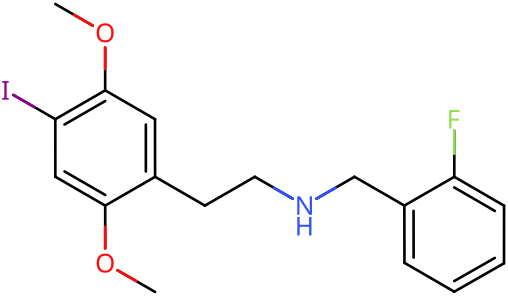
25I-NBF Stats & Data
COc1cc(CCNCc2ccccc2F)c(OC)cc1ILPBKNBHMWRBPHT-UHFFFAOYSA-NReceptor Profile
Receptor Actions
History & Culture
25I-NBF emerged as part of the broader NBOMe and NBF series of N-benzyl phenethylamine derivatives developed for research purposes. The compound has been investigated in its carbon-11 radiolabelled form (designated Cimbi-21) as a potential ligand for positron emission tomography (PET) imaging, specifically for mapping the distribution of 5-HT2A serotonin receptors in the brain. Prior to its scheduling in various jurisdictions, 25I-NBF was briefly available commercially in limited markets as a novel psychoactive substance. However, its period of availability was relatively short before regulatory action was taken across multiple countries.
Effect Profile
CuratedStrong visuals with moderate headspace and body load, mild auditory effects
Moderate euphoria with strong anxiety/jitters, low stimulation and focus
Tolerance & Pharmacokinetics
drugs.wikiTolerance Decay
Rapid tolerance build similar to NBOMe/LSD is reported anecdotally; noticeable tolerance persists several days and may take 1–2 weeks to normalize.
Cross-Tolerances
Legal Status
| Country | Status | Notes |
|---|---|---|
| Hungary | Illegal | Classified as a prohibited substance under national drug legislation. |
| Japan | Illegal | Controlled as a designated substance under Japanese drug control laws. |
| Latvia | Illegal | Prohibited under national controlled substances legislation. |
| Sweden | Schedule I | Added to the Narcotic Drugs Punishments Act on January 26, 2016. Listed under Swedish Schedule I as a substance without accepted medical use, published by the Medical Products Agency in regulation HSLF-FS 2015:35. |
| United Kingdom | Class A | Controlled under the Misuse of Drugs Act 1971 via the N-benzylphenethylamine catch-all clause. Class A substances carry the most severe penalties, including up to 7 years imprisonment for possession. |
| United States | State-level scheduling (Vermont) | Not federally scheduled at the national level. The state of Vermont has independently classified 25I-NBF as an illegal substance. Federal prosecution may still be possible under the Federal Analogue Act when sold for human consumption. |
Harm Reduction
drugs.wiki• 25I-NBF appears several-fold less potent than 25I-NBOMe yet retains broadly similar qualitative effects; mg-level errors can still be medically serious. Use a 0.001 g scale only to prepare a liquid for volumetric dosing; do not eyeball powders.
• NBOMe/NBxx compounds have caused severe toxicity and deaths at what some considered “recreational” doses; risk is heightened by uneven dosing, intranasal powder use, and stimulant/MAOI combinations.
• Misrepresentation on blotter is documented: NBOMe-class drugs have been sold as LSD. Use reagents (Ehrlich or Hofmann positive suggests an indole like LSD; NBOMes typically do not react with Ehrlich) and prefer trusted drug checking. A bitter/metallic taste and oral numbness can accompany NBOMe/NBxx tabs.
• Strong vasoconstriction, tachycardia and hypertension are the main acute physical risks; cold, pale/numb extremities, chest pain, or severe headache warrant immediate medical care. Avoid other vasoconstrictors (nicotine, decongestants, stimulants).
• Insufflation increases adverse events and local tissue irritation; if used intranasally, a dilute measured solution is safer than powder to reduce hot-spots. Buccal/sublingual routes are generally preferred.
• Oral activity across NBOMe/NBxx varies; do not assume that swallowing a blotter eliminates effects or risk.
• Start with an allergy test (≤ 0.5 mg buccal) on first exposure; wait a full day before any reassessment due to variability and slow-onset outliers.
• Strongly avoid poly-drug use, especially serotonergic agents (MAOIs, tramadol, DXM, triptans) and stimulants (amphetamines, MDMA, cocaine). These combinations increase risks of hypertension, seizures, and serotonin toxicity.
• Temperature dysregulation and overexertion have been noted with NBOMe-class drugs; take breaks, keep cool, sip fluids, and avoid redosing during the peak.
• Mental effects depend heavily on set and setting; anxious or chaotic environments increase the risk of panic or unsafe behavior. Trip sitter and a calm space are recommended.
• Post-acute stimulation/insomnia is common; avoid using depressants like large alcohol doses or non-prescribed benzodiazepines to force sleep due to interaction risks.
References
Data Sources
Cited References
Additional references
- TripSit Drug Profile: 25I-NBF
- The Big & Dandy 25I-NBF Thread (user experiences)
- Hansen, M. et al. High-potency N-benzyl phenethylamines: structure-activity at 5-HT2A receptors. J Med Chem 2014
- EMCDDA/EUDA Risk Assessment: 25I-NBOMe (2014)
- Erowid: Spotlight on NBOMes – Potent Psychedelic Issues
- TripSit Wiki: NBOMes (dosing/oral activity variability)
- TripSit Drug Combinations Guide (MAOI/serotonergic/stimulant cautions)
- Bluelight: Volumetric dosing explanation (NBOMe thread)
- Bluelight: Research Chemicals on Blotters (NBOMe warnings)
- Erowid LSD FAQ (set/setting)