
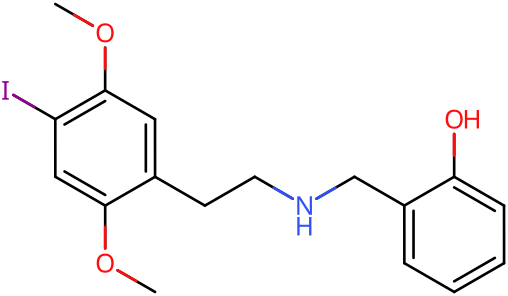
25I-NBOH Stats & Data
COc1cc(CCNCc2ccccc2O)c(OC)cc1IFEUZHYRXGQTBRO-UHFFFAOYSA-NReceptor Profile
Receptor Actions
History & Culture
25I-NBOH was first synthesized in 2006 by a research team at Purdue University working under the direction of David Nichols. The compound was developed as part of ongoing investigations into serotonin receptor pharmacology, with particular interest in its potential application as a radioligand for brain imaging studies. When radiolabeled with carbon-11, 25I-NBOH has been investigated as a tool for mapping the distribution of 5-HT2A receptors in the brain using positron emission tomography (PET), where it is known by the research designation Cimbi-27. The compound had no documented history of recreational use prior to 2011, when it began appearing in online markets as a designer drug. Its emergence coincided with the broader proliferation of N-benzylphenethylamine derivatives during this period. 25I-NBOH is closely related to 25I-NBOMe—a compound that has been associated with numerous deaths and hospitalizations—and is also a known metabolite of that substance. This metabolic relationship has implications for forensic analysis, as does the compound's chemical instability: 25I-NBOH is a labile molecule that fragments into its parent compound 2C-I when subjected to routine gas chromatography methods, a characteristic that prompted the development of specialized analytical techniques for its reliable identification in forensic laboratories worldwide.
Toxicity
PsychonautWiki25I-NBOH is a relatively new substance, and little is known about its toxicity or interaction with other substances. It is assumed to pose similar acute health risks as 25I-NBOMe (see this section for more information). The LD50 has not yet been determined although it is likely to be potentially fatal at heavy dosages. 25I-NBOH's extreme potency means it should not be insufflated (snorted) as this method of administration has been associated with many deaths and hospitalizations with the closely related 25I-NBOMe.
Effect Profile
Curated + 4 ReportsStrong visuals, auditory effects, and headspace with strong body load
Moderate euphoria with strong anxiety/jitters, mild stimulation and focus
Duration Timeline
BluelightTolerance & Pharmacokinetics
drugs.wikiTolerance Decay
Rapid within-session tolerance typical of serotonergic psychedelics; redosing adds side effects with limited benefit. Return to baseline generally reported within 1–3 weeks.
Cross-Tolerances
Experience Report Analysis
ErowidDemographics
Gender Distribution
Too few reports for a chart: gender is known from 12 reports, and a split is drawn only from 20 reports or more. Counts are shown instead. Why 20?
- Male 11 of 12
- Female 1 of 12
Age Distribution
Reports Over Time
Effect Analysis
ErowidEffects aggregated from 4 experience reports (4 single-substance Erowid)
Effect Sentiment Distribution
Confidence Distribution
Each bar is the share of reports mentioning the effect; its whisker, and the band on the rows below, is the 95% interval: where the share could plausibly be with other reports of the same kind.
Too few reports for bars: these effects come from 4 single-substance Erowid reports, and a bar is drawn only from 20 reports or more. With fewer, a percentage cannot tell a common effect from a rare one. Counts are shown instead. Why 20?
Positive Effects 2
Adverse Effects 0
Also reported in combinations. In the 8 25I-NBOH reports where another drug was taken too, 2 mention hospital, emergency services or an overdose, 0 a seizure and 0 psychosis (too few reports for percentages). In the 4 single-substance reports: 0, 0 and 0. These are not in the figures above: they cannot be put down to 25I-NBOH alone, and a mention is not always something that happened to the writer.
Real-World Dose Distribution
ErowidFrom 5 of 11 recorded dose entries: those that state a weight (mg, g or µg), in routes with at least five of them. Values above Q3 + 3×IQR, far above what people typically take, are left out; they can include real heavy doses and overdoses, not only mistakes.
Sublingual (n=5)
Common Combinations
Most co-occurring substances, as a share of all 12 reports filed under 25I-NBOH
Too few reports for bars: these combinations come from 12 reports, and a bar is drawn only from 20 reports or more. With fewer, a percentage cannot tell a common effect from a rare one. Counts are shown instead. Why 20?
- THC 5 of 12
Form / Preparation
Most common forms and preparations, as a share of the 10 reports that give one
Too few reports for bars: these forms come from 10 reports, and a bar is drawn only from 20 reports or more. With fewer, a percentage cannot tell a common effect from a rare one. Counts are shown instead. Why 20?
- Blotter / Tab 6 of 10
- Powder / Crystals 2 of 10
- Liquid 2 of 10
Redose Patterns
Redosing behavior across 10 reports
Too few reports for a chart: redosing is known from 10 reports, and a split is drawn only from 20 reports or more. Counts are shown instead. Why 20?
- Single dose 7 of 10
- Redosed 3 of 10
Legal Status
| Country | Status | Notes |
|---|---|---|
| Germany | NpSG (Controlled) | Controlled under the Neue-psychoaktive-Stoffe-Gesetz (New Psychoactive Substances Act) since November 26, 2016. Manufacturing and importing with intent to distribute, administering to others, and commercial trade are criminal offenses. Personal possession is prohibited but does not carry criminal penalties. |
| Sweden | Schedule I | Listed under the Narcotic Drugs Punishments Act in Schedule I, which covers substances without recognized medical use. Added on August 18, 2015 through Medical Products Agency regulation HSLF-FS 2015:12, where it appears under both the name '25I-NBOH' and its chemical designation. |
| Switzerland | Verzeichnis E (Controlled) | Specifically named as a controlled substance under Verzeichnis E of Swiss narcotics legislation. Production, possession, and distribution are regulated. |
| United Kingdom | Class A | Controlled as a Class A substance under the Misuse of Drugs Act 1971 through the N-benzylphenethylamine catch-all clause, which encompasses structurally related compounds in this chemical class. Class A substances carry the most severe penalties under UK drug law. |
Harm Reduction
drugs.wiki• 25I-NBOH is dosed in micrograms; use a precise scale or volumetric dosing. As with NBOMe-class, overdoses at the milligram level and with intranasal/IV use have led to severe toxicity; stick to sublingual/buccal administration. • NBOMe/NBOH-labeled blotters are sometimes sold as LSD; an Ehrlich reagent that fails to turn purple strongly suggests “not-LSD.” Send to a drug checking service where possible. • Significant vasoconstriction (cold, numb fingers/toes), tachycardia and hypertension have been reported with N-benzyl phenethylamines; keep warm, avoid heavy exertion, and seek medical help if severe pain, color change, or numbness persist. • Seizures have been reported with closely related NBOMe compounds and occasionally with high or mixed doses; avoid tramadol, DXM, bupropion and strong stimulants. • Redosing during the same session is usually ineffective and increases side-effect burden because tolerance rises rapidly within hours. • If agitation, panic, or severe hypertension occur, a benzodiazepine (e.g., diazepam/lorazepam) is commonly used in clinical settings; do not combine preemptively. • Blotter potency is highly variable; one tab may contain hundreds of micrograms to >1 mg. Assume variability and avoid stacking tabs quickly. • Anecdotal reports suggest oral swallowing is less reliable than sublingual/buccal due to first-pass metabolism; holding the blotter/solution in the mouth 15–30 minutes before discarding may improve consistency.
References
Cited References
- Ettrup et al. 2011 - Radiosynthesis and in vivo evaluation of substituted 11C-phenethylamines as 5-HT2A agonist PET tracers
- Åstrand et al. 2020 - Off-target μ-opioid receptor activity of 25I-NBOH and analogues
- Coelho Neto et al. 2017 - 25I-NBOH: a new potent serotonin 5-HT2A receptor agonist identified in blotter paper seizures in Brazil
- EMCDDA: Europol 25I-NBOH Early-warning brief, 2016
- Erowid: 25i Nboh.shtml
- Erowid Experience Vaults: 25I-NBOH Reports
- Hansen et al. 2014 - Synthesis and Structure–Activity Relationships of N-Benzyl Phenethylamines as 5-HT2A/2C Agonists
- Silva et al. 2011 - Theoretical studies on the interaction of partial agonists with the 5-HT2A receptor
- TripSit: Drug Database – 25I-NBOH Fact Sheet (2024 revision)
- Ettrup et al. 25I-NBOH: a high-affinity 5-HT2A agonist for PET imaging. Journal of Medicinal Chemistry 2011;54(13): 4802-4815.
Additional references
- Erowid – NBOMe series overview; potency, substitution for LSD, vasoconstriction risk.
- TripSit Wiki – NBOMes dosage and duration guidance (microgram potency; 25I-NBOMe ranges as class analogue).
- Hi-Ground NBOMe harm-reduction flyer (2024) – reagent guidance, onset/duration windows, seizure warning.
- Erowid – 25I-NBOMe fatalities (intranasal and high-dose cases), as cautionary evidence for N-benzyl phenethylamine risks.
- Effect Index – 25i-NBOH trip report cross-referenced in effect pages (visual phenomena, muscle twitching).
- EU Drug Agency (EMCDDA/EUDA) Joint Report on 25I-NBOMe – severe toxicity profiles and mis-sold as LSD context.