
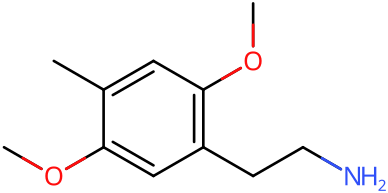
2C-D Stats & Data
NCCc1cc(OC)c(C)cc1OCUNQQFDCVEMVQHM-UHFFFAOYSA-NReceptor Profile
Receptor Actions
History & Culture
1964–1975
The synthesis of 2C-D was first documented in scientific literature by Beng T. Ho and colleagues at the Texas Research Institute of Mental Sciences in 1970, who described both its preparation and pharmacological activity in animals. However, Alexander Shulgin had already begun human trials of the compound at sub-threshold doses as early as 1964. Between 1974 and 1975, Shulgin conducted further investigations at higher doses, discovering the compound's psychoactive effects. The properties of 2C-D in humans, alongside those of 2C-B, were formally published by Shulgin and Michael Carter in 1975. The designation "2C-D" reflects the compound's chemical relationship to the amphetamine DOM, with the "2C" indicating it is a two-carbon phenethylamine analogue. Shulgin later provided comprehensive documentation of the compound in his 1991 book PiHKAL: A Chemical Love Story.
1970s–1980s
Throughout the 1970s and 1980s, German psychiatrist Hanscarl Leuner and his student Michael Schlichting conducted extensive research on 2C-D at higher doses within the context of psychedelic-assisted psychotherapy. In these clinical studies, the compound was designated by the names DMM-PEA and LE-25. Despite demonstrating potential as a functional psychostimulant for therapeutic applications, 2C-D never achieved broad clinical adoption. During the same period, Darrell Lemaire, publishing under the pseudonyms Hosteen Nez and Lazar, explored the use of low-dose 2C-D as a potential cognitive enhancer or "smart drug."
2005–present
By 2005, 2C-D began appearing as a novel recreational substance in the United States. Unlike more popular members of the 2C family such as 2C-B and 2C-T-7, it remained unscheduled in the United States and most other jurisdictions at that time. This changed in 2012 when the compound was added to Schedule I of the Controlled Substances Act through the Food and Drug Administration Safety and Innovation Act. Alexander Shulgin's characterization of 2C-D as "pharmacological tofu" has significantly shaped perceptions of the compound. This description suggests that 2C-D can extend or potentiate the effects of other substances without strongly influencing the qualitative character of the experience—analogous to how tofu absorbs the flavors of accompanying ingredients. Some interpret this characterization as evidence that 2C-D is unremarkable as a standalone psychedelic. Others dispute this view, maintaining that the compound is an unusually versatile and complete psychedelic experience in its own right. In contemporary practice, 2C-D remains relatively obscure compared to other members of the 2C family. It is seldom encountered through conventional drug markets and is instead primarily obtained as a research chemical through online sources.
Subjective Effects
Physical
The physical effects of 2C-D can be broken down into several components which progressively intensify proportional to dosage.
- Spontaneous tactile sensations: The body high of 2C-D can be described as a pleasurable, all-encompassing comfort sensation. This maintains a consistent presence that steadily rises with the onset and hits its limit once the peak has been reached.
- Sedation: In terms of its effects on the physical energy levels of the tripper, the 2C-D experience begins with mild sedation that increases as the trip progresses, and lacks the distinctive energetic feeling associated with most phenethylamines.
- Nausea: Although nausea remains present, in comparison to other phenethylamines such as 2C-E, 2C-I or 2C-B, this remains extremely mild and dissipates quickly even with higher dosages. It is a very kind and mild psychedelic for this reason.
- Bodily control enhancement and Motor control loss: Whilst at lower doses one may find that their bodily control is enhanced, at higher dosages it seems to become suppressed.
- Tactile enhancement
- Temperature regulation loss
- Pupil dilation
Cognitive
The head space of 2C-D is described by many as one which is both insightful and relatively normal in its thought processes even at moderate to high dosages. The feeling of "unaltered consciousness" may be bothersome to trippers that are willing to experience events and concepts from a shifting point of view, since on 2C-D everything is fairly normal, stable and therefore rather uninteresting.
- Analysis enhancement
- Introspection
- Thought acceleration
- Time distortion
- Novelty enhancement
- Conceptual thinking
- Thought connectivity
- Current mind state enhancement
- Personal bias suppression
- Memory suppression
- Ego death
Sensory
- Enhancements
- Distortions
- Hallucinations
2C-D presents a full and complete array of possible visual distortions.
- Drifting: (Melting, flowing, breathing and morphing) - In comparison to other psychedelics, this effect can be described as highly detailed, slow and smooth in motion, static in appearance and realistic in style.
- Tracers
- Colour shifting
2C-D presents a full and complete array of possible visual enhancements.
- Acuity enhancement
- Colour enhancement
- Pattern recognition enhancement
2C-D produces a full range of high level hallucinatory states in a fashion that is more consistent and reproducible than that of many other commonly used psychedelics. This holds particularly true in comparison to other substances within the phenethylamine family.
- Transformations
- Internal hallucinations: (Autonomous entities; settings, sceneries, and landscapes; alterations in perspective and scenarios and plots) - In comparison to other psychedelics such as LSD, 2C-D is high in hallucinations embedded within visual geometry. This particular effect commonly contains hallucinations with scenarios, settings, concepts and autonomous entity contact. They are more common within dark environments and can be described as internal in their manifestation, lucid in believability, and interactive in style.
- External hallucinations: (Autonomous entities; settings, sceneries, and landscapes; alterations in perspective and scenarios and plots) - 2C-D is capable of external hallucinations embedded within visual geometry. This particular effect commonly contains hallucinations with scenarios, settings, concepts and autonomous entity contact. They can be described as external in their manifestation, lucid in believability, and interactive in style.
Forked from Subjective Effect Documentation by Josie Kins, September 2015. Via dose.wiki (CC0).
Toxicity
PsychonautWikiThe toxicity and long-term health effects of recreational 2C-D use do not seem to have been studied in any scientific context and the exact toxic dose is unknown. This is because 2C-D is a research chemical with very little history of human usage. Anecdotal evidence from those within the community who have tried 2C-D suggests that there are no negative health effects attributed to simply trying the substance by itself at low to moderate doses and using it very sparingly (but nothing can be completely guaranteed). Independent research should always be done to ensure that a combination of two or more substances is safe before consumption. It is strongly recommended that one use harm reduction practices when using this substance.
Effect Profile
Curated + 33 ReportsStrong visuals, headspace, and auditory effects with strong body load
Duration Timeline
BluelightCommunity Effects
TripSitTolerance & Pharmacokinetics
drugs.wikiTolerance Decay
Classic psychedelics exhibit rapid tolerance and cross‑tolerance mediated by 5‑HT2A signaling; typical advice is spacing experiences by 1–2 weeks for a ‘fresh’ response. Data are synthesized from historical and user‑reported sources; formal human PK/PD tolerance studies for 2C‑D are lacking.
Cross-Tolerances
Experience Report Analysis
ErowidDemographics
Gender Distribution
Age Distribution
Reports Over Time
Effect Analysis
ErowidEffects aggregated from 33 experience reports (33 single-substance Erowid)
Effect Sentiment Distribution
Confidence Distribution
Each bar is the share of reports mentioning the effect; its whisker, and the band on the rows below, is the 95% interval: where the share could plausibly be with other reports of the same kind.
Positive Effects 12
Adverse Effects 7
Show 5 neutral or unclassified mentions
Also reported in combinations. In the 39 2C-D reports where another drug was taken too, 2 (5.1%) mention hospital, emergency services or an overdose, 0 (0.0%) a seizure and 0 (0.0%) psychosis. In the 33 single-substance reports: 9.1%, 0.0% and 0.0%. These are not in the figures above: they cannot be put down to 2C-D alone, and a mention is not always something that happened to the writer.
Dosage Distribution
Dose distribution from experience reports, one dose per report (the first listed). Doses above Q3 + 3×IQR, far above what people typically take, are left out of the median and range and listed under each route: most are real heavy doses or overdoses, not mistakes.
Real-World Dose Distribution
ErowidFrom 85 of 91 recorded dose entries: those that state a weight (mg, g or µg), in routes with at least five of them. Values above Q3 + 3×IQR, far above what people typically take, are left out; they can include real heavy doses and overdoses, not only mistakes.
Oral (n=73)
Insufflated (n=11)
Common Combinations
Most co-occurring substances, as a share of all 72 reports filed under 2C-D; whiskers are 95% intervals
Form / Preparation
Most common forms and preparations, as a share of the 54 reports that give one; whiskers are 95% intervals
Body-Weight Dosing
Dose per kg of body weight, one dose per report (the first listed), from reports giving a weight of 30–250 kg. Doses above Q3 + 3×IQR, far above what people typically take, are left out of the median and range and listed under each route.
Oral
Insufflated
Redose Patterns
Redosing behavior across 55 reports
Legal Status
| Country | Status | Notes |
|---|---|---|
| Australia | Prohibited | Subject to a blanket ban covering all substituted phenethylamines, including the entire 2C-X family of compounds. |
| Austria | Illegal (NPSG) | Prohibited under the Neue-Psychoaktive-Substanzen-Gesetz (New Psychoactive Substances Act). Schedule II of the accompanying NPSV regulation explicitly bans all substituted phenethylamines. |
| Brazil | Controlled | Listed on Portaria SVS/MS nº 344 as of February 18, 2014. Possession, production, and sale are prohibited. |
| Canada | Schedule III (CDSA) | Controlled under Schedule III of the Controlled Drugs and Substances Act as of October 31, 2016, as a derivative of 2,5-dimethoxyphenethylamine. |
| China | Category I Psychotropic Substance | Controlled as of October 2015. Sale, purchase, importation, exportation, and manufacture are prohibited. |
| Denmark | Schedule B | Listed as a Schedule B controlled substance under Danish drug legislation. |
| Finland | Prohibited | Banned in December 2014 under a government decree on psychoactive substances prohibited from the consumer market. |
| Germany | Anlage I BtMG | Listed in Anlage I of the Betäubungsmittelgesetz (Narcotics Act) as of December 13, 2014. Manufacturing, possession, importation, exportation, purchase, sale, procurement, and dispensation without a license is prohibited. |
| Israel | Controlled | Added to the national list of controlled substances in December 2008, making purchase, sale, and possession illegal. |
| Japan | Controlled | Regulated under the Pharmaceutical Affairs Law, making possession and sale illegal. |
| Latvia | Schedule I | Listed as a Schedule I controlled substance under Latvian drug control legislation. |
| Netherlands | Legal (pending review) | Currently not controlled, though it falls within a substance group that may be prohibited under recently enacted New Psychoactive Substances legislation. |
| Sweden | Health Hazard | Classified as a health hazard by the Statens folkhälsoinstitut under the Act on the Prohibition of Certain Goods Dangerous to Health (Lagen om förbud mot vissa hälsofarliga varor) as of March 1, 2005, in regulation SFS 2005:26. Sale and possession are illegal. |
| Switzerland | Controlled (Verzeichnis E) | Specifically named as a controlled substance under Verzeichnis E of Swiss narcotics legislation. |
| Turkey | Illegal | Classified as a drug under Turkish law. Possession, production, supply, and importation are prohibited. |
| United Kingdom | Class A | Controlled under the Misuse of Drugs Act 1971 as a result of the phenethylamine catch-all clause, which covers substituted phenethylamine derivatives. |
| United States | Schedule I | Federally controlled under the Controlled Substances Act since July 9, 2012, when the Food and Drug Administration Safety and Innovation Act was signed into law. Manufacturing, buying, possessing, or distributing requires a DEA license. Additionally controlled at state level in Alabama, Florida, Louisiana, Oklahoma, Pennsylvania, and Vermont. |
Harm Reduction
drugs.wiki• Oral 2C‑D typically lasts 3.5–5 hours with a 15–45 minute onset; avoid redosing during the first 90 minutes because the come‑up can be deceptively light and the dose–response becomes steep, increasing risks of anxiety, hypertension, and confusion. Erowid timing table supports these ranges. • Use a milligram‑precision scale or volumetric dosing; this drug is active at low tens of milligrams and small measurement errors can radically increase intensity. Erowid’s general dosing guidance recommends threshold/allergy tests before a full trial. • Insufflation of 2C‑x compounds is often extremely painful and damaging to nasal mucosa and produces a sharper, less controllable onset; many users regret it even at low doses. Reports for 2C‑D note nasal irritation/drip and 2C‑T‑7/2C‑B pages document severe burning; oral dosing is generally safer on the body. • Combining with MAOIs (including linezolid) can unpredictably potentiate phenethylamines and raise the risk of serotonin toxicity or hypertensive crisis; avoid this combination entirely. • Lithium has repeatedly been linked to seizures and severe adverse reactions with serotonergic psychedelics (documented with LSD); by mechanism and class, this risk likely generalizes to 2C‑x, so avoid lithium + 2C‑D. • Tramadol lowers seizure threshold and adds serotonergic load; TripSit flags tramadol + 2C‑x as unsafe. • MDMA and other stimulants add cardiovascular and serotonergic stress; users report uncomfortable vasoconstriction, tachycardia, and anxiety when mixing stimulants with 2C‑x; avoid or approach only with strong precautions. • SSRIs/SNRIs commonly blunt classic psychedelic effects; they are not protective against adverse psychological reactions and can still interact in complex ways. If on prescription psych meds, do not stop them abruptly to ‘trip harder’; consult a clinician. • Expect mild elevation in heart rate and stimulation; those with uncontrolled hypertension, arrhythmia, or significant cardiovascular disease should avoid use. • 2C‑D has been explored at low sub‑psychedelic doses for focus or “pharmacological tofu” potentiation; however, co‑administration with other psychedelics can extend or intensify effects unpredictably—treat combinations as higher risk and lower your doses if mixing. • Supply risks: Samples sold as “2C‑x” or “tusi/pink cocaine” are frequently polysubstance mixtures (ketamine/MDMA/cocaine etc.) and sometimes contain potent adulterants; use reagent or, ideally, lab drug checking before ingestion. • An initial allergy test at ~¼ of a light dose on a quiet day reduces idiosyncratic reaction risk; escalation should wait until full baseline the next session.
References
Data Sources
Cited References
- Bluelight: Report – 2C-D 30 mg (2024)
- Dean et al., 2013 – 2C or not 2C: Phenethylamine Designer Drug Review
- Demystifying Serotonin Syndrome (NIH)
- Erowid: 2C-D Dosage
- Erowid: 2C-D Effects
- Ho et al., 1970 – Amphetamine analogs. II. Methylated phenethylamines
- Hosten & Lazar – Smart Pills: 2C-D as Cognitive Enhancer
- PiHKAL Entry #23 – 2C-D
- Theobald et al., 2006 – 2C-D Metabolism
- Wikipedia: 2C (psychedelics)
- Erowid: Effects – 2C-D
Additional references
- Erowid – 2C‑D Effects
- Erowid – 2C‑D Dosage
- Isomer Design – 2C‑D (Entry 23)
- TripSit Wiki – 2C‑D overview
- TripSit – Drug combinations (2C‑x section)
- Erowid – 2C‑E Dose (insufflated table used by analogy)
- Erowid – 2C‑T‑7 Effects (insufflation warnings)
- Erowid – LSD Interactions (Lithium + LSD seizure reports)
- NCBI – StatPearls: Monoamine Oxidase Inhibitors
- PubChem – 2,5‑Dimethoxy‑4‑methylphenethylamine (CID 135740)
- Toronto Drug Checking Service – 2C‑class often mis-sold as ‘tusi’ mixtures
- Erowid – Psychoactive Dosages (allergy/threshold testing)