
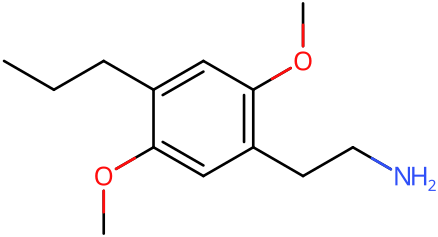
2C-P Stats & Data
CCCC1=CC(=C(C=C1OC)CCN)OCPZJOKFZGPTVNBF-UHFFFAOYSA-NReceptor Profile
Receptor Actions
Subjective Effects
Physical
- Spontaneous tactile sensations: The body high of 2C-P is intense but, in comparison to 2C-E or 2C-B, it can be considered mild though is still capable of becoming very powerful and highly physically euphoric. It is similar yet distinct from the body high experienced on 2C-E, 2C-B, and LSD. The sensation itself can be described as intense and will manifest itself in the form of a continuously shifting tingling sensation that travels up and down the body in spontaneous waves. This is coupled by an equally intense yet slightly uncomfortable energetic pins and needles sensation that constantly encompasses a person's entire body and a slight warm glow that manifests itself much less consistently than the other two physical components. All of these are capable of becoming very physically euphoric but can be described as proportionally intense with the visual and cognitive effects when compared to LSD.
- Stimulation: In terms of its effects on the physical energy levels of the tripper, 2C-P is usually considered to be very energetic and stimulating in a fashion that is quite comparable to that of MDMA.
- Sexual arousal: A commonly felt physical component of the 2C-P trip is the way in which it heightens and enhances sexual arousal. When experienced, this sensation is not overwhelming or out of control but simply remains something that the tripper is constantly aware of. If sexual activities of any kind are engaged in, they are found to be immensely more pleasurable beyond anything that could be possible sober with orgasm becoming difficult to reach but completely possible to obtain. When obtained, the orgasm itself is capable of temporarily increasing the effects of the drug, most commonly experienced as visual effects dramatically increasing in a short yet powerful burst.
- Increased bodily control
- Tactile enhancement
- Nausea: Mild to extreme nausea is consistently reported when consumed in moderate to high dosages and either passes once the tripper has vomited or gradually fades by itself as the peak sets in.
- Temperature regulation loss
Cognitive
The head space of 2C-P is described by many as one which is both insightful and relatively normal in its thought processes even at moderate to high dosages.
- Current mind state enhancement
- Thought acceleration
- Feelings of fascination, importance and awe
- Time distortion
- Introspection
- Personal bias suppression
- Conceptual thinking
- Ego suppression, loss and death
- Thought loops
- Feelings of interdependent opposites
- Delusions
- Unity and interconnectedness
Sensory
- Enhancements
- Distortions
- Hallucinations
- Visual drifting: (Melting, Flowing, Breathing and Morphing) - In comparison to other psychedelics, this effect can be described as highly detailed, slow and smooth in motion, static in appearance, and unrealistic/cartoon-like in style.
- Tracers
- After images
- Texture repetition
- Colour shifting
- Scenery slicing
- Increased visual acuity
- Enhancement of colours
- Enhanced pattern recognition
2C-P produces a full range of high level hallucinatory states in a fashion that is more consistent and reproducible than that of many other commonly used psychedelics, particularly in comparison to other substances within the phenethylamine family.
- External hallucinations
- Internal hallucinations: In comparison to other psychedelics such as LSD, 2C-P is extremely high in hallucinations embedded within visual geometry. This particular effect commonly contains hallucinations with scenarios, settings, concepts and autonomous entity contact. They are more common within dark environments and can be described as internal in their manifestation, lucid in believability, interactive in style and almost exclusively of religious, spiritual, mystical or transcendental nature in their overall theme.
Forked from Subjective Effect Documentation by Josie Kins, September 2013. Via dose.wiki (CC0).
Toxicity
PsychonautWikiThe toxicity and long-term health effects of recreational 2C-P use do not seem to have been studied in any scientific context and the exact toxic dose is unknown. This is because 2C-P is a research chemical with very little history of human usage. Anecdotal reports suggests that there are no negative health effects attributed to simply trying the substance by itself at low to moderate doses and using it very sparingly (but nothing can be completely guaranteed). Independent research should always be done to ensure that a combination of two or more substances is safe before consumption. It is strongly recommended that one use harm reduction practices when using this substance.
Overdose
The LD50 of 2C-P has not been established. However, it is believed that 2C-P is likely to have a smaller therapeutic window compared to other 2C's, meaning a lethal dose may be achieved more easily. In 2017, a 25-year old British female died following the ingestion of a large dose of 2C-P at a music festival.
Addiction & dependence
As a serotonergic psychedelic, 2C-P is considered to have a low potential for abuse and dependence. Tolerance to the effects of 2C-P is built almost immediately after ingestion. After that, it takes about 3 days for the tolerance to be reduced to half and 7 days to be back at baseline (in the absence of further consumption).
Effect Profile
Curated + 84 ReportsStrong visuals, headspace, and auditory effects with strong body load
Duration Timeline
BluelightCommunity Effects
TripSitTolerance & Pharmacokinetics
drugs.wikiTolerance Decay
Typical psychedelic acute tolerance appears within the same day and decays over ~1–2 weeks; cross‑tolerance with other serotonergic psychedelics is expected. Data are based on community guidelines for psychedelics generally; specific 2C‑P pharmacokinetics are not established.
Cross-Tolerances
Demographics
Gender Distribution
Age Distribution
Reports Over Time
Effect Analysis
Erowid + BluelightEffects aggregated from 84 experience reports (45 single-substance Erowid + 39 Bluelight)
Effect Sentiment Distribution
Confidence Distribution
Each bar is the share of reports mentioning the effect; its whisker, and the band on the rows below, is the 95% interval: where the share could plausibly be with other reports of the same kind.
Positive Effects 65
Adverse Effects 54
Show 34 more adverse effects
Show 18 neutral or unclassified mentions
Also reported in combinations. In the 40 2C-P reports where another drug was taken too, 8 (20.0%) mention hospital, emergency services or an overdose, 0 (0.0%) a seizure and 0 (0.0%) psychosis. In the 45 single-substance reports: 20.0%, 0.0% and 2.2%. These are not in the figures above: they cannot be put down to 2C-P alone, and a mention is not always something that happened to the writer.
Dose-Response Correlation
How effect frequency changes across dose levels. Whiskers, and the numbers' hover text, give each figure's 95% interval.
Not drawn, too few reports (a dose tier needs 20): Oral Heavy (n=15). Why 20?
Dosage Distribution
Dose distribution from experience reports, one dose per report (the first listed). Doses above Q3 + 3×IQR, far above what people typically take, are left out of the median and range and listed under each route: most are real heavy doses or overdoses, not mistakes.
4 reports gave a dose above the typical range (35–75 mg), so they are not in the figures above. 3 of them mention hospital, emergency services or an overdose. Listing a dose here does not mean it is safe.
Real-World Dose Distribution
ErowidFrom 77 of 87 recorded dose entries: those that state a weight (mg, g or µg), in routes with at least five of them. Values above Q3 + 3×IQR, far above what people typically take, are left out; they can include real heavy doses and overdoses, not only mistakes.
Oral (n=51)
Insufflated (n=13)
Rectal (n=7)
Common Combinations
Most co-occurring substances, as a share of all 85 reports filed under 2C-P; whiskers are 95% intervals
Form / Preparation
Most common forms and preparations, as a share of the 58 reports that give one; whiskers are 95% intervals
Body-Weight Dosing
Dose per kg of body weight, one dose per report (the first listed), from reports giving a weight of 30–250 kg. Doses above Q3 + 3×IQR, far above what people typically take, are left out of the median and range and listed under each route.
Oral
4 reports gave a dose above the typical range (0.617–0.852 mg/kg), so they are not in the figures above. 3 of them mention hospital, emergency services or an overdose. Listing a dose here does not mean it is safe.
Show the reports
- 0.852 mg/kg · mentions hospital, emergency services or an overdose
- 0.824 mg/kg · mentions hospital, emergency services or an overdose
- 0.649 mg/kg · another drug taken too · mentions hospital, emergency services or an overdose
- 0.617 mg/kg · another drug taken too
Insufflated
Redose Patterns
Redosing behavior across 61 reports
Legal Status
| Country | Status | Notes |
|---|---|---|
| Austria | 2C-P is illegal to possess, produce and sell under the NPSG (Neue-Psychoaktive-Substanzen-Gesetz Österreich). | In its Schedule II, the further specifying NPSV (Neue-Psychoaktive-Substanzen-Verordnung Österreich) explicitly bans all substituted phenetylamines. |
| Canada | As of October 31, 2016; 2C-P is a controlled substance (Schedule III) in Canada. | |
| China | As of October 2015 2C-P is a controlled substance in China. | |
| Denmark | In Denmark, 2C-P has been added to the list of Schedule B controlled substances. | |
| Finland | Scheduled in "government decree on psychoactive substances banned from the consumer market". | |
| Germany | 2C-P is an Anlage I controlled drug. | |
| Japan | 2C-P is a controlled substance in Japan effective March 25th, 2015. | |
| Latvia | 2C-P is a Schedule I controlled substance. | |
| Sweden | The Riksdag added 2C-P to Narcotic Drugs Punishments Act under swedish schedule I ("substances, plant materials and fungi which normally do not have medical use" ) as of August 16, 2016, published by Medical Products Agency (MPA) in regulation HSLF-FS 2016:80 listed as 2,5-dimetoxi-4-propylfenetylamin. | |
| Switzerland | 2C-P is a controlled substance specifically named under Verzeichnis E. | |
| United Kingdom | 2C-P is a Class A drug in the UK. | |
| United States | 2C-P was placed into Schedule I (with the DEA Drug Code of 7524) making it illegal to possess, distribute and/or manufacture without a license in the United States by an act of the US Congress on July 9, 2012 when US President Barack Obama signed the Synthetic Drug Abuse Prevention Act of 2012 (SDAPA). | The law came into effect on January 4, 2013. |
Harm Reduction
drugs.wiki2C‑P is a highly potent, long‑lasting psychedelic; a small change in dose can cause disproportionately larger effects. The come‑up is often delayed, with some users not reaching clear effects until 3–5 hours; redosing during the come‑up has led to accidental overdosing. Volumetric dosing is strongly advised for accurate sub‑10 mg measurement and to reduce weighing error risk. Compared to 2C‑E, 2C‑P is typically longer in duration and can be more intensely visual with a heavier body load at higher doses. Cardiovascular side‑effects (tachycardia, hypertension, vasoconstriction) and anxiety are reported more often at higher doses or with stimulant combinations; those with cardiovascular disease should avoid. Insufflation has a faster onset but is frequently described as more uncomfortable and physically taxing than oral use. In unregulated markets, powders or pills sold as a '2C' or 'Tusi/pink cocaine' have repeatedly contained no 2C substance and instead mixtures of ketamine/MDMA/stimulants and even traces of fentanyls/benzodiazepines; reagent testing or using a professional drug‑checking service is therefore recommended and avoiding redose is prudent if onset is delayed. U.S. legal status: Schedule I; UK: Class A.
References
Data Sources
Cited References
Additional references
- Erowid 2C‑P Vault (overview)
- Erowid 2C‑P Effects/Duration
- TripSit Wiki: 2C‑P page (duration, HR notes)
- TripSit: Quick Guide to Volumetric Dosing
- TripSit: Drug Combinations (2C‑x sections)
- PiHKAL #36: 2C‑P (Shulgin)
- EffectIndex trip report: 2C‑P 16 mg (heavy body load)
- Drug Checking (Toronto): 2C‑class misrepresentation incl. fentanyl/benzos traces
- TripSit: Psychedelics page (tolerance guidance)
- Erowid 2C‑P Legal Status (US Schedule I)